저자: 미상 · 외국인
요약 보기
조엘 그린블랫의 매직 포뮬라(높은 ROA + 낮은 PER 순위 결합) 소개. 시장 가격은 공포·탐욕에 흔들리나 기업 본질가치는 안정적이며 저평가 우량주 선별이 핵심. 백테스트 17년간 연 30.8% 대 시장 12.3%, 1만달러가 약 100만달러 대 7만달러로 성장했다고 주장. 종목을 1년 보유 후 교체, 분기마다 5~7종목씩 매수해 20~30종목 분산을 권장. 개별 종목 선택은 위험하므로 전략 기반 접근을 강조.
다듬은 글
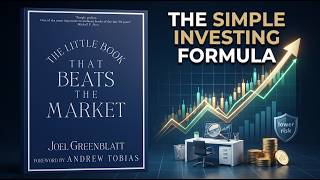
Welcome to this explainer. Today, we're diving into something pretty wild. We're looking at a system built to completely take the guesswork out of investing. It was created by the legendary investor Joel Greenblatt, and it's called the Magic Formula. Now, I know, I know, Magic Formula sounds totally like a gimmick, right?
But, the data backing this up is absolutely staggering. So, today we're going to break down exactly how this formula works step-by-step using nothing but the cold, hard facts. Choosing individual stocks without any idea of what you're looking for is like running through a dynamite factory with a burning match.
I mean, choosing individual stocks without a rock-solid strategy, you are literally asking for trouble. Sure, you might survive, but you're playing an incredibly dangerous game. So, let's dive into this and figure out how to blow out that match and actually navigate the factory in one piece. All right, here's our road map for today.
First, we'll look at the madness of the market. Second, valuing a business. Third, the two core pillars. Fourth, how the formula works. And finally, step-by-step execution. Let's get right into it. Section one, madness of the market. Just look at Amazon for a second. In a single year, its stock price bounced from $1,377 all the way up to $2,012.
The total value of the entire company swung wildly from $650 billion to a trillion, and then back again. Or take Gap, America's largest fashion retailer, bouncing between 18 and $31 a share. That's a 70% swing. Now, do you honestly think Gap sold 70% more clothes 10 months ago compared to today? Obviously not, right?
It just shows how the market totally overreacts to new information. So, the real takeaway here is this. Market prices are basically driven by fear and greed. They bounce up and down constantly. But, the true, underlying value of a business, that usually stays much more stable. Our ultimate goal as investors is to spot that true value when the actual price drops below it.
Now, you might be thinking, "Well, why not just avoid this whole mess and keep my money in the bank?" Well, with basic savings accounts offering almost nothing, keeping your cash under a mattress means you're losing about 4% a year to inflation. By leaving it idle, you're actively losing money every single year.
So, we have to invest. Section two, valuing a business. Let's use a super simple analogy from our sources. Imagine your friend owns a shop called The Swedish Merchant, and they only sell Swedish goods. Last year, this little shop made a neat, clean profit of exactly $100,000. So, how much would you be willing to pay to buy that shop right now?
Honestly, it's incredibly tough to answer. You might guess anywhere from 500,000 to $2 million. dollars. You see, predicting future earnings is well, it's really hard. Our sources actually highlight this great story about a sixth-grader named Jason, who ran this highly profitable gum-selling operation at school.
When someone asked if he'd sell 50% of his future 5-year profits for 100 bucks today, Jason smartly said, "No way." He realized that a 5-year payout gets hit by inflation, new competition, and all sorts of future risk. He knew the true value of cash today was worth way more than a blind guess at the future.
And you know what? Jason was totally right. Guessing future earnings over the next 5 to 10 years is just a losing game for the average person. Valuing a business with absolute certainty is incredibly difficult, and as Greenblatt points out, most everyday investors have absolutely no business trying to do it on their own.
Section three, the two core pillars. Let's reframe what cheap actually means. Imagine The Swedish Merchant has a competitor down the street called Just Broccoli. Both businesses have a price tag of $1 million, but The Swedish Merchant makes $100,000 a year, while Just Broccoli only pulls in 50,000. Which one are you going to buy?
The Swedish merchant obviously, because you're paying $10 for every $1 of earnings rather than $20. It literally pays you back in 10 years instead of 20. In the stock market, this exact concept is called the price to earnings ratio or PE. It's just a metric to figure out if you're buying a business at a cheap discounted price relative to what it actually makes.
Another way to look at it is earnings yield. For example, if Jason's gum shop publicly traded at $12 a share and each share earned $1.20 in profit, that's a 10% earnings yield. Basically, you always want a low PE or a high earnings yield. That tells you you're getting a real bargain. But wait, a cheap price isn't everything.
We also need quality. Let's look at those two shops again. Say it cost $500,000 to physically build the Swedish merchant store and it also cost $500,000 to build the just broccoli store. One generates 100k in profit from that initial build while the other only generates 50k. It's crystal clear. The Swedish merchant is vastly superior.
It's a much higher quality business model. So, how do we measure this? We use something called return on assets or ROA. You might also hear it called return on capital. This metric basically proves the quality of a business based on how efficiently it turns its initial investments into ongoing profit.
The higher the ROA, the better the business. It just proves that the company has a really strong underlying competitive advantage. Section four, how the formula works. Now we get to the core of how this magic formula actually works. It boils down to this elegantly simple combination. First, it systematically searches the market to find high quality companies, meaning those with a high return on assets.
Then it filters that list to make sure those specific companies are currently selling at a cheap price, meaning they have a low PE ratio. It systematically buys highly efficient companies, but only when they're trading at absolute bargain prices. And by ranking them mathematically, it completely removes dangerous human emotion from the equation.
And guys, the historical data on how this works in practice is just staggering. During a 17-year back-testing period evaluated by Greenblatt, the magic formula absolutely crushed the market. While the overall market average returned a perfectly respectable 12.3% per year, the magic formula returned 30.8% annually.
To put that in perspective, if you invested $10,000 over that 17-year period, it would have grown to around $70,000 in the general market. But using the magic formula, that same 10K would have turned into nearly $1 million. Now, Now, a quick reality check. It's vital to understand that not every single stock the formula picks is going to be a winner.
Some are going to be total duds. But this is all about averages. By ranking companies into deciles, Greenblatt proved that the absolute top-ranked group of stocks consistently outperform the second best. The second outperform the third, and so on. On average, the math proves that this system works because it uncovers true underlying market bargains.
Section five, step-by-step execution. Okay, so how do you actually execute this? The first step is to go to a stock screener. Our sources mentioned using sites like Ticker Tape or even Joel Greenblatt's own site, magicformulainvesting.com. You'll want to set a minimum market cap. Some sources suggest $50 million, others suggest to 5,000 crore if you're in that market.
The whole point is just to filter out the tiny, super unstable micro companies. Once you've done that, you filter the entire market for low PE ratios and high ROA. Once you export that data, here's how the specific ranking math works. You rank all the companies' PE ratios from lowest to highest, giving them a score of 1, 2, 3, and so on.
Then you do the same for their ROA, ranking them from highest to lowest, and again, scoring them 1 2 3. Finally, you just add a company's PE score to its ROA score to get a final total ranking. Sort that total from lowest to highest. Boom. The companies with the absolute lowest combined scores are, mathematically, the best value stocks on the market.
Once you have your ranked list, here's the playbook. You buy five to seven of those top-ranked companies using a portion of your capital. You repeat this every two to three months until you hold a really nice diverse portfolio of 20 to 30 stocks. And here is the strict rule. You have to hold each stock for exactly one year.
Actually, our sources share a really great tax tip for this. Sell your winning stocks a few days after the one-year mark, and sell your losing stocks a few days before the one-year mark for better tax efficiency. Then, you simply take that money, rerun the formula, and buy the new top-ranked stocks.
Look, it definitely requires patience. And sure, it removes the thrill of trusting your gut. But the math speaks for itself. It consistently isolates high-quality businesses at bargain prices. So, what does this all mean for you? Will you keep running through the dynamite factory with a burning match?
Or will you step back and let the magic formula do the heavy lifting? Thank you so much for joining me for this explainer, and keep learning.
Comments 0