저자: 미상 · 외국인
요약 보기
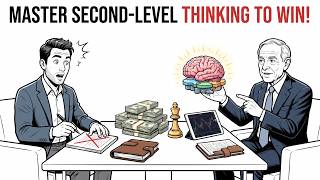
하워드 막스의 '1단계 vs 2단계 사고' 개념을 소개한다. 대중 컨센서스는 이미 가격에 반영돼 위험하고, 소외되고 버려진 자산이 오히려 비대칭적 기회를 준다고 주장한다. 위험은 변동성이 아니라 영구적 자본 손실 확률이며 이는 과도한 가격 지불에서 온다고 설명한다. 시장 사이클은 인간 심리(탐욕과 공포)로 반복되며, 2008·2020년 공포 국면에서 규율 있는 투자자가 저가에 매수한 사례를 든다. 특정 자산에 대한 가격 예측은 없다.
다듬은 글
What if everything you think you know about reading a stock chart or picking a winner is actually a carefully constructed optical illusion designed to separate you from your capital? And what if Howard Marks knows the exact secret behind the trick? Think about how a magic show works. You sit in a dark room.
You watch the magician wave a glowing wand in their right hand. Your eyes lock onto the motion. You feel completely certain you know what is happening. Right up until the moment the rabbit appears from an empty hat on the other side of the stage. The financial markets operate on that exact same mechanism of distraction.
Every single day, flashing red numbers, breaking financial news, and roaring bull markets wave a glowing wand right in front of your face. They demand your attention. They trigger your primitive fear and your sudden greed. And while you are staring fixatedly at the surface spectacle, the real transfer of wealth is happening somewhere else entirely.
Underneath the floorboards. Most people believe that investing is a game of predicting tomorrow better than the guy next to you. Howard Marks spent decades studying the ruins of brilliant portfolios to prove how utterly false that belief is. He watched Ivy League graduates, mathematical geniuses, and corporate insiders lose fortunes not because they were stupid, but because they were looking at the wrong layer of reality.
They were playing checkers on the surface while a grandmaster was playing three-dimensional chess in the dark. To understand why successful investing requires thinking in layers, you have to first confront the most dangerous comfort in the financial world. The consensus opinion. Imagine walking into a bustling marketplace.
Every single vendor is shouting about a specific new asset. They are holding up charts showing an unbroken line shooting straight up into the sky. Your neighbor bought some yesterday and is already smiling. The television anchors are nodding with solemn confident authority, explaining why this time the rules of economics have completely changed.
It feels safe. It feels warm. It feels almost foolish not to join in. That collective warmth is the first layer of the illusion. And almost 90% of human capital lives and dies right there on that shallow surface. Howard Marks calls this first-level thinking. First-level thinking is simple, comfortable, and comforting because it relies entirely on agreement.
A first-level thinker looks at a business and says, "This company makes incredible products. Everyone loves them, and revenue is growing by 50%. Therefore, it is a great investment." It sounds logical, doesn't it? It reads like common sense on a printed page. Yet, that single sentence is the quiet graveyard of modern wealth.
Because if a business is universally recognized as magnificent by every retail investor, fund manager, and television pundit on Earth, the price you pay has already absorbed that perfection. The good news is no longer an advantage. It is a heavy, suffocating anchor. When you buy into a consensus, you are paying top dollar for a story that everyone already knows by heart.
And the moment reality shifts even a fraction of a millimeter away from absolute perfection, the trap snaps shut. This is where the illusion begins to unravel. Have you ever wondered why the assets that feel the most terrifying to touch, the lonely, beaten-down, deeply hated stocks that nobody wants to mention at a dinner party, are so often the ones that generate legendary returns over time?
The answer is hidden in the second layer. When Howard Marks took over the distressed debt markets decades ago, he didn't look for the shiny companies everyone was praising. He walked straight into the financial basement where everyone else refused to look. He looked at bankruptcies, corporate liquidations, and broken balance sheets.
To a first-level thinker, those places looked like toxic waste. To a second-level thinker, they looked like an asymmetry of risk and reward. Because when an asset is universally despised, its price drops so far below its actual intrinsic value that the bad news is already entirely baked into the floor.
There is nowhere left for the story to go except sideways or up. That is what second-level thinking actually means. It is not about being smarter than everyone else. It is about asking questions that make other people uncomfortable. A second-level thinker looks at a wildly popular, soaring stock and asks, "What if the market's current optimism is completely dependent on a miracle that has a 90% chance of failing?" They look at a crashing company and ask, "What if the market is pricing in a total corporate apocalypse while the underlying assets are actually worth twice as much in a liquidation?" Notice the shift in gravity.
The first-level thinker asks, "How good is this company?" The second-level thinker asks, "What does the price already assume? And what is the probability that the crowd is catastrophically wrong?" This requires a complete rewiring of how your brain processes comfort and danger. Evolution taught our ancestors to run with the tribe.
If everyone in your tribe started running toward the cave, you didn't stop to calculate fluid dynamics or analyze predator density. You ran with them because staying behind meant death. That exact survival instinct is what destroys investment portfolios today. When the financial herd starts running toward a booming asset class, your biological wiring screams at you to sprint alongside them.
Standing still feels like dying. Remaining skeptical feels like missing out on life itself. Howard Marks understood that human psychology is the ultimate driver of market cycles, and cycles never change because human nature never changes. Greed and fear take turns steering the human vehicle, and both emotions are blinding.
When greed takes the wheel, it creates a first-level wonderland where risk is entirely forgotten. People stop asking what could go wrong because everything is currently going right. They confuse a bull market with personal brilliance. They leverage their homes, their savings, and their futures on the arrogant assumption that tomorrow will look exactly like yesterday, only shinier.
And that is precisely when the ground beneath them turns to glass. Think about the psychological toll of holding your ground when everyone around you is getting rich on a speculative frenzy. It is agonizing. Your friends are showing you their digital portfolios multiplying by the week. They look at you with a mixture of pity and condescension.
You look like a dinosaur stuck in the mud. This is the emotional crucible of second-level thinking. You have to be willing to look foolish in the short term to be right in the long term. You have to tolerate the social friction of disagreement. Howard Marks often notes that you can be wrong and still lose money.
But you can also be right and still lose money if your timing defies the collective madness of the crowd. Being a second-level thinker means accepting that you will often feel lonely, uncertain, and doubted. It means treating popularity as a warning sign rather than an endorsement. When an investment becomes popular, its risk profile deteriorates rapidly, regardless of how wonderful the underlying business might be.
Let us pull back another layer and look look how risk actually operates in the real world. Most ordinary investors define risk as volatility, the jagged up and down movement of a price chart on a screen. They see a stock drop 10% in a week, feel a spike of nausea, and label it as dangerous. Howard Marks turns that definition completely upside down.
To him, volatility is not risk. Volatility is simply the price of admission in a liquid market, and sometimes it is a symptom of emotional overreaction. The true definition of risk, the kind that ruins lives and destroys multi-generational wealth, is the probability of permanent capital loss. And where does that probability come from?
It does not come from bad luck. It comes from paying too high a price. And why do people pay too high a price? Because they relied on first-level thinking. They fell in love with the surface story and completely ignored the underlying layers of valuation, leverage, and macroeconomic vulnerability. Consider a massive, dominant corporation.
Its brand is a household name. Its stores are packed from morning until night. Its management team speaks with absolute confidence on financial television. The first-level thinker sees all of this and opens their wallet wide. The second-level thinker pauses, takes a step back, and inspects the engine room.
They look at the debt maturing in the next 24 months. They look at the supply chain vulnerabilities hidden across three different continents. They look at the regulatory crosshairs tightening around the industry. And most importantly, they look at the valuation multiple, the jaw-dropping price tag attached to every dollar of earnings.
If the price assumes that nothing will ever go wrong, then even a mild, ordinary business hiccup becomes a catastrophic event for the shareholder. The business itself might remain wonderful, but the investment can still turn into a disaster. Separating the quality of the business from the attractiveness of the investment is one of the most profound mental leaps you can ever make.
It is the difference between admiring a piece of art and paying 10 times what it is worth at an auction where everyone is drunk on champagne. As you begin to examine your own financial history through this multi-layered framework, a strange clarity starts to take over. You stop reacting to every headline.
You stop feeling the frantic itch of FOMO when a random asset doubles overnight. You begin to realize that the market is not a casino where you need to win every hand to build a secure future. It is a waiting room. Most of the time, the smartest thing you can possibly do is absolutely nothing. You sit quietly on your hands, observing the waves of human emotion crashing against the shore, waiting for the exact moment when panic creates a profound, undeniable mismatch between price and intrinsic value.
Howard Marks spent decades waiting for those rare moments of dislocation. The 2008 financial freeze, the 2020 sudden panic, when first-level thinkers dumped everything in blind terror, allowing disciplined second-level thinkers to step in and scoop up extraordinary assets at bargain bin prices. They didn't predict the exact day the crisis would hit.
No one can do that. Instead, they built a portfolio posture that assumed the future was unknowable and therefore prepared for the worst-case scenario while remaining patient enough to capitalize on it. They understood that you do not need to know what is going to happen next week to be successful. You only need to know how to behave when uncertainty arrives at your doorstep.
The shift from first-level certainty to second-level awareness changes how you view not just money, but life itself. You start questioning the narratives handed to you by authority figures, media outlets, and social consensus. You stop seeking the easy, comfortable answer, and start leaning into the friction of deep analysis.
You realize that real advantage is never found where the spotlight is burning the brightest. It lives in the shadows, the complexities, and the quiet spaces where others refuse to look. If this deep dive into investment psychology and the hidden layers of market behavior change the way you see risk and opportunity, take a moment to subscribe, leave a comment with your thoughts on second-level thinking, and hit the like button to support the channel.
Comments 0