원문 보기
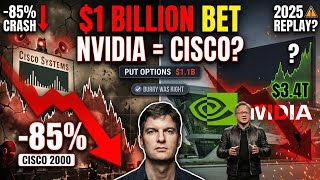
$1.1 billion. That's how much Michael Bur, the man who predicted the 2008 housing crash, just bet against Nvidia and Palenter. On November 3rd, his hedge fund, Cyan Asset Management, disclosed it held bearish put options with a combined notional value of $1.1 billion as of September 30th. Think about that for a second.
This is the investor who shorted the subprime mortgage market before anyone else saw the collapse coming. Christian Bale played him in the big short. He made billions while the world economy burned. And now, for the first time in years, he's making a public move. A massive short position against the most hyped companies in the AI boom.
But here's what Wall Street isn't telling you. On November 22nd, Bur published his first Substack post in years. The title, the cardinal sign of a bubble, supply side gluttony. And in that post, he dropped a comparison that should terrify every Nvidia shareholder. he said. And once again, there is a Cisco at the center of it all with the picks and shovels for all and the expansive vision to go with it.
Its name is Nvidia. Cisco, the company that rose 3,800% between 1995 and 2000, became the most valuable company in the world at $560 billion in market cap, then crashed 85% within one year. 25 years later, Cisco's stock still hasn't recovered to its dotcom peak. And Bur is saying Nvidia is the Cisco of the AI bubble, the epicenter, the company everyone thinks is invincible, the one that's about to collapse and take the entire market down with it.
The mechanism behind this comparison reveals why Bur closed his hedge fund days after disclosing this bet. He's preparing for the biggest crash since 2008, and Nvidia is ground zero. Let's start with the playbook because history doesn't repeat, but it rhymes. And right now, the AI boom is following the exact same pattern as the internet bubble 25 years ago.
In his Substack post, Bur wrote, "During the dotcom boom, the tech industry was defined by highly profitable large caps, among which were the so-called four horsemen of the era, Microsoft, Intel, Dell, and Cisco." Wait, highly profitable large caps? That's the narrative today. Everyone says this time is different.
The.com bubble was unprofitable startups burning cash. But today's II companies are making billions. Wrong. Bur destroys that argument. The four horsemen were profitable. Microsoft was printing money. Intel dominated chips. Dell was a hardware giant. Cisco was the infrastructure provider for the entire internet.
They were all massively profitable. And they all collapsed. Cisco went from $15 billion in 1995 to 560 billion in March 2000, a 3,800% gain in 5 years. It became the most valuable company in the world. Then within 12 months, it lost 85% of its value. By October 2002, the NASDAQ had fallen 77% from its peak, wiping out more than $5 trillion in market value.
Now, let's look at today. Bur identifies the five horsemen of the AI boom. Microsoft, Google, Mida, Amazon, and Oracle. And at the center, Nvidia, the picks and shovels company, the infrastructure provider. Nvidia is stock has surged 12fold since the start of 2023. Its market cap hit $3.4 trillion in June 2025, making it the most valuable company in the world.
Sound familiar? But the chart I'm about to show you reveals the trap that's about to snap shut. Bur calls it supply side gluttony. And it's the cardinal sign of every bubble in history. Not speculation, not irrational exuberance. Supply side gluttony. When companies build too much infrastructure too fast for demand that doesn't exist.
Here is the data. The five horsemen have pledged to invest well over $1 trillion into microchips, data centers, and other AI infrastructure over the next few years. Nvidia, Microsoft, Google, Meta, Amazon, Oracle. They're all racing to build the biggest, most powerful AI systems on the planet. But here's the problem.
There's nowhere near enough demand to justify that level of investment. Bur wrote, "It's just not so different this time. Try as so many might do to make it so." A key issue with the dot bubble was catastrophically overbuilt supply and nowhere near enough demand. The internet boom saw telecom companies laying millions of miles of fiber optic cable.
They spent hundreds of billions building infrastructure for a future that was years away. When the bubble burst, bond investors in those telecom companies recovered just over 20% of their investments. The rest vaporized. Now AI companies are doing the exact same thing. They're spending a trillion dollars on chips and data centers, forecasting enormous growth that may never materialize.
And when reality hits, when the revenue doesn't come, the infrastructure becomes worthless. The companies collapse and Nvidia, the supplier of all those chips, crashes hardest of all. But there's another mechanism at play, one that's even more insidious. Bur calls it give and take deals. Wall Street calls it circular funding, and it's the same accounting trick that hid the losses during the crash.
Here's how the circular funding scheme works. On September 22nd, 2025, Nvidia announced it would invest up to $100 billion in OpenAI and supply it with data center chips. Think about that. NVIDIA is giving OpenAI $100 billion. And OpenAI is using that money to buy NVIDIA chips. It's not a sale. It's a loan that comes back as revenue.
NVIDIA books it as income. OpenAI books it as infrastructure investment. Both companies report massive growth. Investors celebrate. Stock prices sore, but no actual value is being created. It's just money moving in a circle. Then it gets worse. Nvidia announced it would invest $10 billion into Anthropic.
In return, Enthropic will invest $30 billion to scale its clawed AI model on Microsoft as Nvidia powered Azure cloud platform. Again, Nvidia's money comes back as revenue through Microsoft's cloud purchases. One analyst from Bernstein said, "On one hand, this assists open AI in achieving ambitious goals for compute infrastructure.
On the other hand, concerns about a circular economy have been previously raised and this will amplify those worries." Translation: This is fraud. It's Enron level accounting. Nvidia is creating fake revenue by lending money to customers who use that money to buy Nvidia products. When the music stops, when the funding dries up, the revenue vanishes and the stock collapses.
CEO Yensen Hang tried to dismiss the concerns, saying the investments are a tiny percentage of Nvidia's revenues. But Bur isn't buying it. He's shorting Nvidia because he knows this circular funding scheme is unsustainable. And when it unravels, it takes the entire AI sector down. But there's a third mechanism, one that Bur has been hammering on X for weeks.
Stock delution. Here's the smoking gun. Since 2018, Nvidia has bought back $112.5 billion worth of stock. That's right. $12.5 billion in share repurchases. You think that would reduce the total number of shares outstanding, right? More buybacks equals fewer shares equals higher value per share. Wrong.
Despite spending $12.5 billion on buybacks, Nvidia has 47 million more shares outstanding today than it did in 2018. How is that possible? Stock-based compensation. Nvidia reported it paid $20.5 billion in stock-based compensation over that period. But Bur says the true cost of that dilution was $112.5 billion.
The entire buyback program went to offsetting employee stock grants. Zero value went to shareholders. Bur posted on X. The true cost of that SBC dilution was $112.5 billion reducing owners earnings by 50%. Translation: Nvidia as free cash flow is in $188 billion since 2018. It s2.8 billion. Half of the company's earnings went to employees, not shareholders.
And Wall Street has been ignoring this massive wealth transfer. Nvidia's CFO Colet Crest tried to push back saying the company has visibility to $0.5 trillion in Blackwell and Reuben revenue over the course of 2025 and 2026, but Bur fired back. Just because something is used does not mean it is profitable.
He gave the example of airlines retaining old planes to boost capacity during the holiday season. Even though they're only marginally profitable and not worth much at all, Nvidia's older chips are far less energyefficient than its newer ones. Customers using them are paying massive electricity bills.
And when they realize those chips aren't profitable, they'll stop buying. Demand collapses. Nvidia's stock crashes. So, here's the death spiral scenario. The AI boom continues for another 6 to 12 months. Nvidia keeps reporting record earnings. The stock hits new highs, maybe 4 trillion, maybe 5 trillion in market cap.
Everyone celebrates. The five horsemen keep spending. Data centers keep getting built. Then reality hits. AI companies realize they're not generating enough revenue to justify the infrastructure spending. The circular funding loop breaks. Open AI can't pay back Nvidia. Anthropic defaults. Microsoft cuts cloud spending.
The trillion dollars in AI infrastructure becomes stranded assets. Nvidia's revenue collapses overnight. Earnings miss. The stock drops 20%. Then 30%. Then 50%. Panic selling begins. Institutional investors dump their positions. Margin calls cascade. And within 12 months, Nvidia loses 80 to 85% of its value.
Just like Cisco did in 2000, the NASDAQ crashes. The S&P 500 plummets. Trillions of dollars in market value vaporize. Retail investors, the ones who bought Nvidia at the top, lose everything. And Michael Bur, the man who shorted the AI bubble before anyone else, makes billions. Cisco rose 3,800%, hit $560 billion, crashed 85%.
Took 25 years to recover. Nvidia rose 12fold, hit $3.4 trillion. Bur is betting it crashes 85% within the next year. $1.1 billion in put options. First Substack post in years. Hedge fund closed to outside investors. Bur is all in on this bet. Are you watching the show or are you holding Nvidia at the top? What do you think? Drop your answer in the comments below.






댓글 0