원문 보기
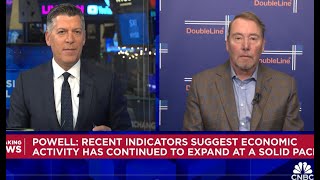
for more let's welcome in double line Capital CEO and CIO and founder Jeffrey gunlock welcome back on what's become a tradition and I'm glad to have you Jeffrey good to be here Scott your reaction on what you just heard and what the FED did well there's a lot more confusion now than there was a couple of months ago um regarding the Future Path but the squaring of the 2-year treasury yield in the fed funds rate is now complete I talked several months ago about the Fed was behind the curve and needed to get aggressive in getting more in line with the 2-year treasury but now the 2-year treasury is at 4.35 and the FED funds rate is at 4 and 38 if you take the middle of the range so they're exactly there underneath the surface though uh there were a couple of of problems the first thing he said at the beginning of his press conference as always is they're squarely focused on their dual man and then he used the word cooling for the labor market and he pointed out that it's looser than it was pre pandemic so that seems to be not trending quite the way they might want and at the same time he said uh uncertainty regarding inflation is clearly higher in fact I think he let something slip on an ad lib and I think he said let's see he said is a forecast from a few months ago on inflation seems to be have fallen apart I think are the words that he used so what we we have now is a neutral rate versus the 2-year treasury yet the Dual mandate that they're squarely focused on is not exactly trending in in the perfect Direction uh the the inflation uh data points have not improved since the September meeting um about we we follow about 30 different inflation uh primary inputs and the number that are showing accelerating inflation in the several quarters ahead have increased since September also what's very interesting about what's happened over what's been really a very aggressive cutting cycle I mean they've cut 100 basis points in 3 months so that's a 400 basis point annual rate and if you go back over all these fed hiking Cycles or cutting Cycles FedEd cutting Cycles going back to 1984 so Going Back 40 years this is the first time that after the first cut in the FED funds rate that interest rates have gone up and not down the 10 year treasury yield is up by 80 basis points from September 18th and usually the yield falls on the 10year treasury once you go into a Fed hiking cycle so the takeaway that I got from that press conference was there's not going to be an aggressive cutting cycle as a base case in 2025 obviously the market went from four implied fed uh rate Cuts in 2025 to now the fed's down at two and the market is pretty much in sync with that so much slower rate cuts and of course risky assets and a very highly valued stock market doesn't like the idea that rate cuts are less likely on both sort of both sides of the Mandate uh our Our intention with the path that was so comfortably in place per the press conferences uh in the mid part of this year that's the confidence just isn't what where it used to be so I think the FED is now extraordinarily data dependent um as we enter 2025 I know they're all always data dependent but at this juncture it's very uh it's critical that we watch that unemployment rate which fed Paul said that job creation is not high enough to keep the unemployment rate steady so the base case is that ratees going in the you know up which is not the direction they want and at the same time some inflationary primary inputs are suggesting that we're not going to get to 2% I thought the last question that was asked in the press conference was a perfect ending kind of is it really is it good enough to be at 2 and a half% inflation do we have to give up on 2% inflation you know are we is where we are the best we're going to get and my take away from that press conference is the short answer to that is yes I I think that we're not likely to get to 2% inflation in 2025 and the FED says so themselves in fact we'll probably start having inflationary pressures towards the middle of 2025 and the uh the headline CPI rate will probably not be below 2.5% when the inflation rate starts heading up towards three now obviously all these things can change we don't have great visibility on the second half of 2025 but unless the price of energy Falls which is possible with drill drill drill coming being the rhetoric of the incoming Trump Administration we'll see but uh oil prices have been remarkably stable and uh that's the real wild card is if they would go up for whatever reason we would start to see significant inflation risk and there'll be no fed Cuts in 2025 if that's the case do you believe the projection of two cuts next year how many Cuts do you actually think they'll be able to do if you think that inflation is going to be even stickier than they may think and they clearly think as pal said himself quote we see the risks as higher he called it as I suggested out of the news conference he called it the single most important thing that moved the needle today the fact that their own inflation projections are higher than they were before yeah I I think it looking forward for 2025 I would say that two rate Cuts would probably be the I would say that's kind of on the maximum side right now because I didn't I didn't hear anything really from that press conference that suggested that we're looking at rate Cuts I think you opened up by saying you might interpret what was said as as there's a pause coming I would say that that's absolutely Ely the case that I would say the odds of a cut uh in the January meeting are are quite low at this point and I think that that speaks to the fact that they need a few months of data to try to figure out where their footing is right now relative to that dual mandate that they've been uh every every news conference starts out with we're squarely focused on it and they're not there and it's moving in the wrong direction I think on both ends so well um I would think that two rate Cuts would be the maximum in 202 surveying the landscape as best we can from here middle of December of 2024 mean their their estimates have obviously been off in terms of where they thought the neutral rate was um chair pal saying today quote we are significantly closer to neutral now obviously implying that they're close to being done because the neutral rate is much higher than they once thought it would be yeah I I I take a lot of incoming you know unfriendly fire for my Constant Comment that the two-year treasury is really the guidepost for the FED but I deeply believe it and I can prove it if anyone wants to spend 15 minutes going through some charts with me but it's been proven once again they they are basically neutral relative to the treasury bond market pricing the 2-year Treasury and he acknowledged that the neutral rate is higher so it's it's fascinating what's happened I mean they've they've gone from this massive gap between treasury yields and the FED funds rate and now with the FED funds rate being down by 100 basis points and the 2-year treasury up by 80 B basis points that Gap is completely closed so I I I think it's it's not illogical to believe that two rate Cuts is if anything on the high side as we survey obviously an uncertain landscape with a new Administration coming in and the like but I think two rate Cuts is is now sort of a maximum for the year which is why we need to repic some of the you know the the the PE ratios and the stuff uh that are have been hoping for uh more than a rate cut or two in 2025 to what degree is the new Trump administration's agenda inflationary in its own right they just don't know tax cuts right tariffs stronger economic growth it throws a real bit of uncertainty into their own calculus it does indeed and I think J Powell uh tipped hat to that concept I think he used the analogy of a room full of furniture that you walk into and the lights aren't on you got to watch out for you got to you got to walk more slowly you got to be careful and be feeling your way so I think that's a beautiful analogy I'm glad he used it because I feel like we're back at that place again that we were a little bit uh differently but some of the same Dynamics going on back almost 3 years ago when I used the Mr meoo sort of analogy you know with a car that's bumping into the trees and stuff uh because you can't see very well well J Powell just said they can't see very well right now and that's acknowledging what you just said judge and that is that who knows what's going to happen it seems like Trump is is angling for an inflationary is policy tariffs uh would raise inflation perhaps by several tents depending upon how they're applied and we don't even know how that's going to happen yet and what's going to be the stimulus to the economy are is he really going to be expanding the deficit which would be uh really dangerous uh you know by having tax cuts um we already have a big problem this is we we have Rising interest rates they're already up on the long End by you know over 300 basis points over the past couple three years and you know this is causing further pressure on the budget deficit which I talk about all the time but now that rates have gone up 80 basis points in a Fed cutting cycle I think there's tremendous uncertainty on what's going to happen with inflation uh the deficit and the economy uh and the base case is one that is not going to make J Powell's job any easier probably higher inflation through tariffs at least initially and the unemployment rate seems like it's heading higher per J Powell's own analysis so it's a tough it's a tough period now with assets as high as they are uh in terms of valuation one thing that I think is interesting for investors now is it seems unlikely that you're going to get a big drop further in the FED funds rate and that means that we're back to attractive yields being somewhat sustainable possibly on things that are pretty safe and rates are high enough that they give a and their spreads that you can get a yield above inflation so you go back to those doubleb bank loans which were under pressure with the FED cutting but now that the FED is much more likely to be on hold those yields you know they're pricing above a four and and 38 sort of Base rate you you put a couple hundred BAS points on there and you're cruising along at about a 7% type of a yield without a lot of risk and the chance of that yield dropping thanks to rate Cuts is demonstrably lower today than it was uh you know a month ago say so there's it's a it's a rates are there are real rates J Powell is correct about saying that you know the inflation rate is sticky he says it's now going sideways at about 2 and a half to 2 and 3/4 year-over-year but you know Treasury yields are up at at 4 A2 so there there is a real rate there and you can get real rates of return out of uh intermediate dated bonds if you take moderate credit risk and it looks like that's going to be earned for some time to come so I I think that uh there's a good environment for that part of the asset class go ahead Scott forgive me forgive me for interrupting you Jeffrey um you you can't see it because you're looking straight into a camera um but you're looking at a market that is deteriorating as we have this conversation we're down more than 800 points now on the Dow near 2% but it is the NASDAQ Jeffrey down more than 3% that's a loss of more than 640 points if you look at the treasury market uh obviously yields as I suggested at the outset here are higher you're at 450 Jeffrey on the 10-year you're at 435 on the 2-year we've seen the dollar Spike as well which is going to be very unsettling to some certainly multinationals when it comes time for earning how should we think about all that well we've had such a powerful run in Risk assets since the FED start cutting rates you know we we had we had about a 10% uh gain in say the S&P 500 we had a loss of nearly 10% on 30-year treasuries so it's a very unusual situation that the valuation has has gotten that out of whack during a Fed rate cutting cycle so yeah the market is clearly over bought uh the the PE Ratio the cape ratio is up at 38 I mean these are high valuations and there's a lot of overb belief in the market uh because it's been so good and unfortunately human nature is to is to project forward what's happened in the recent past and particularly when it goes on for more than a few months and so there's a lot of overinvestment that you know there's a lot of profits to be taken let's just put it that way and uh so it's not surprising that but it's a everyone expected the so-called it's kind of an oxymoron but the the hawkish cut but I don't think they expected so much uncertainty to come out from that press conference on pretty much all sides of of the future outlook and what you're saying is there's a lot of uncertainty and who knows what might the economy might have to experience I think that all kind of uh explains that there should be some sort of at least a short-term repricing you never know fed day can be a head fake you never know we have to see how the rest of the week evolves but I wouldn't be surprised if we saw lower prices in the aftermath of of this this fed commentary it certainly is Justified 940 the loss now on the Dow you said ahead of the election Jeffrey quote if the house goes to Republicans there's going to be a lot of debt there's going to be higher interest rates at the long end and it'll be interesting to see how the FED reacts to that we sort of alluded to this already but I want you to go deeper on that because we obviously had the Red Wave um in the election and now we're trying to figure out where we're going to go uh from here and how the FED is is going to react to it you wrote a guest essay in The Economist recently as well um where you talk once again about your worry about the ever growing deficit they being the administration incoming think that they can grow their way out of this problem do you disagree with with that I think it's hard to grow your way out of the problem if you're doing nominal GDP that's really strong because nominal GDP being really strong would mean higher long-term interest rates and my thesis that we are incly rising interest rates now at the long end seems to be being borne out I mean here the fedus cut rates 100 basis points and the 10-year treasury yield is up by over 80 basis points since that time period so I I I think you have a risk that the interest expense on the debt is going to be really problematic in that nominal growth scenario because if you get so much debt that is leading to this nominal growth you're going to have not just more bonds you're going to have a higher interest rate on those bonds and this is not hypothetical it's happening in real time the FED has cut rates 100 basis points and the 10 year is up 80 basis points over that time period I think that has something to do with the market sussing out the fact that we have an interest expense problem we used to pay $300 billion a year in interest expense and now it's $1.3 trillion a year in interest expense and we still have all of these bonds that were issued in 2017 18 19 first part of 20 down at 1% interest rates they're being rolled over now at 4 and A2 and so it doesn't look like we're going to get a lot of relief uh out of that 4 and A2 because that's where the short rate is and that's where the long rate is and so we're going to continue with this interest expense problem so I have a hard time believing that you can do this magic trick of high nominal GDP and low inflation and low interest expense the the arithmetic just doesn't add up and that was that's that's kind of the point that's being made that we've talked about interest expense problems for for for four decades since or three decades anyway since Ross perau did the voodoo stick on his infomercials and of course what I always say in the investment business and the in macro economy things can happen as you expect but will always take much longer than you think is humanly possible so here it is 30 years later 32 years later than Ross perau and he was right about a debt interest expense problem he was just at least 30 years too early it takes longer than you think but I think the worm has turned here and I don't think you can have a nominal growth solution you need to have some sort of action taken on the on the expense issue and I hope that this Doge uh I don't know what you call it it's a group of people I suppose it's not a cabinet position or anything but the department of governmental efficiency so-called I know they're not going to take a huge chainsaw to to expenses but hopefully this is a step in the right direction at least we can start I know you're not going to find hundreds of billions just laying there on the sidewalks they could be comfortably cut but at least let's move in that direction let's start with not promoting uh Egyptian tourism with $6 million of borrowed money from the US taxpayer let's start there and then uh move more aggressively as we find our way down more than 1100 now on the Dow so we're falling apart a little bit as the market tries to come to grips with what chair Powell had to say even as the market was pretty much set up for fewer Cuts already the FED moving towards it but I think the market trying to sus out Jeffrey what all of this means for the coming year and whether we'll actually get the cuts that the FED is even projecting now whe inflation remains even more sticky than it fears you told me last time that you like the Intermediate part of the bond market of the treasury curve the so-called belly what about now yeah well I still like it and it's not so much that I like the belly it's that I don't like the long end and you have to be somewhere and so I don't want to own 30-year treasury bonds I don't want to own even uh anything longer than 10year treasury bonds there's no extra yield there for it I mean you're only getting 14 basis points going from 2 years to 10 years so I I I think you hang out in lower duration then an index fund and you have a middle- ofthe capital structure type of a portfolio this is what we've been doing pretty much all year uh Scott we've lowered our interest rate risk uh systematically not not in a large way but systematically over the course of this year and I think you can you can get yields that are in the 6% to 7% range without a lot of risk out of fixed income but you want to do that not in long maturities you want to do that in a portfolio that's sort of 2 to 5 to seven years at the most so laded out that way and I I think you know you you've had a pretty good year there's plenty of fixed income types of products of this ilk that I'm describing that are up over 8% Total return year-to date which is very substantially higher than index fund and I still think that that's the The Playbook as we turn the year although I do note uh that it's very uh interesting how often the market changes direction right at year end as people reposition for the new year um I I wonder if we won't see interest rates start the year with with a rise to the upside again as we did entering 2024 especially at the long end well I mean it's the most difficult thing to to project you know here we are at the end of the year as you say no one wants to sell a lot of things although they are obviously today you have tax considerations to make but when you turn a calendar into a new year there could obviously be some selling related to that let me ask you about Bitcoin uh because we haven't talked about that in in a while and you've watched it like we all have country seems captivated by this move that we've seen since the election what are your thoughts yeah I think of Bitcoin as owning gold on substantial leverage maybe even as much as 20 20x leverage and gold has moved up a lot and Bitcoin obviously has moved up a lot more particularly in the aftermath of of the election um I believe that both gold and Bitcoin have been there their strength has been a harbinger of skepticism regarding the fiscal path that developed countries are on and uh I think that that has probably been relaxed a little bit today perhaps but uh I I don't I I think that uh the positioning in gold and Bitcoin will probably continue to increase I view that people are are viewing them as more asset allocations than speculations as we look into an uncertain future regarding the economy the fed the pace of inflation unemployment all of this stuff and the need for fiscal rectitude starting to become more clearly in Focus which I think will happen uh so I I I continue to hold gold it's it's quite high it's not going to like this rise in the dollar it's not going to like the fact that the FED is less likely to cut rates so in the short term I I I I think we'll probably see sideways movement in both Bitcoin and gold do do you own any Bitcoin at the current time no I I've never owned Bitcoin it's just it's just not for me um I I just can't stand Investments they're that unal unanalyzable and that uh you know ill illiquid and that high risk High volatility it's really the volatility that I'm allergic to in Bitcoin so I don't think I'll ever own Bitcoin until such time as we have a total regime change and we would actually have the uh a cryptocurrency or a digital dollar if you will I think we're ways away from that but if we ever get there then are going to be sort of forced to to to play by the rules of the game I always like to get your thoughts as well let's do this lastly on what the best looking portfolio should be right now you you have not you know often suggested 6040 you said suggested that breakdown should be uh smaller in in different areas so given what we know today the kind of year we've had in stocks where you think we're going in terms of yields what you said about the dollar and gold and Bitcoin what do you think the right portfolio breakdown looks like right now I think now you should be increasing cash because the yield on cash appears not to be going away so it looked like there was a chance you know that we would have a shrinkage in the cash yield but that's not likely to happen based upon today's press conference I would actually hold about 30% in cash right now because you're not giving up much yield versus uh other assets that have volatility and risk I like that Bond portfolio that I described obviously because that's how I'm managing my money and my client's money and I would have half of my money in that and about 30 % in cash waiting for volatility to give you better entry points into risk your assets and then 20% I would own in in basically at this point I would own US stocks at this point it's not very high allocation uh but I think that I think that US Stocks is continues to be supported by the strong dollar which should maintain for some time now that the interest rate differential is likely to stay in the Dollar's favor uh as we move into 2025 Jeffrey um we're going to leave it there I so much appreciate this past year visiting with you every fed day I know our viewers do I certainly feel smarter after talking to you after one of these decisions in that news conference and I look forward to a new year of doing this happy and healthy 25 to you same to you judge and good luck everybody happy healthy holidays and let's let's have a great 2025 all right there you go that's Jeffrey gunlock double line we'll see you on the other side


Comments 0