원문 보기
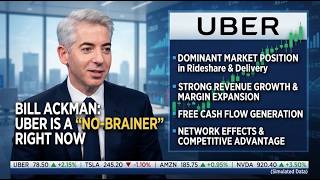
Well, let's get straight to the point. For years, the story around Uber has been, to be honest, pretty simple, hasn't it? It was a revolutionary app, sure, but it was also perceived as a money-burning machine that put growth above all else. Well, it's time to break this outdated notion. Welcome to this review, where we will analyze the impressive evolution of Uber: from a simple ride-hailing service to a highly profitable global platform .
Here is our plan for today's discussion. First: outside of travel. Second: transition to profitability. Third: engines of growth. Fourth: risk assessment. And finally: assessing the future. So, chapter one: beyond travel. Let's look at their global scale. The paradigm shift here is as striking as night and day.
The old Uber was focused solely on growth at all costs. They actively subsidized trips to gain market share with the simplest possible app. But the new Uber is a completely different beast. Now it is moving towards profitable growth, operating as a global platform for dual services: mobility and delivery, not to mention developing local commerce.
And Uber's current scale is simply impressive. Operating in 99 global markets means they serve over 28 million monthly active users . Just think about it for a moment. That's a huge portion of the world's population that interacts with their platform every month. But here's the main nuance. Despite its complete global dominance, the stock trades at a significant discount both to its industry peers and to its own historical valuations.
Why is that? Well , that creates a very interesting framework for the rest of our analysis today. Let's move on to the second section: the transition to profitability. What's truly breathtaking is one eye- popping number—$14.19 billion . This is Uber's total revenue for the second quarter of 2026, which was reported very recently.
To put this into perspective: that's 12% more than a year ago. They are now operating with colossal, unprecedented amounts of money. And the basic growth indicators complement each other perfectly. Revenue grew by 12%, that's a fact, but the number of trips increased by 18%, reaching an impressive 3.9 billion for the quarter.
And these trips are delivering consistent double-digit revenue growth, pushing gross bookings up 22%—to $58 billion in constant currency. Essentially, more trips directly convert into more money circulating throughout the ecosystem. But the real story, the fundamental shift that completely changes how we view the company—is that $10 billion.
This is Uber's free cash flow over the past 12 months. They achieved this for the first time in their history. Uber has officially become a money-making machine. Adjusted EBITDA grew 33% year- over-year to $2.82 billion, and operating margin increased to 13.3%. So, they don't just make money, they actively save it.
The key point here was perfectly summed up by Uber CFO Balaji Krishna Murthy. He said: "We continue to convert rapid revenue growth into faster profits and significant cash generation." To put this financial language into simple terms, they take their enormous scale and turn it into real cash. This conversion rate is incredible: earnings per share ( non-GAAP) increased by 35% to 81 cents.
Chapter 3. Three engines of growth. So what does the roadmap look like for the next 3-5 years? Wall Street actually believes the best is yet to come. Uber's futuristic growth strategy is solidly built on three distinct pillars. The growing Uber One ecosystem, the transformational acquisition of Delivery Hero, and the long-term bet on autonomous vehicles.
Let's break them down. Let's start with the Uber One ecosystem. It is directly related to your life if you use the app. They now have over 50 million members. That's 20 million new members added in just 15 months. And these participants are incredibly valuable. They spend three times more than regular users and provide over 50% of all bookings on the platform.
But here's the brilliant part. They recently partnered with Expedia to offer 10% back in Uber credits on 700,000 hotels. As CEO Dara Khosrowshahi noted, one long weekend in New York City practically pays for a year's subscription. This is no longer just a loyalty program. This becomes the foundation of their ever- growing business.
Next up is a large-scale merger and acquisition deal. On July 16, 2026, Uber announced a $14.8 billion all-cash offer for Delivery Hero. The deal is expected to close in the second half of 2027 with high single-digit accretive earnings per share by year 3. This is truly a transformational deal for the company.
It generates a staggering $236 billion in cumulative projected gross bookings and nearly doubles the number of markets where Uber offers mobility and delivery services globally. And there is a third pillar that sounds like science fiction, but is being actively implemented right now. Uber is aggressively positioning itself as an operating platform for global autonomous vehicles .
They already have operations in seven cities, including Abu Dhabi, London, and Tokyo . By the end of 2026, they will expand to eight more cities. Additionally, they are actively deploying over 2,000 Pony.AI robo-taxis across Europe and launching a program with Autobrains in Munich. They don't sit idly by and wait for the future.
Today, they are building the operational infrastructure to fully embrace the future global reality of robotaxi . But what could go wrong? You know, it's incredibly easy to get caught up in the optimistic hype surrounding robo-taxis and billions in cash flows. But to truly understand this, we need to take an objective and sober look at reality.
Chapter four, risk assessment. Let's talk about the main obstacles. Let's objectively outline these three huge challenges. First, regulatory risks. On August 21, the Dutch Data Protection Authority imposed a fine of 290 million euros (or $324 million) under GDPR for automated driver deactivation . Uber is now appealing the decision, calling the fine disproportionate , but regulatory oversight of their vast European reach is unquestionable.
Second, execution risk. A deal with Delivery Hero is not just about signing a check. This is a very complex asset divestiture procedure, covering 14 markets and requiring significant antitrust approvals in many jurisdictions. And third, these obstacles with autonomous vehicles. The technology is undoubtedly exciting , but uncertainty in the regulatory, technological, and legal spheres makes the actual timing of mass adoption a big mystery.
Chapter five, assessing the future. Let's consider the sentiment of analysts. According to a survey of 50 analysts by S&P Global, the consensus forecast is a strong buy recommendation with an average price target of $101.78. This represents a growth potential of over 26% from current levels. Some firms are predicting even higher figures.
Truist expects 112, TD Cowen—118, Bernstein—110. The market is clearly very optimistic about where this whole platform is headed. But what is truly fascinating are the metrics highlighted by CIC. Despite huge investments in future technologies such as autonomous cars, Uber currently trades at surprisingly affordable valuation multiples.
They trade at just 21 times their expected 2026 earnings and 15 times their 2027 earnings. This is because it expects aggressive growth in earnings per share from $3.36 in 2026 to nearly $4.39 in 2027 . Add to that the fact that they just returned a record $3 billion to shareholders through share buybacks in the first quarter, and you effectively have a fast- growing company that behaves like a responsible value stock.
Which leaves us with one last important question to ponder. Has the market fully factored in Uber's transition from a "growth at any cost" model to a profitable and ever- evolving global platform? When analyzing the information from this analysis, you must weigh these undeniable integration and regulatory risks against the incredible historical transformation of the company.
They have built a platform , are generating billions in cash, and are literally laying the foundation for an autonomous future. The data is right in front of you. Thank you for figuring this out with me. Keep analyzing, asking questions, and I'll see you in the next video.




Comments 0