원문 보기
Let's jump right in. Welcome to this explainer. Today, we're unpacking a genuinely fascinating letter to shareholders from the Fundsmith Equity Fund. Written by CEO Terry Smith for the first half of 2026, it details a frankly bizarre paradox that is currently warping the entire stock market. We're going to explore how a massive, unprecedented surge in passive investing, combined with this wild AI frenzy we're seeing, has created an environment that completely defies traditional financial logic.
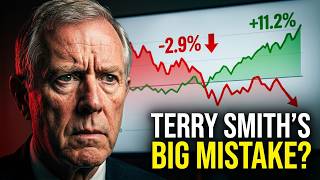
And we'll see exactly how a rigidly disciplined fund like Fundsmith is being forced to adapt just to survive. So, to really grasp the problem here, we have to start with a stark number: -2.9%. That was Fundsmith's return for the first half of 2026. Now, what makes this specific number so incredibly significant isn't just that it's negative, it's that it underperformed the broader market, specifically the MSCI World Index, by over 14 percentage points.
Ouch. For a fund that is strictly, and I mean strictly, focused on the fundamental quality of businesses, this massive gap was a glaring signal that something highly unusual was happening right beneath the surface of the market. But, you know, this underperformance actually reveals a mathematical mystery if we look over a five-year period in the UK market.
The Vanguard UK All Share Tracker made a stunning 66% return, which absolutely trounced the average UK active equity fund, which returned just 32%. And this brings us to an almost impossible question, which is really the crux of our explainer today. Think about this for a second. If the average active fund charges, say, 1% in fees and returns 32% after these charges, and the passive index is supposed to literally just be the sum of those active managers, shouldn't the tracker have made something like 37%?
How on Earth did it make 66%? Logically, a passive index shouldn't be able to beat the sum of its own parts by 34%. It makes absolute nonsense of the original argument that index funds just allow you to settle for the market average. There is no average here. Okay, part one, the passive feedback loop.
Let's see how the rules of the market are essentially broken right now. This quote from industry titan David Booth hits the nail on the head, revealing an uncomfortable truth about modern investing. He points out that if you go to an index, somebody is still managing that portfolio, right? But it isn't a traditional fund manager, it's the index provider.
Index funds have essentially become highly concentrated active funds run by these massive index providers. Case in point, when major indices simply relax the rules to accommodate the SpaceX IPO, it proved that index funds are really just massive trading desks. The index providers literally just changed the rules, and the trillions of dollars parked in passive funds blindly follow along.
Passive funds are definitely no longer the low-risk, super diversified portfolios they were originally pitched as back in the day. Now, they're highly concentrated momentum engines. I mean, half of Vanguard's FTSE 100 tracker is held in just 10 stocks. 10. But the most staggering metric here is the trading volume.
Back in the 1990s, active funds made up about 80% of market trades. Today, according to Cboe Global Markets, it's plummeted to just 10%. The prices you're seeing on the screen are no longer driven by fundamental management decisions. They're being driven by the blind, automated momentum of funds flooding into passive trackers.
Which leads us perfectly into part two, the momentum market, where fundamentals are completely ignored. Things have gotten extreme out there. Momentum investing is currently at a 30-year high. To put that into perspective, the current outperformance is actually more extreme than it was in late 1999, right before the infamous dot-com bubble burst.
And it's a vicious cycle. As active funds naturally underperform this runaway momentum train, more people abandon them for passive funds, basically pouring gasoline on the fire. Because so few active managers are actually left to stabilize prices, we're seeing multi-billion dollar companies swing violently.
Take Snowflake, for example. It's a massive database company and it jumped from a $60 billion dollar valuation to $82 billion dollars overnight. An overnight jump of $22 billion dollars. The very next day, Dell opened 33% higher and that's after its shares had already doubled since March. With active managers reduced just a tiny 10% of market trades, there is almost nobody left in the room to look at a $20 billion overnight jump and say, "Okay, that move is ridiculous.
I'm going to sell and take profits." Fundamental rules are entirely upside down right now. Within the Russell 2000 index, companies with negative earnings, meaning they literally lose money, are aggressively outperforming profitable companies. No joke. Money is flowing blindly into hype and momentum, entirely ignoring whether a business actually generates a profit or not.
So, on to part three, adapting the strategy. How does a firm navigate this kind of frenzy? Historically, Fundsmith lived by a legendary three-step mantra. Number one, buy good companies. Number two, don't overpay. And number three, crucially, do nothing. Just let the compounding take effect. Sounds great, right?
But in this bizarre new reality, Terry Smith notes that rule number three is officially changing. They simply can no longer afford to just sit on their hands. As a direct result of abandoning that do nothing rule to try and dodge this momentum frenzy, the fund's portfolio turnover spiked to a record 51% in the first half of the year.
Why so high? Well, because they run an open-ended fund, meaning investors can pull their cash out at any time to go chase the passive momentum. Fundsmith realized that sticking to a strict buy and hold strategy might actually run them out of business before the broader market ever return to logic. So, the really crucial takeaway here is that they can no longer safely execute their classic move, which used to be buying quality companies when they suffer a temporary dip in price.
Doing that today has become like trying to catch a falling knife. If a stock drops today, the massive unthinking algorithms that run the index funds will automatically sell it, crushing the stock price even further in this crazy downward spiral. It's a momentum enhancement effect that pretty much guarantees you're going to get your fingers cut.
Moving on to part four, the new portfolio. Let's look at this aggressive repositioning. This shift resulted in a major portfolio overhaul. They shed companies that lacked fundamental momentum or were suffering from mismanagement, completely exiting heavyweights like LVMH, Nike, and Coloplast, the latter of which saw its organic growth really fall off.
But at the same time, they weren't just selling. They were initiating or building stakes in totally different companies like Netflix, Uber, TSMC, and Legrand. For instance, let's take a closer look at a new buy like Legrand. This perfectly illustrates what Fundsmith actually considers a quality company.
It isn't some flashy AI hype stock. It's an entrenched, highly profitable business making the incredibly mundane physical infrastructure that the whole digital world relies on. We're talking things like electrical sockets and data center busways. Electricians trust the brand, which gives it a massive 20% global market share and incredible returns on invested capital in the low 20s.
And, you know, despite that record high turnover of 51% we talked about, they haven't abandoned their core philosophy at all. The resulting portfolio remains anchored to some really incredible fundamental metrics. With a 31% return on capital employed and a 62% gross margin, they are clearly still ruthlessly focused on buying strong, cash-generating businesses at fair valuations.
The contrast here is absolutely staggering. And honestly, it's something fundamental investors take a lot of comfort in right now. While the massive tech companies that dominate the S&P 500 are currently burning through their cash reserves to fund an unproven AI arms race, which has pushed the index's free cash flow yield well below 2%.
Fundsmith's portfolio is yielding a highly robust 4.3%. They are generating real, tangible cash, not just hype. So, we'll leave you with this final, somewhat chilling question posed directly in the shareholder letter. Because history practically guarantees that market anomalies this extreme, where unprofitable companies soar and indices magically beat their own underlying assets by 34%, well, they always end.
And usually they end badly. So, what's going to break the fever? Will the AI bubble pop when the outsize returns just don't materialize? Will massive layoffs force everyday workers to withdraw their 401k index investments, sending that passive flow into a violent reverse? Or will it be some sort of crisis we simply can't foresee yet?
Whatever the catalyst ends up being, the momentum will eventually break. Thanks for joining us for this explainer, and hey, keep a close eye on those fundamentals.
Comments 0