저자: BillAckman · 외국인
요약 보기
Pershing Square USA 상장 관련 설명. 일반 클로즈드엔드펀드와 달리 연 25% 수익(8년 기준, 펀드 평균 7%)을 주장하며 거버넌스·전략·성과가 다르다고 강조. 할인 거래 우려에 대해 SPARC 사례(Sam Zell 리츠 프리미엄)를 들어 반박. 상장 공모 $5B 규모, 기관·패밀리오피스 중심 청약, 주식 5주당 PSUS(GP 지분) 1주 증정 구조로 첫날 수요 확보. 대형 IPO 파이프라인(SpaceX 등) 언급. 자산 가격 방향에 대한 예측은 없음.
다듬은 글
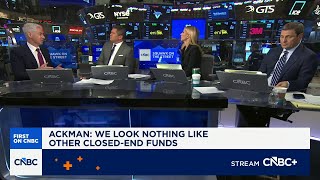
I mean, that was a big deal for you, getting retail investors involved in this. You did a YouTube presentation. You did I think a podcast with Vlad Tenev of Robinhood and got some allotment there. What Why Why retail investors and what's your sense of what demand is going to be like there? Well, uh this is a very unusual Well, we basically we took the body of a closed-end fund, but we look nothing like other closed-end funds in terms of scale, in terms of governance, in terms of strategy, in terms of performance.
You know, the average equity closed-end fund over the last 8 years has generated a 7% return. We've generated a 25% return over the same period per annum. All right, so it's a very different kind of animal. Um and uh why now? Or I've said your question. Yeah, I mean, why demand for retail? Uh Why is that?
it was the point I was trying to make, which is typical closed-end fund, 99% of the buyers are retail. It's really like a financial product that's sold to financial advisors and they put it in a client's portfolio. This was a We did this like a traditional IPO. Uh 80-plus percent of the investors are actually institutions.
Most of them family offices, pension funds, insurance companies, very sophisticated investors. None of them had ever before invested in a closed-end fund. So, we took this structure, which is an amazing structure. People I'd never looked at closed-end funds. What's unique about closed-end funds? You can buy minority stakes in companies.
You can buy controlling stakes in companies. You can use derivatives to hedge risk. And you There's only one layer of tax. Typical corporation there's corporate tax and then there's tax when you pay a dividend. Mhm. So, it's the most tax-efficient corporation, it's the most flexible corporation, but no one's ever used it for the purpose we're using it for.
Yeah, why do they tend to trade at a discount, closed-end funds? Because they're passive collections of securities with fees. That should trade at a discount. But don't blame the closed-end fund industry for uh don't blame the structure for the performance. And the analogy I would make, go back to the 1970s.
A whole bunch of real estate investment trusts were launched. They all traded at discounts. Why? Because the sponsorship was weak, because the performance was weak, because the asset quality was poor. And then in the early '90s, I'm sure Carl will remember, Sam Zell took public one of the first multi-billion-dollar professionally managed real estate companies.
And he chose to do it in a REIT. And people were like, "Sam, why would I invest in a REIT? REITs trade at discounts." He said, "No, no, not this one." What happened? traded at big premiums, particularly in the '90s, because lower cost capital in public markets, liquidity. And what did Sam have? He had best-in-class governance, he had best-in-class performance, he had best-in-class asset quality.
That's what we're doing. We're kind of the the rebirth of the closed-end uh investment company universe. How do you feel about the amount you raised? I think $5 billion was was about half of the as much as you were aiming for, as much as $10 billion. Aiming is not the right word, okay? So, we were giving Actually, this is a very unusual offering.
Uh we've All we've talked about is Pershing Square USA, but as part of this 2 years ago we came to market. What we heard from people is they like the structure, they like the governance, like the track record, they like the sponsor. But they're like, "Why should I invest on the first day? Just going to be a pile of cash." Hard to get a pile of cash to trade up on the first day.
Retail loved it. Financial advisors loved it. But the institutions you need to do a large-scale offering are used to what IPO that pops, you know, it goes up 10, 15, 20% the first day. So, that's why I scrapped it. I said I'm going to come back with something better. That was 24. That was 24. It's actually my wife's idea.
I went home, I complained to her it's going to be a $2 billion offering. I thought it could be 10. She said, "Well, is there something else you could give them?" And I said, "Sweetheart, this is a really good idea." And so, what we're doing is we're giving a piece of the GP, the management company, the entity that receives fees from the funds.
And it's like a gift with purchase. And so, for every five shares you buy PSUAS in the IPO, you get one share of what we call Pershing Square Inc. So, the the IPO pop comes from the receipt of another security. It's almost like buying stock in an IPO getting immediate spin-off of another company. Once we had that, we were able to create an offering that was oversubscribed, which has never happened.
There's no such thing as an oversubscribed closed-end fund offering, because they take every dollar of demand. In this case, we cut back the institutions very significantly in the offering. We let the retail investors get every dollar of It's usually the retail gets cut massively back and the institutions are favored.
We did the opposite. Now, we picked the best-in-class institutions. Um but just to give you context, a $5 billion offering is the sixth largest IPO in the last decade. It's like the 20th largest IPO in American history. So, you're not disappointed. I asked the bankers, I said, "When was the last time you worked on a five Have you ever worked on a $5 billion-plus offering?" And only a couple of people in out of a group of 60 had raised their hand.
So, this is there's a lot of bigger ones coming though very soon, as you well know. I mean, SpaceX will be a lot bigger, obviously. Yeah. Um but in this universe, I mean, permanent capital, you know, this has never happened before. And uh you know, so I think it's a great thing for Obviously, we have some of the wealthiest investors in the world.
We have a you know, $200 billion family office that invested in this transaction. We have pension fund that invested $500 million in this transaction. This was the you know, the $2.8 billion cornerstone round is the largest amount of committed capital ever raised for an IPO. So, we we broke a lot of records here.
And ultimately at the end of the day it's going to be about the performance long term. But you know, this is a pretty high quality deal.



Comments 0