저자: CNBC Television · 외국인
다듬은 글
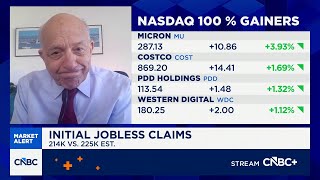
For what this all means for stocks, let's bring in Jeremy Siegel, WisdomTree chief economist and Wharton School Professor of Finance. Jeremy, great to see you. Happy holidays. Thank you. Uh labor market still doesn't give you too many things to worry about in claims, although yesterday people were looking at Conference Board uh job differential and what that might mean for I don't know, the prospect of a jobless expansion, let's say.
Yeah, I know. The the sweet spot for jobless claims, uh you know, is between 200,000 and 240. We have just been there virtually every week, which is really, you know, shows, you know, not an overheating labor market to say the least, but one that is certainly not deteriorating and, you know, setting us up for potentially good 2026.
Do you think uh a more dovish rate environment can unwind some of the job loss that might come from technology? Yeah. I mean, I I you know, I I think we should be in the low threes on the Fed funds rate. I mean, we really had a good inflation report and I don't think it's as distorted as a lot of people had had feared.
The the housing component um is going to actually contribute a downward pressure for I think many, many months uh on the service part of the CPI over the next year. And that's going to keep it in line once the the Trump bump of those tariffs, which I think were mostly through, maybe a little bit more uh in the next month or so goes through, uh you know, I think we we would be on the low twos on on the CPI enough for the Fed to get it the get the rate down further.
Fed policy, though, Professor Siegel, isn't in a vacuum in that you also have the backdrop of a fiscal stimulus in the form of changes to tax policy, which could benefit individuals in the form of a bigger refunds, lower tax rates, as well as corporations. So, how do you balance the two in terms of on the one side you have things that could actually uh spur growth, spur some inflation, and on the other side you've got also the Fed that that could lower rates.
Yeah, and as Kyle mentioned at the top, you know, we we still have two little bumps we have to go through before those tailwinds you just mentioned uh take place. I mean, we do have a Supreme Court ruling likely in a few weeks about the legality of the terror. Now, my recommendation is basically the Supreme Court should do is is say to Trump, "Hey, you you need approval of Congress.
We're going to give you 6 months to get it, rather than just saying it's illegal, give refunds." I think that would be real disruptive. So, we're going to have to see how that proceeds. And then, hey, let's not forget um there may be another government shutdown on January 30th, something nobody wants, but uh and uh few are talking about now.
If we get through those two bumps, uh those tailwinds that you talked about are certainly uh you know, operative uh over the next year. Yeah, it's really I think the the picture right now of push and pull uh for Q1, Q2. You mentioned the tax refunds, uh maybe checks from Congress, we'll see. Certainly gas prices, all positive.
And then on the negative, if they start seizing student loan uh uh payments, or electricity keeps running double CPI, or ACA subsidies expire, I mean, that that's that's a real balance of uh of risks and tailwinds, isn't it? Yeah, it it is. I mean, the ACA the subsidies are going to be the big battle.
I mean, you know, the Dems have have certainly put their, you know, put their hat on that as being the uh somewhat of what they're going to campaign on uh for the for the midterm election. So, you know, I uh you know, I I well, I think we have to look at what's going to happen in 4 weeks there, and what the what the Republicans are going to do.
That that that is, you know, health care costs, electricity costs are are are the drags. Certainly gasoline costs are certainly a positive. The refunds are definitely a positive. Uh and and the fact that, you know, rental prices and home prices have stopped going up. They're still expensive, and, you know, certainly out of reach of of of quite a few Americans, but at least we don't have that uh you know, double-digit inflation that we had in the early 2020s.



Comments 0