
원문 보기
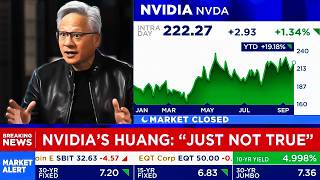
Moving on to shares of Nvidia up around just about half a percent or so after analysts at JP Morgan released a note ahead of the chip maker's GTC conference saying that Nvidia might be holding on to news regarding a new chip design for AI inference computing that would be in partnership with AI startup Groq.
Nvidia posted an earnings beat last week but was lower on continued AI fears. JP Morgan does see Nvidia as a buy ahead of that big GTC conference. Doesn't inference require less memory than than training? And you know that who's coming out I think with GTC this is my conjecture a inference chip that is got a lot more powerful come from Nvidia.
Okay. That's that's been rumored. I think we'll see that at GTC. Okay. And that's to go against the Google the GPU which is by the way Broadcom which is of course tonight. Yes. Broadcom helps them design that chip. quarter which they didn't like Broadcom. Right. They crushed it. Uh and of course uh Andy Jassy's got something cooking there, too.
It's always funny By the way, what is Jensen what what is Jensen saying about memory now given he had the good call there and he is speaking I believe today at Morgan Stanley. So is Satya Nadella we should monitor both of those. I think they're beaming in they're I don't think they're in physically.
I'm not sure. I don't think they're physically. Satya you're going with the computer? Yeah, I'm going in, too. 100%. Cuz I don't know if they're showing up at the White House. Isn't there something at the White House they should Say what? She meant Colossus. That was another one. No, I just think when they went back to talk.
Triples. Thank you. Look, I think that Jensen speaks a lot but the GTC speech is one that he historically goes into a deep dive and comes out and if he does have a chip that goes up against Google that whole theory about Google making chips for everybody else in inference I'm going to question that.
And let's not forget your Google talk about frenemy. You I think you invented that term. I mean Google and Amazon want all that they can get from Nvidia. By the way, Microsoft is just an Nvidia house and Anthropic is an Nvidia house. Anthropic is a Tesla billionaire and I thought it would have some impact.
Good Bloomberg story about how this man has bought a million shares of Nvidia and people are yawning at his million share buy. Who was that who bought a million shares, sorry? The K O G U A N. I really apologize that I that it's not not going to A Tesla billionaire, got it. Okay. But it just, you know, you've got these stories about Nvidia, you've got the GTC coming up and the stock is still in the do nothing pit.
Nvidia main driver, share of winnings. Those are usually not complained about. A little bit more expensive than where Nvidia right now is, but look, it's been a core holding for us. We've owned this stock since October of 2021. Are we still all, you know, tensed up about Nvidia or can we feel better about the way that that that stock's traded?
So it's up 5% over the last month. It might not feel like it because in those days after the earnings report, it traded so poorly. Yeah. But then we've had the turnaround. It was our It's our largest holding. We about a 6% We've added to it on on when it was down earlier in the year. I think it it is time to kind of put it past right now and I I think we're going to see a risk on rally broadly.
I think the software is coming out of it. The one thing that's that we're really looking at as you know, at our portfolio is the CapEx AI spending. Now, some of the multiples we're seeing with Broadcom and Nvidia come down significantly and you know, the the the spending the the borrowing has been so loose.
I mean, if somebody wanted a million dollars, you don't you don't ask for a million, you ask for two million and I mean, you're getting loans and no covenant loans, lax collateral, the they're very competitive rates. So that's what we've seen really washed out within this sell-off in software and I think that leads way here, you know, why that they were trading at such lower multiples and I think we'll see them trade at higher multiples going forward.
Okay, so chips, watching chips. I want to come to you and I want to get to a lot more before we get out of here for a break. Um, you trimmed Taiwan Semi. Yeah. Can you give me some details uh on that? Sure. I mean, I started buying Taiwan Semi when I was in the '70s. Uh, it became just about twice the size of my largest core position.
So, I was actually late in trimming it, but it's still by far my largest position. Uh, just from a risk and a portfolio management standpoint, I had to take some off the table. So, that's the only reason. It's nothing about the fundamentals. As I said, still by far, by leaps and bounds, my largest position.
And everything you're saying positive about Broadcom and Nvidia, you know, they make the chips for everybody, period. Except for Intel's got their own fabs. So, as you see growth there, you'll continue to see it at Taiwan Semi. You got overnight uh some big news there, you know, they're in this big battle with the Open AI.
And I I what I think was interesting is that the their now their runway is at 19 billion. I think a week, 2 weeks ago it was 14 billion. For me, this is good news for AI in general. Right? I mean, you know, everyone was talking about the AI bubble, uh will there be a return on investment? I think we're starting to see that, and I think one of the beneficiaries of this is a name that you pounded the table on, Nvidia.
Nvidia, tremendously. But what this actually tells us, Charles, is that AI demand is real. It is scalable faster than anybody anticipated, and that's the litmus test that we just saw from Nvidia's earnings. They just confirmed that. And finally, we're seeing tremendous demand. the earnings were great in every respect, the stock got hammered.
It got it ran up. I mean, it's it's done really well as of recent. So, for all of these stocks, even the software names, and you saw that the valuations in technology last 6 months, they're they're kind of coming our way, and actually they needed to pull back a little bit. So, it's okay, but the the demand for software and hardware is real.
That's what Anthropic tells us. Wow, and I know that people are hoping to hear maybe something from Jensen Huang one way or the other on memory pricing. He's speaking right now at this Morgan Stanley conference. Uh, here's something else he addressed down a couple moments ago. I just want to mention it.
He said that Nvidia's $30 billion investment in Open AI could quote be the last time we'll have the opportunity to invest in a consequential company like this. He's talking about because they could have this IPO by year-end. But what is the broader significance of that statement do you think? Yeah, well, part of it is he's playing a game of poker, right?
I mean, there definitely could be more investments obviously in the coming years. You know, but but I think the reality is there's more and more pressure for Open AI, for Anthropic, for these other companies where they're not just going to continue to get these investment dollars in the tens of billions.
They're going to have to ultimately show profits. It's an arms race, too, that's all happening. And I think you're seeing that with Anthropic and software and what's what's happening there. And Jensen's well aware of it. He knows he has the magic wand. And when he talks, everyone listens. So, you know, this is very strategic in terms of what he's saying here relative to Open AI, a little shot across the bow.
The revolution will not be televised, Dan, but the AI revolution is going to be powered largely by natural gas. I know you're not the energy guy, but we've been talking a lot about the war in Iran and energy prices. Any part of you worries that what we're seeing in energy at some point may play havoc with AI?
Look, Brian, no doubt. I mean, obviously you're the energy guru. And I think the reality is is that when you look at what's happening right now, the biggest worry is the shortage from an energy perspective. There's more data centers under construction than active data centers. It's why you have the White House meeting today.
You know, these companies are going to have to flip their own bill. And look, nat gas is going to play a huge role. And big tech companies, the hundreds of billions they're spending, energy is going to be a piece. And also, it's going to be a big second, third derivative. I could argue energy is going to be one of the biggest derivatives of the AI trade.
Uh Jensen same thing uh today uh around uh Nvidia and what it's about. And Sam Altman from OpenAI yesterday got added to the lineup. So, he'll be here tomorrow morning at 7:00 a.m. But, I would say the compute story is very, very strong. I would say the LLM story, we are partners with xAI, OpenAI, Gemini, as well as Anthropic per the interview yesterday.
That is intact, but what happens beyond that? What are the other layers? Jensen did say though today software is going to live. Software, I think he said, is still going to run the world, but it's going to be agentic. And I think that is a part of the messaging that's coming out. And I guess that's what we hear.
Some software lives and some software dies and that's what the market's trying to figure out now. All right, I hope you're all doing great today. Jensen Huang spoke today at the Morgan Stanley TMT conference. A lot of topics were covered and compute directly translates to revenues and therefore compute directly translates to a country's GDP.
Jensen reminded us that Nvidia's tokens per dollar per unit of power is significantly better than the competition and it's not even close. Jensen told us that in the future all software will be agentic and that the software industry of the future will be much larger than the software industry of today.
But, their business model will change. In the future, software companies will rent agents that will lead to extraordinary token demand and by implication extraordinary compute demand. As I've said for a while, I'm expecting a surge in compute demand from . When asked about supply constraints, Jensen said, quote, "I love constraints." And quote, "The fact that everything is scarce is fantastic for us." Jensen explained that since the world is limited on power, Nvidia's customers must choose the absolute best architecture that produces the most tokens per dollar per unit of power.
Choosing the right architecture is directly tied to a company's revenues. Therefore, in a power-limited world, customers must choose Nvidia since their systems produce substantially more tokens per dollar per unit of power. And second, on the topic of supply constraints being a positive for Nvidia, Jensen said that Nvidia has already secured everything in advance: memory, Co-WoS, advanced packaging, wafers, connectors, cables, and so on.
We saw this in action just this week when Nvidia announced strategic partnerships with optical interconnect companies Coherent and Lumentum. From a technology perspective, Nvidia sees what's ahead. They see the areas where there could potentially be bottlenecks in the future, and they secure capacity well in advance before most market participants even realize that there could be a future constraint.
Also today, Jensen said, quote, "I'm cultivating new ecosystems for the future." He elaborated by saying that the AI natives and companies that Nvidia is partnering with is expanding the CUDA ecosystem. In other words, Nvidia is not aimlessly throwing money around. They're making strategic investments that expand the CUDA ecosystem.
Jensen provided an update on OpenAI and told us that Nvidia and OpenAI have finalized an agreement and Nvidia is going to invest $30 billion in OpenAI. Jensen explained that the opportunity for Nvidia to invest $100 billion in OpenAI is, quote, "probably not in the cards because OpenAI is going to go public toward the end of this year." And so this may be the last opportunity for Nvidia to invest in OpenAI before they go public.
I'm sure you all remember that there was a lot of confusion about Nvidia and OpenAI's partnership in early February, and now we have a conclusive straightforward answer from Jensen. Nvidia is investing $30 billion, and there's been a change of plans regarding the $100 billion investment that was announced back in September because OpenAI is preparing to go public later this year.
I'm so glad that we finally have a straightforward answer on this topic. Jensen also said that Nvidia's $10 billion investment in Anthropic will probably be their last investment in Anthropic as well. He didn't specify why, but there have been rumors that Anthropic is also preparing to go public, and so perhaps that's why.
Jensen mentioned that Nvidia expanded OpenAI's capacity from Azure to OCI to now AWS, and he said Nvidia is ramping OpenAI's AWS capacity like mad. Nvidia is also scaling Anthropic's capacity at AWS as well as Microsoft's Azure. This is interesting. Essentially, Jensen made the point that previously OpenAI was viewed as being synonymous with Microsoft, and Anthropic was viewed as being synonymous with Amazon.
But now, Nvidia is significantly scaling OpenAI's capacity at AWS, and significantly scaling Anthropic's capacity at Azure in addition to scaling at AWS. Jensen also said that a brand new AI lab named MSL recently came into the world, and they're going to need a few million GPUs as well. It's important to note that the MSL that Jensen is referring to is Meta Superintelligence Labs, a relatively new division at Meta.
But Jensen specified that the compute demand from MSL is net new on top of Meta's already enormous demand for compute. And MSL will need a few million GPUs. Jensen said that these three AI labs, OpenAI expanding capacity at AWS, Anthropic expanding capacity at both Azure and AWS, and MSL significantly expanding its capacity, are providing three new growth vectors for Nvidia.
Jensen said that Nvidia's demand profile went from being incredibly high to being higher than that. When asked specifically about Nvidia stock, Jensen said, quote, "You can't hold the stock back." Jensen said the reason for this is that compute equals revenues for companies, and quote, "Every single company will need compute for revenues." That's a big statement, and it underscores the technological shift that is currently happening.
Every single company will be changed by AI, and therefore, every single company's revenues will eventually be tied to compute. That's a big statement with major implications, and I think Jensen is correct. When asked about physical AI, Jensen said that Nvidia is the frontier of physical AI and is positioned to be the leader in physical AI.
Nvidia's Cosmos is the most downloaded physical AI model in the world. Nvidia is also the frontier of autonomous AI, both autonomous vehicles and humanoid robotics physical AI. Jensen said that in two years' time, we're largely going to be done talking about agentic AI because everyone's going to be using it.
And we're going to be talking about physical AI starting in the next two to three years and for the next decade. As a reminder, .



Comments 0