저자: EdYardeni · 외국인
요약 보기
2025년 관세 공포 이후 증시가 급반등해 S&P500이 역대 고점 부근이라는 진단. 경기 침체 예상은 빗나갔고 경제 회복력이 확인됨. AI 수혜는 Magnificent 7을 넘어 'Impressive 493'(나머지 S&P500 기업)으로 확산될 것이며, 기술주 비중은 이미 과도해 실물경제(금융·산업재) 쪽으로 로테이션이 진행될 것이라 봄. 금 가격은 연초 3,000달러에서 4,500달러까지 오른 상황에서 2026년 말 5,000달러, 2029년 10,000달러 전망을 유지. 물가는 관세 영향을 제외하면 2%로 내려왔을 것이며 생산성 향상이 인플레를 2%로 끌어올릴 것으로 봄. 2026년 S&P500 목표치는 7,700(약 10% 상승).
다듬은 글
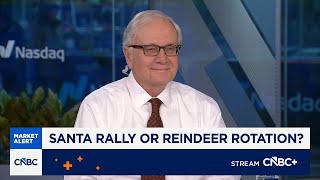
Joining us now, Ed Yardeni, president of Yardi Research. What a year. We can start looking back at it. Um, all of the uh liberation day angst turned into a buying opportunity. Did indeed obviously we hear the this is the worst economy that the world has ever seen, although the stock market keeps hitting new highs.
Correct. So, I don't Well, I mean, we we've had the most widely anticipated recession of all times. This didn't happen. I mean, how many years has it been now? Yeah. And the economy's proven its resilience, and I think it'll continue to do so. So, we're just below 6,900. Dom Chu was just talking about the records of a lot of Wall Street
um prognosticators. You started the year, I think, at 7 7,000. Yeah. whoops around with the tariffs, but you quickly just you jump back to 7,000. Yeah. We may not hit seven. We may uh we may hit 6,900 uh today at this point. Yeah. I mean, it could happen in a couple of days was right. We're basically there.
7,000 a lot better forecast. I'm going to declare mission accomplishment. Yeah. Oh, good. Uh it's a lot better than a 5,800 U forecast which which some individual obviously we we just had a technical analyst on Chris Veron who was talking for technically about why why he's seeing a did you see him because because fundamentally you're talking about the same things in terms of a rotation away yeah from some of the speculative sectors to real economy stuff
to the real economy stuff. Well, I I think uh the Magnificent Seven I think I previously made a analogy with the Game of Thrones where they you know seven independent kingdoms they had their moes around them and they were happy prospering with their unique businesses but AI has kind of forced them to compete with one another and so it's become a a much more competitive game and I think that uh is going to start to narrow some of their profit margins and get people to understand that um the real beneficiaries of AI are going to the what I call the impressive 493
causing you to actually um make a change in in a we're not be able to we're not going to be able to watch your performance on a 15-year basis. Uh that's that's asking to maybe we can I plan on it. Uh actually what will that be? Yeah. When we're looking back. Yeah. But but you actually and and Becky made note of that that how significant it was that that you had been overweight tech, but it's so overweight now.
It's it's had it's hard to get hard to get more overweight than it already is. Well, if you take information technology and communication services and the S&P 500, they're 45% of the market cap of the entire index. And so if you tell people overweight that, what are you telling them? Like 50 55 60? Uh, I mean that's not even close to what the their impact is in the overall economy, right?
And the real beneficiaries are going to be everybody else that uses AI and what other whatever other technologies they come up with. I also thought it was interesting that you said that that lower uh interest rates don't necessarily help a weakening labor market. So if if what you're saying is correct about the economy, you agree with we just talked about the Cleveland Fed president.
You don't think we need any additional rate? I don't think so. But if the Fed has this notion that we have to get to 3% uh sometime in the foreseeable future, then I think a lot of that liquidity, a lot of that stimulus will go into financial assets and precious metals. I mean, I'm I've been talking about uh since the beginning of the year been talking about getting to 4,000 on the price of gold.
It was 3,000 at the beginning of the year. I thought 4,000 by the end of the year and here we are at 4,500. I thought 5,000 by the end of next year. Now I'm thinking maybe I'm going to have to raise that number and I'm still thinking 10,000 uh by the end of the decade, which is actually when I also think the S&P will get to that level.
So 10,000 for both by the end of the decade. That's interesting. Um you also point I was wondering if the correlary is true. If if lower yields don't help with a weak labor market, does raising rates always help with inflation? Is that the way to cure inflation? Well, yeah, I don't think we have much of an inflation problem.
I think if it wasn't for the tariffs, inflation would be down to 2% by now. And you think so? Well, I I I know so based on the CPI, the CPI, it's the durable goods inflation rate that has come up from minus4% to plus 1% over the past year. And a lot of that was because of the of the tariffs. But that's a tempor I I do think it's a transitory thing.
And I think productivity is going to bring inflation up to 2%. If you were advising the Trump administration, would you would you tell them to hold firm? Because you see how they're reeling from the affordability uh issue. Is is it all for not if it we'd be at 2%. But you know what? Even if we weren't at 2%.
Yeah. People in the country would still feel Oh, yeah. That's true. Like they don't have enough money because of the 22% under the Biden administration. Well, I I think you know when you look at, for example, insurance in New York State for just one young person in their 20s, it's like $4,000 a year.
I mean, it's it's it's insane some of these prices levels. And so, uh, clearly this is having a depressing impact on some consumers, particularly younger consumers. Uh, but on the other hand, you've got the baby boomers are retiring with $80 trillion of net worth. So they continue to spend and I think they're actually helping some of the some of their younger kids with mortgages and and so on.
So 10,000 by the end of the decade 2029. Yeah. No, by 2029. Yeah. So that's not that's not the the if you compound that 26 27 28 those what is it 7% a year or something? Yeah. I mean it's Yeah. It's just an extrapolation. Next year, do you have a when do you put out a a year end target for the S&P for
for next year? Yeah. 7700. So it's a 10% increase which would be the fourth 7,700. Yeah, that would be the fourth year in a row of double digit gains which which has happened before. It's not that unusual. We had those three in was it in the 90s we had 30% plus for three years. Yeah, correct. That we're not going to do.
Yeah, but four straight years are double digits. I think, you know, let's let's you know, we don't want to do too much. If we do too much, we're talking about a meltup and a meltdown scenario. And I don't think we're going to What do you consider real economy stocks? What what what what sectors? Well, I think, you know, I've been uh I continue to recommend overweighting financials.
They work very well. I think they do well with a an economy that's solid. I'm not that concerned about things blowing up in the in the capital markets and the credit markets. Uh, I think if we have some private uh, credit loans, it's on your radar screen though, isn't it? Private credit. Yeah, it's on everybody's radar screen.
I mean, you cockroaches. Jamie Diamond called it. Yeah, cockroaches. Yeah, but you know, Jamie Diamonds, he's got to work. Yeah, he's been a pessimist for a while and he's been cautious. He's a banker. Yeah, which is a reasonable thing for him to uh to say. It is something we should be watching out for, but I don't think it's going to be a problem.
And so uh yeah, I think industrials clearly are real economies sector and we still have a lot of uh money being spent on uh building manufacturing facilities. Uh you know I don't know what the the the actual number is of trillions that will be uh brought over by Trump's um negotiations on tariffs. But that's going to be an important factor.




Comments 0