저자: 미상 · 외국인
요약 보기
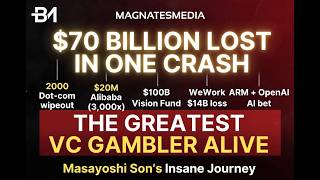
소프트뱅크와 손정의의 역사를 다룬 영상. 2000년 닷컴 붕괴로 손정의 개인 자산 약 700억 달러 손실, 소프트뱅크 가치 93% 폭락. 2000년 알리바바 2,000만 달러 투자가 600억 달러 이상으로 불어나 회사를 살림. 비전펀드 1,000억 달러 조성 후 WeWork 실패(140억 달러 이상 손실). 이후 ARM IPO 등으로 방어 모드 전환, AI 중심 재편. 현재 포트폴리오는 ARM·OpenAI 중심이며 AI 베팅의 성패를 질문으로 남김.
다듬은 글
All right, let's talk about SoftBank. It's one of the most important and honestly most volatile investment firms in the world. But really, the story of SoftBank is the story of one man, its founder, Masayoshi Son, and his absolutely insane history of making world-changing billion-dollar gambles. So, let's dive in and see how he does it.
I want to start with just one number, 70 billion dollars. That is the largest personal fortune ever lost by a single person in one market crash. I mean, think about that. It's a staggering amount of money that would, for anyone else, be an absolute career ender. And that entire 70 billion-dollar loss, it belonged to Masayoshi Son.
His net worth was just completely obliterated during the dot-com crash back in 2000. For literally anyone else, that would have been game over. So, how on earth did he survive? And that, right there, is the core question of this entire saga. How did he not only claw his way back from total ruin, but then turn around and make even bigger, even crazier bets?
Well, that's exactly what we're going to figure out. You see, to really understand the bets, you have to understand the man. And his story starts out, believe it or not, pretty humbly, but with this incredible ambition right from day one. All rooted in this vision that he was going to dominate the information revolution.
The early days were just a total whirlwind. So, in 1981, you've got a 24-year-old Son founding SoftBank, literally giving speeches while standing on top of apple crates. But he moves so fast. He jumped from software into publishing tech magazines, which was a brilliant move cuz it gave him this inside look at all the hottest trends.
That savviness led to an IPO in '94, and then this huge leap onto the world stage with Yahoo Japan. And by '99, he'd already pivoted the company into the investment machine we know today. And, you know, this whole mindset is baked right into the company's logo. It's based on the flag of the Kaientai, a group of 19th century rebel samurai who wanted to shake things up and modernize Japan.
That tells you everything you need to know about how Son sees himself, as a revolutionary who's here to disrupt the old way of doing things. Okay, now we get to the most dramatic moment in SoftBank's history. The dot-com crash should have been the end of the company, but instead, it led to what is arguably the single greatest investment ever made.
So, picture this. It's early 2000. The dot-com bubble is at its absolute peak, and SoftBank's value has ballooned to 180 billion dollars. For a brief, shining moment, Masayoshi Son was the richest man on the entire planet. He was standing right at the top of the financial world. And then, the crash.
SoftBank's value didn't just drop, it completely evaporated. A 93% collapse. Remember that 70 billion-dollar personal loss we talked about? This is when it happened. An almost total, catastrophic wipeout. But, in the middle of all that financial wreckage, with his company teetering on the edge of oblivion, Son made a small, and what looked like a totally insane, bet.
He put just 20 million dollars into this tiny, completely unknown e-commerce company in China. Well, that 20 million-dollar bet on a little company called Alibaba turned into more than 60 billion dollars. That's a 3,000 times return. It's widely seen as the single greatest venture capital investment in history.
And that one bet didn't just save SoftBank, it funded absolutely everything that came next. So now, flush with cash and a ton of credibility from the Alibaba win, Son sets his sights on something that would totally rewrite the rules of tech investing. He wanted to weaponize capital like no one had ever seen before.
He called it the Vision Fund. I mean, just look at this comparison. The scale is just staggering. A really big, typical venture capital fund might raise a billion, maybe two. Son went out and raised a hundred billion dollars. He wasn't playing the same game as everyone else. He was creating a brand new one, using this overwhelming mountain of cash as his primary weapon.
And the strategy behind this giant fund was called the cluster of number ones. The idea was pretty straightforward. You pour billions into a company like Uber to make sure it becomes the undisputed leader. Then you do the same for, say, DoorDash in food delivery. Then you get them to work together, creating this powerful network that only SoftBank really controls.
Now, this strategy hit its absolute peak of insanity with WeWork. At one point, the Vision Fund's money implied that this company, which basically just runs out office space, was worth 47 billion dollars. This was the high point of all the hype and exuberance. And then, the fall. The WeWork deal didn't just go bad, it imploded in spectacular fashion.
It resulted in a total loss for SoftBank of over 14 billion dollars. It went from being the Vision Fund's crown jewel to maybe the biggest venture capital failure of all time. So, what went so wrong? Well, this quote right here gives us a huge clue. Son had this belief in what he called the animal smell of a founder, this gut instinct.
But the problem was, that gut feeling started to become more important than, you know, actually checking the financials. This founder worship led directly to the disaster at WeWork. After the WeWork debacle and the huge Vision Fund losses, a lot of people thought SoftBank was toast. But once again, Son pulled off this incredible pivot, turning the company away from the brink of collapse and aiming it straight at the next great technological wave, artificial intelligence.
And the recovery plan was incredibly swift and disciplined. First, he just slammed on the brakes. He called it defense mode and basically stopped all new investments to stop the bleeding. Second, he started selling off assets to raise cash, including most of that legendary Alibaba stake. And third, he unleashed his secret weapon, the IPO of the chip designer Arm.
And here's the genius of owning Arm. See, Arm doesn't actually make chips, it owns the blueprints, and its specialty is power-efficient design, which is why its architecture is inside 99% of all smartphones. Well, guess what else needs to be super efficient to run? Giant AI models. By owning Arm, SoftBank effectively owns a foundational piece of the entire AI revolution.
Of course, the road to AI dominance hasn't been perfect. Son himself admitted to a huge miss, calling the sale of their Nvidia stake back in 2019 the fish that got away. And yeah, you can see why. Just a few years later, that stake would have been worth over 150 billion dollars. It just shows you the mind-blowing scale of this AI boom.
And that brings us to today. Right now, SoftBank is all in on AI. This isn't just another investment theme for them. You really get the sense that this is it. This is the ultimate culmination of Masayoshi Son's entire high-stakes career. This chart really tells the whole story of the transformation.
Just a few years ago, this whole thing would have been dominated by Alibaba. But today, the portfolio is centered entirely around Arm, a big new stake in Open AI, and other critical AI assets. It's a completely reborn company, built specifically for the age of AI. And so, we're left with the one question that will define SoftBank's future.
After this wild career of dizzying highs and absolutely catastrophic lows, has Masayoshi Son finally positioned his company for its greatest victory yet? Or, is this massive all-in bet on AI the one gamble that finally proves to be too big? Right now, the whole world is watching to find out.
Comments 0