원문 보기
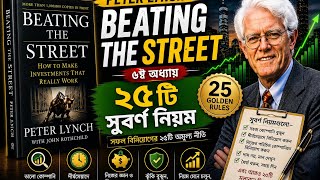
Look, if you've ever glanced at the stock market and thought, "Man, I could never do that. I'm not some Wall Street insider." Well, I'm thrilled to tell you that you are absolutely wrong. Today, we're diving into one of the most empowering frameworks ever put together for the everyday investor. In this explainer, we're doing a complete review of chapter six from Peter Lynch's absolute masterpiece, Beating the Street.
Specifically, his 25 golden rules of investing. The whole goal here is to completely shatter the myth that you need a fancy finance degree to build serious wealth. Let's get right to it. Now, to really grasp these rules, you've got to understand the guy who wrote them. Peter Lynch is, honestly, a total legend.
While he was managing the Fidelity Magellan Fund for 13 years, he took a $1,000 investment in 1977 and turned it into a staggering $28,000 by the time he stepped down in 1990. In Beating the Street, he takes all of that massive success and distills it into this really powerful, super easy-to-understand framework.
He was absolutely convinced that regular individual investors can match wits with the experts. So, let's look at exactly how he says you can do that. To make all 25 golden rules a bit easier to digest, we've organized our road map today into five clear themes. One, the amateur advantage. Two, know what you own.
Three, ignore the hype. Four, market psychology and patience. And five, final golden thoughts. Kicking things off with section one, the amateur advantage. This right here perfectly captures Lynch's contrarian mindset. Over the last few decades, the stock market has basically been taken over by this professional herd of investors who, for the most part, just follow the crowd.
But, here's the wild part. Contrary to popular belief, that actually makes things way easier for you, the amateur. See, professionals are bogged down by strict rules and the need for consensus. But, the observant amateur, you are totally free to use your own personal edge to spot incredible growing companies right in your own backyard way before Wall Street even bats an eye.
The crucial takeaway is that your investors edge isn't something you have to buy from some Wall Street guru. It's something you literally already possess. Lynch believed everyone has the brainpower to make money in stocks. You beat the market by tuning out that professional herd and just paying attention to the industries and companies you interact with every single day.
Seriously, if you work in tech or health care or retail, you're in a unique position to see which companies are absolutely crushing it locally long before the analysts in New York figure it out. Moving right along to section two, know what you own. I love this quote because it cuts right through all the complicated financial jargon.
Lynch is reminding us of a rock-solid truth. Stocks are not lottery tickets. They aren't just magical pieces of paper bouncing around on a screen. Behind every single stock is a real breathing business. And there's always a very real direct reason why that company and therefore its stock performs the way it does.
Since we're dealing with real businesses, you absolutely have to know exactly what you own and why you own it. Just telling yourself, oh, this baby is a cinch to go up. Yeah, that doesn't count as research. Lynch makes it crystal clear that the biggest losses in the market come from companies with poor balance sheets.
You always always have to check if a company is actually solvent, meaning they have more cash coming in than going out before you risk a single dime. He actually compares investing without studying to betting in a poker game without even looking at your cards. The more companies you study, the more pleasant surprises you're going to find.
Look at 10 companies, you might find one great story. Study 50, you might find five. Doing your homework really does pay off. That brings us to section three, ignore the hype. Now, this might sound completely counterintuitive, especially when your newsfeed is just blasting the latest trendy tech stock, but Lynch uncovered this golden rule: Avoid hot stocks in hot industries.
Why? When industry that's growing at breakneck speed attracts way too much attention and a ton of competitors. Instead, he found that the most reliable, consistent big winners are often hiding in boring, overlooked, cold industries. That's where a truly great company can just quietly dominate without having a massive target on its back.
He's also big on avoiding the next big thing because, let's be real, long shots almost always miss the mark. If your eye is small company, wait until they actually turn a profit before pulling the trigger. What if you're looking at a troubled industry? Well, buy the companies with staying power and wait for actual signs of revival.
As Lynch reminds us, buggy whips and radio tubes never came back. Plus, you've got to treat stocks kind of like kids. Don't take on more than you can handle. A part-time stock picker really only has time to closely follow maybe eight to 12 companies, and honestly, you don't need more than five in your portfolio at any one time.
And hey, if you look around and can't find anything attractive, just park your money in the bank until you do. Okay, section four, market psychology and patience. This analogy from Lynch is just brilliant because it completely reframes how we look at the market. Declines are not the end of the world.
They aren't a reason to panic. They are literally just predictable storms. If you're bundled up and prepared, they can't hurt you. Actually, a market drop is an unbelievable opportunity to scoop up bargains that have been dumped by investors who were just fleeing the storm in total panic. So, the big takeaway here is to aggressively tune out the noise.
Nobody, and I mean nobody, can consistently predict interest rates, the economy, or the stock market. You've got to avoid that weekend thinking and just dismiss those dire doomsday predictions you hear from newscasters. The only time you should ever sell a stock is if the company's actual business fundamentals deteriorate, not just because the sky feels like it's falling.
Just remember, while a stock's price might detach from the company's real success over a few months, in the long term, there is a 100% correlation between the success of the business and the success of its stock. And here's the underlying math that makes all that patience so incredibly worthwhile. Think about it.
If you invest a thousand dollars in a stock, the absolute maximum amount you can ever lose is a thousand dollars. But, if you are patient with a few fundamentally good companies, your upside is totally exponential. You could stand to gain ten thousand or even fifty thousand dollars over time. You literally don't need every stock to be a winner.
You only need a handful of massive winners in your entire lifetime to make your investing journey incredibly successful. Finally, wrapping up with section five, final golden thoughts. This right here is arguably the most important question you will ever have to ask yourself. We said earlier that everyone has the brainpower to make money in stocks, but Lynch boldly points out that not everyone has the stomach for it.
If you're the kind of person who is highly susceptible to selling everything in a sheer panic the second the market drops, you probably ought to avoid individual stocks and stock mutual funds altogether. You've [snorts] really got to be deeply honest with yourself about your own psychology here. But listen, if individual stock picking isn't your thing, there is zero shame in that.
If you just don't have the time to do the homework or the stomach for the volatility, you can absolutely just invest in equity mutual funds. Just make sure you are truly diversifying. And by that, I mean choosing managers who pursue different styles, growth, value, small cap, large cap. Like Lynch says, owning six of the exact same kind of fund, that is not diversification.
But whatever path you take, just remember, investing is incredibly fun and exciting, but it is super dangerous if you try to do it blindly without doing any work. We'll leave you with this final golden thought from our explainer today. Time is completely against you when you own complex fast-moving things like options, but time works beautifully for the patient investor who just holds on to superior companies.
Even if you completely missed the first five years of a great companies growth, if it's genuinely a superior business, it's still going to be a fantastic stock to own for the next five years. So the only question left for you is this. Are you going to be the observant amateur who does the homework and reap the exponential rewards or are you just going to follow the panic turd? Thanks so much for joining me and happy researching.

Comments 0