
원문 보기
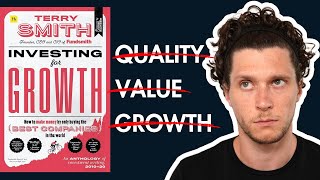
Hey everyone, in this video I'm going to give you a quick summary of what I learned at Terry Smith's fund's annual meeting. For those who don't know Terry Smith, he's an investor we could put in the " quality" category, even though, as we'll see, he's not at all neglecting valuation. He's had an annual return of 15.4% since the fund's inception over 10 years ago, which is a very, very good performance.
So I'm going to share my notes with you, highlighting the things I found interesting. We'll talk about investment strategy, valuation, Adobe (which just lost 14% a few days ago), Amazon, and Fortinet. The first point I took away is the importance of not changing your investment strategy from year to year based on your performance.
In the presentation, he starts by talking about his performance in 2023 and also in previous years, and we see that he underperformed the market. In 2022 and 2023, in a situation like this, many less experienced individual investors might be tempted to think they don't have the right strategy and need to change it, but that would surely be a big mistake.
For example, if we take the well- known example of Peter Lynch, we note that in years when the market performed positively, his fund's performance was significantly higher than the market's. But when the market performed negatively, Peter Lynch's fund's performance was even worse. Ultimately, if we look at the long term, his fund significantly outperformed the market.
Over 13 years, it achieved a 30% annual return, which is absolutely enormous. In the presentation, Thesm Miss shows us that in 2022 and 2023, many underperforming sectors had very good performances. These were actually anomalies. He's talking about, for example, the industrial energy sector. Banks and so on, so many businesses that are fundamentally among the best performed very well during this period.
But you have to be aware that this was a unique period and that the fundamentals remain the fundamentals of asset-light companies with very high returns, very high profitability rates, no debt, growth, and so on, with very high margins. You have to remain rational; these are still superior businesses, and you have to have confidence in your strategy and in the fact that it will outperform in the long term, but not necessarily every year.
Secondly, they don't care at all about not being very sectorally diversified. This reminds me of, for example, a video I made several months ago about Next City. I concluded that Next City was, let's say, a rather rotten business, and in the comments, people were saying, "Yes, but that's normal, it's real estate, so it's normal that they have debt.
You can't..." You don't expect them to have the same margins as companies like Visa and all that, but what I replied was that if you have a sector where you expect there to always be a lot of debt, always very weak markets, and so on, why force yourself to invest in an inferior sector? Well, it's certainly not a very good idea.
And there you have it. I think there's no problem choosing these sectors since there are sectors that are clearly superior to others. So if you want to make money, you're not going to go into the bad sectors. And so he's clearly telling us that he will never invest in energy, he doesn't invest in banks, he doesn't invest in real estate, he will never invest in anything related to air transport since these are businesses that very often even tend to destroy value, therefore having profitability ratios that are lower than the cost of capital.
So it's like if you buy a property, you make a real estate investment on credit. The loan is 5% per year. But if you have a 4% annual return, you're losing 1% per year, so there's value destruction. In fact, it's not enrichment at all; on the contrary, it's impoverishment. So there are sectors like that, and conversely, they focus on good sectors, such as technology, consumer products, and healthcare.
Third point: the P/E ratio isn't enough to determine if a company is expensive. A big mistake you can make when looking at valuation, when trying to determine if a business is priced correctly or not, is to simply look at a multiple and think, "Okay, 15 is a normal multiple, the market is 17," something like that.
So 25 or 30 is enormous, it's definitely too expensive, I'm not buying it. But the notion of expensive or cheap doesn't exist in absolute terms; it's always relative to what you get in return. So in the case of a business, it's relative to the growth you get in return. And to the quality you get in return, and that's perfectly logical.
Just imagine, to go back to simple examples, imagine you launch your own business, a very simple business. You're all alone, for example, let's say you have a YouTube channel and you sell a subscription, a software program. Let's say last year you made €100,000, this year you're making €200,000, and you plan to make €400,000 the following year and €800,000 the year after that.
Then you receive an email from someone who wants to buy your business. If they offer you €400,000 to buy your business, but you know that in one year you've just made €200,000 and you expect to make € 400,000 next year, so today that would be a multiple of twice what you made, well, obviously you're going to refuse since you have 100% growth per year.
And if they offer you at least € 1 million, then you're going to... Perhaps you should start thinking about whether you'd rather have 1 million now or maybe more later. Conversely, if you have no growth, but you've been making 100,000 for three years and someone offers to buy you for 400,000, well, that's much more interesting because you'll gain four years' worth of revenue.
So we can clearly see that the valuation multiple depends entirely on growth. A certain multiple will be cheap if you have very high growth, but it might be very expensive if you have very low growth. You also have to consider the quality aspect. A business with a lot of debt is obviously less attractive than one with no debt, so you'll be willing to buy it for less, and so on.
So you absolutely mustn't just look at the multiple; you have to take growth into account primarily, and also debt, and so forth. Fourth point: in 2023, they sold Adobe, so it wasn't following their latest venture, Firefly, which they just launched. And who still refuses to provide images of white people.
That said, I tested it, and it's much less blatant than the case of Google's AI. So, this was before, in 2023. He bought the stock during the big dip in 2022 and sold it in 2023. The reason he sold it is interesting. He says Adobe paid 20 billion for the acquisition of Figma. Figma is used a lot in teams between developers and designers, allowing designers to collaborate on mockups and share them with developers.
It's quite practical. What bothered him was that Adobe didn't want to give any figures for Figma—revenue, profits, etc. All the figures were secret because they had signed an NDA. So, they weren't allowed to disclose the numbers. He already found that suspicious. He wondered why they had signed that.
If they signed that, there's a problem behind it. Something to hide, but since it's a large private company, they were still able to find some figures. It turns out that Adobe paid 20 times Figma's revenue, so Figma was making $1 billion a year. They paid $20 billion, which is 20 times revenue—that's expensive.
So, one could already say it's a poor allocation of capital. It was also suggested that Adobe's willingness to pay so much reveals that they identified a weakness in their business that they wanted to address by acquiring Figma. Therefore, for them, this indicated a weakness in their business. Moreover, the acquisition has since been canceled, and Adobe had to pay $1 billion to stop the deal.
In point number 5, he briefly mentions Amazon, which also sold in 2023. The reason for the sale is that Andy Jassi, the new CEO who succeeded Jeff Bezos—originally the one who led the entire AWS division and is now CEO of Amazon as a whole—announced he wanted to invest a huge amount. The focus was on online grocery shopping, so being able to buy vegetables, fruits, and so on on Amazon.
According to Teris Smith, this was a truly catastrophic decision and a very poor allocation of capital. He preferred that Amazon focus on business models of much higher quality, such as AWS or even their advertising business. Therefore, he decided to sell, and then clarified that this focus on selling online courses didn't happen.
So it will be interesting to read Amazon's annual reports and analyst questions, which I have n't done, to see if this is still relevant, if they changed their minds, if they realized it might not have been a good decision, and so on. But in any case, if you're investing in Amazon, this is an important point to consider.
Another point: among the stocks he bought in 2023 is Fortinet. I have a small position in Fortinet. On the other hand, it's not yet a company I know very well, and he doesn't talk about it much in the presentation, but he does say something interesting: he considers Fortinet to be in a duopoly situation with Palo Alto Networks, which is a very, very positive point.
Businesses that are in a monopoly or duopoly situation are often businesses that perform extremely well. We think of Visa and MasterCard, which are in a duopoly; there are Moodies and SNP Global, which are also in a duopoly, and so on. So, a very good point. And in this duopoly, I'm very happy to only have Fortinet, since I looked at the figures.
In any case, the capital leasing seems much better on the Fortinet and Palo Alto Networks side, their SBC, so the stock-based compensation is much higher, to the point where the shareholders are still diluted, in fact, are diluted a lot, unlike with Fortinet. So, I need to continue digging into this company, but it's a positive point.
Seventh point is Being okay with the idea of never investing in a stock that interests us, he says that in his investment universe—all the companies that meet his quality criteria and in which he could invest—there are plenty that have been on his radar for 14 years, but which he has never bought, never been able to buy, because he considered them never to be at an attractive valuation.
This makes me think of two things: first, we tend to categorize investment styles a lot— value, quality, large, large, whatever— but I find this quite dangerous because there's a risk of falling into caricature and thus ignoring criteria that are more associated with another investment style. So here we see that Terrysmith is often considered a quality investor, yet growth is completely one of the things that are important to him in his investment choices, as is valuation.
It's simply that he believes the right approach is to start by selecting the right companies, so he narrows down his universe. investment, and among these good companies, we'll invest in those with the most attractive valuations at the moment. So, there's that: not neglecting valuation because we tell ourselves that quality comes at a price, growth comes at a price, yes, but there are limits.
And secondly, when I do my stock valuations, I'm well aware that some stocks may never reach the price I'd be interested in, but that doesn't bother me at all. In fact, you should n't be bothered by that. And finally, it's perfectly normal to invest in only a few companies each year, and that's enough.
In fact, there's no need to buy 20 different companies a year. So, I think it's better to be quite cautious, quite conservative, and therefore not try to buy all the companies that interest us and not say, "I absolutely have to have that one," because there's a risk of making mistakes. Then, point 1, 2, 3, 4, 5, 6, 7, 8.
So, this is on the subject of... is it The idea that you should exit the market comes from someone who asked them, "Do you think it's a disadvantage to be invested all the time?" Terismis, on the contrary, said that exiting the market is extremely risky. He talks about a scenario we see very often: if you missed the 10 best days, if you were n't invested during the best 10 days, your performance is halved.
If you missed the 20 best days, you divide it by another factor, and if you missed the 40 best days, you divide it by another factor. So, on those days, we're there; we should be able to time them. But he believes that, and I quote, "We don't have the skills to predict when to exit, and we don't know anyone who does." So, be careful when someone tells you the market is going to fall, you should exit, and so on.
It's often the best way, unless you're very lucky, to ruin your long-term performance. And one last point on the question of investing in what you understand, and here I found... It's interesting because it goes against what we often hear. We often hear that we should only invest in what we know, in what we truly understand, which is true to a certain extent.
But I think we can often go to extremes, and it can become a bit of a neurosis. So I like what he says about that. He says that people often tell him the problem with artificial intelligence is that we do n't really understand how it works, and therefore we can't invest in it; it's complicated to invest in.
But in fact, he says that there are very few things we truly understand in detail about how it works. He gives a very simple example: a cleaning product for the bathroom. It's a very basic product that everyone has. Everyone sees that it works, but in fact, nobody knows how it works. Nobody really knows what the chemical ingredients are.
Yet we know it works, and we know the companies that make these products, and I really agree with him on that. So obviously it's always better to know as much as possible about a company, but I don't think you should wait until you understand everything perfectly before investing. Otherwise, you'll never, or almost never, invest.
And I think the Pareto principle applies: you have 20% of the information that will give you 80% of the necessary understanding. And yes, it's useful and interesting to go beyond that 80%, but you have to be aware that it's a diminishing return, and you shouldn't wait until you know a company 99% before investing €1000 in it.
So that's what I found interesting. If you liked the video, you can give it a like; it helps me promote the channel. And if you're not already subscribed and you found it interesting, you can subscribe, and I'll see you for the next video. See you later!
Comments 0