
원문 보기
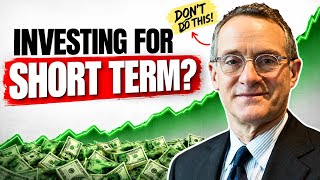
What you learn from history is the market goes down. It goes down a lot. The math is simple. There's been 93 years this century. This is easy to do. The market had 50 declines of 10% or more. So 50 declines in 93 years, about once every 2 years the market falls 10%. We call that a correction. That means that's a euphemism for losing a lot of money rapidly but we
we call it a correction and so 50 declines in 93 years about once every 2 years the market falls 10%. All those 50 declines 15 have been 25% or more. That's known as a bear market. We've had 15 declines in 93 years. So every 6 years the market's going to have a 25% decline. That's all you need to know.
You need to know the market's going to go down sometime. If you're not ready for that, you shouldn't own stocks. And it's good when it happens. If you like a stock at 14 it goes to 6, that's great. You understand the company, you look at the balance sheet and they're doing fine and you're hoping to get to 22 with it.
14 to 22 is terrific. 6 to 22 is exceptional. So you take advantage of these declines. They're going to happen. No one knows when they're going to happen. You'll be very People tell you about it after the fact that they predicted it but they predicted it 53 times and uh So you can take advantage of the volatility market if you understand what you own.
So I think that's the key element another key element is that you have plenty of time. People are in an unbelievable rush to buy a stock. I'll give you an example of a well-known company. Walmart went public in October of 1970. 1970 went public. Already had a great record. It had 15 years performance, great balance sheet.
You could have waited 10 years saying you're a very conservative investor. You you're not sure this Walmart can make it. You want to check you you're you've seen them operating small towns. You're afraid they can only make it in seven or eight states. You want to wait till they go to more states. You keep waiting.
You could have bought Walmart 10 years after it went public and made 35 times your money. If you bought it when they went public you would have made 500 times your money but you could have waited 10 years after Walmart went public and made 30 over 30 times your money. You could have waited 3 years after Microsoft went public and made 10 times your money.
If you knew something about software, I know nothing about software. If you knew something about software you would have said, "These guys have it. I don't care who's going to win, Compact, IBM. I don't know who's going to win, Japanese computers. I know Microsoft MS-DOS is the right thing." You could have bought Microsoft.
Again, I'm repeating myself. Stocks are not a lottery ticket. There's a company behind every stock and you you can just watch it. You have plenty of time. People are in an amazing rush to purchase a security. They're out of breath when they call up. You don't need to do this. It's uh uh One one of the things I find a rule I I I a couple of rules I want to throw out that I find [clears throat] useful.
Excuse me. Is a lot of times people buy on the basis the stock has gone down this much. You know, how much further can it go down? I remember when Polaroid went from 130 to 100. People said, "Here's this great company, great record. If it ever gets below 100, you know, just buy every share, you know." And it did get below 100.
A lot of people bought on that basis saying, "Look, it's gone from 135 to 100. It's now at 95. What a buy." Within a year it was 18. And this company had no debt. I mean, this is a company It was just so overpriced it went down. I did the same thing in my in my first or second year of Fidelity. Kaiser Industries had gone from $26 a share to 16.
I said, "How much lower can it go? It's 16." So I think we bought one of the biggest blocks ever on the New York on the American Stock Exchange of Kaiser Industries at 14. I said, "You know, it's gone from 26 to 16. How much lower can it go?" Well, at 10 I called my mother and said, "Mom, you got to look at this Kaiser Industries.
I mean, how much lower can it go? It's gone from 26 to 10." Well, it went to 6, it went to 5, it went to 4, it went to 3. And I ended Fortunately this happened rapidly or I would probably be still caddying or working at the stopping shop but I it happened fast so it's able to this compressed that and at 3 I figured out, you know, there's something very wrong here because Kaiser Industries owns 40% of Kaiser Steel.
They own 40% of Kaiser Aluminum. They own 32% of Kaiser Cement. They own Kaiser Broadcasting. They own Kaiser Sand and Gravel. Kaiser Engineers. They own Jeep. They own business after business and they had no debt. Now, I learned this very early. This is might be a breakthrough for some people. It's very hard to go bankrupt if you don't have any debt.
It's It's tricky. Some people can approach that. It's a It's a real achievement. They had no debt and the whole company at 3 was selling at about 75 million. At that point it was equal to buying one Boeing 747. I said, "There's something wrong with this company selling for 75 million. I was a little premature at 16 but uh I said everything's fine and eventually this will work out." And they what they did is they gave away all their shares to their shareholders.
They they passed out shares of Kaiser Cement. They passed out shares of Kaiser Aluminum. They passed out their public shares of Kaiser Steel. They sold all the other businesses and you got about $50 a share. And but if you didn't understand the company, if you're just buying on the fact the stock had gone from 26 to 16 and then it went to 10, what would you do when it went to 9?
What would you do when it went to 8? What would you do when it went to 7? This is the problem that people have. Is they sell stocks because they didn't know why they bought it. Then it went down and they don't know what to do now. Do you flip a coin? Do you walk around the block? You know, what do you do?
It's psychiatry They haven't worked so far. I've never seen them running in the the psychological psychiatry fund. I've never seen listed for the for the SEC to make it through as a mutual fund. So I they haven't seemed to help. I've tried prayer. That hasn't worked. The the So if you don't understand the company you have this problem when they go down.
uh Eventually they always come back. This one is uh This one doesn't work either. People think RCA just about get back to its 1929 high when General Electric took it over. Lot of double knits never came back. Never those beauties. Floppy disks, Western Union. The list goes on and on. People saying it'll come back.
Well, it doesn't have to come back. Amidst the Iran-US-Israel conflict, global markets have taken a sharp hit. The S&P 500 and Nasdaq are down 7% in just a month. India's Nifty 50 and Sensex have corrected 10%. Europe's Euro Stocks has slipped over 10%. Japan's Nikkei 225 is down around 7%. And China's Shanghai Composite has fallen 6%.
And honestly, this list keeps getting longer. But here's the truth. Most investors forget in a times like these. As Peter Lynch said, "If you study the history, markets fall and stocks fall even more. That's not a bug, it's a feature. The stock market is brutal in the short term but incredibly rewarding for those who survive it.
So what should you do right now? Don't panic but prepare. Markets don't fall forever. They recover when fear fades, when war cools down and when economies stabilize. And when they do, the biggest gains often come when most people are still scared. But more importantly, survival is the key. So what should you do now?
Only invest money you don't need for the next 5 to 6 years. If volatility shakes you, reduce your exposure to equities and balance it with safer assets. Because a 10 to 20% fluctuation in a small allocation is manageable but watching 70 to 80% of a net worth swing widely can break even the strongest investors.
At the end of the day, investing isn't about maximizing returns. It's about staying in the game. So invest in a way that lets you sleep peacefully. And more importantly, invest in a way that lets you stay invested. So do let me know in the comment section what are you doing in this market fall, whether you're buying, selling, holding or exited completely.



댓글 0