
저자: AdamPatty;ShelleyAntonyitz · 외국인
요약 보기
Vista Shares가 Bill Ackman 추종형 covered call ETF(ACKY)를 출시하며 월 1.25% 목표 인컴을 제시. 액티브 ETF는 약 1.1조 달러로 성장 중이며 고인컴 ETF로 자금 유입이 계속된다고 설명. 금리 인하 기대가 높고 S&P500·나스닥 상위 종목 집중도가 높아 분산이 필요하다는 주장. 노동시장 부진으로 9월 금리 인하가 유력하며 시장은 연내 3회 인하를 반영 중이라는 진단.
다듬은 글
Welcome to ETF Edge, your go-to place for all things exchangeraded funds. I'm your host, Dominic Chu. Now, within the ETF industry, the income generating fund space is the latest to explode with offerings, providers are looking for some novel ways to stand out. But as market conditions change, can returns stand up to those changing expectations?
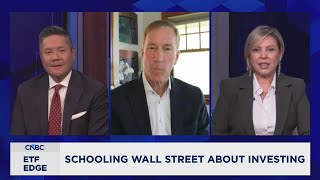
Joining me now is Adam Patty, the CEO of Vista Shares, alongside Shelley Antinewitz, the chief economist at the Investment Company Institute or ICI. Uh thank you Adam and Shelley for being here with us right now. Uh maybe Adam, I'll I'll start with you given that you are the fund operator in this discussion right now.
Your company has been tracking some of the kind of bigger investing type names, one in particular over the course of the last several months, and now you're about ready to launch another fund tracking another notable hedge fund manager. Take us through what you're launching this coming week. Well, thanks for having me.
Yeah, tomorrow we are launching ACKY and the strategy is to invest like Bill Aman but with 15% target income annually paid monthly. So we look to pay out 1.25% per month using an option strategy uh over all of the holdings in the portfolio and the the strategy mirrors exactly what we did with OMAH back in March which is invest like Buffett but with the 15% annual income.
So that fund has been very successful of driving almost 500 million in six months. Um we're getting great feedback. Performance has been strong. So um you know looking to replicate that success and bring out unique strategies that help investors diversify their core equity portfolios. Now Adam, it is not to take anything away from Bill Aman, but Bill Aman maybe hasn't been around or a household name as much as Warren Buffett and Bergkshire Hathaway have over the last several decades.
So, as you launched OMH, which tracks the Birkshire portfolio with your income enhancements, what exactly led you to Bill Aman to follow up as a second act to your Berkshire tracking fund? Yeah, I mean, look, there's only one Warren Buffett, so you've got you're one and done if you're trying to find another Warren Buffett.
However, um you know, look, there are a slew of investors out there that have tremendous track records, who are absolutely brilliant, um who have a lot of respect, and certainly Bill Aman is right at the top of that list. So, what we did is we went back into the lab and we looked at a whole host of different types of managers, and we tried to identify those managers that tend to have high conviction picks and hold their securities in their portfolio for a long period of time.
So, that really closed down the loop, right? So, a lot of managers are out there doing a lot of trading on daily basis um or they're hedging out certain exposures on their long positions. We were looking for high conviction managers. Um and certainly Bill Aman is the best of the best when it comes to that.
And um we settled on on working on his portfolio, doing the research, and then determining if we could in fact pull off a covered call strategy on his holdings, which after looking at many years of re of his portfolio, we determined yes, we can. and uh we're bringing ACKY out tomorrow. All right. So, Shelley, that now I I'll turn to you as you look at things from kind of like that high perch from the investment company institute, which is the trade organization of course that represents many mutual fund and ETF managers out there.
We've talked a lot about the evolution from passive, you know, ETF type products, indexing type products into this more active stock picking type space. just how quickly is that product growing? The the kind of tracking star managers type product and maybe perhaps just active ETFs at large. Active ETFs have really taken off.
You know, I mean, they're going to be a big topic here at our inaugural ETF conference, as you can see the sign behind me. Um, so I'm beaming in from Nashville. And active ETFs right now are $1.1 trillion dollars. And there is hundreds of billions of dollars a year that have been coming into organic growth into active ETFs.
Active ETFs cover a range just a whole range of strategies. Many of them are focused on cuttingedge technology. So you have ETFs that are looking at AI. They're also looking at um uh they're also looking at uh um cyber security. Um but you know, if we want to go back over to highincome ETFs, highincome ETFs are super popular as well.
And we've got an aging demographic here in the US. the baby boomers are solidly in retirement and they're looking for these types of income streams um that Adam was talking about. And so high income ETFs are great because they can help because of this steady income stream. They can reduce the overall volatility in the portfolio.
Um they typically use dividend paying stocks, high yield bonds and as Adam mentioned these option strategies to also add income to the portfolio. Um if you just look at the dividend paying uh high high income dividend paying ETFs, there's over $350 billion in assets and those got 20 billion in inflows in early September.
So there is strong demand for the product. Shelley, what exactly I you mentioned some of the demographic tailwinds driving some of these income producing type strategies. I wonder if you could also take us through a little bit about just how you see some of these types of income overlay on equity portfolio strategies.
What type of role they play in an investor portfolio as they approach a time where income becomes more of a priority. where do they fit Visa v say a high yield bond fund or an investment grade bond fund or a treasury type fund I think that um the high income strategies where they're looking at um or they have uh stocks in the portfolio dividend paying stocks and the overlay of the option strategy that actually helps provide a bit of a diversification.
It also allows with the exposure to the equities, it also allows um some of these funds to have some upside risk. Now, if you're using a covered call strategy, some of that will be mitigated. That upside would be mitigated, but you have to remember that the portfolio is receiving premiums from writing those covered calls and that is helpful for investors looking for income.
Adam, the covered call aspect of a portfolio. In essence, it means that you're selling options, call options at outofthe money levels above the current market for the portfolio overall, generally speaking, and then using those option premiums to enhance the returns and then pay them out. My question to you is we have been living in a very low relative volatility regime for months, quarters if not years at this point.
Maybe an exception can be made for the the Trump tariff announcements that came out in April kind of through the early part of May. There was volatility there. But in a world where volatility is not as ex existent as it has been over the last several years, what exactly does that do to the type of options writing that you have to do to generate the returns that you were targeting?
It's a great question and that's why you need to do the research. So um you know as volatility goes down it certainly gets more difficult to generate those premiums. But the key for us is well first of all it's the research looking back in history at different volatility regimes to in to ensure that in fact we can make our numbers but I think what's important to understand is that we're not waking up in the morning and trying to maximize our income right we are trying to hit 1.25% 25% per month, which is a modest amount actually.
Um, you know, we're not, if we generate more than 1.25% per month, we're going to roll it back into the NAV. And in fact, if our underlying holdings generate dividends, that's being rolled back into the NAV as well. So, you know, we are, you know, we don't want to maximize the income. We want to be stable and consistent to hit that 15% on an annual basis.
And um you know our research indicates we can do that in in any type of uh volatility regime. We also have the ability to use different option strategies, not just covered call strategies. So if things really tighten up, we can switch around the strategy. We can even use index options if we need to.
Um but for now, I think we're we're all set with our covered call strategy that covers the entire portfolios. Okay, Adam, it was Bergkshire to start and Warren Buffett. It is now going to starting tomorrow and this week going forward be Bill Aman and Persian Square. What exactly has been the demand profile that you've been evaluating from the investors that you are in essence polling to see the types of products that you were bringing to market and what types of managers you you mentioned the idea of having uh concentrated picks you know kind of best idea stock pickers out there but as we look down the line can we expect more funds in your mind to come out that are tracking kind of like these star type managers?
Yeah, I mean when we filed for this product ACKY, uh we filed for a slew of other ones as well based on our research. Um so if this does well, we can certainly bring out others. This is not everything we do, but we think it's an important piece of it and um you know, we're just going to make sure that whatever we do bring out uh we underpromise and overd deliver and um you know has a you know high quality portfolio and um is designed properly for different market conditions.
So, you know, we uh we hope this is the second of a family of similar products that we could bring out in the future. Shelley, this is the latest evolution in this kind of uh progression in the ETF business over the last couple of two or three decades at this point from almost being focused exclusively on passive or index type tracking instruments to now seeing a boom in the number of these active managed ETFs.
What exactly has been the primary driver in your mind of that kind of dramatic shift that we're seeing from index passive type investing that appeal to the masses like a fire and forget type strategy if you will to now what having one where investors are maybe even actively seeking outperformance above and beyond an index return.
Well, we're seeing a lot more financial advisors use active ETFs in their model portfolios. Um, recent data shows that about onethird of financial advisors are using an active ETF in their model portfolios when they're managing their retail clients assets. Also, you've got the investors, the sort of do-it-yourself in ETF investors, and they are also flocking to active ETFs.
um they latest data shows that uh there's about a hundred billion dollars of direct investment by retail investors in active ETFs. So you know there is this appeal also um ETSs uh they have broad appeal across sort of the age range. About half of ETF retail owners are between the ages of 35 and 64 but a quarter of them are under 35.
And a lot of these investors are attracted to more of these innovative ETFs and these thematic ETFs as I was saying before you know the cutting edge tech the cyber security crypto they're looking for those exposures. Okay. Now Adam a final question to you uh before I get to Shel with her final question.
My final question to you is as you look out for the balance of this year, given what you've seen in terms of your investor flows, given what you've seen in terms of interest in your funds, given what you've seen in the portfolio dynamics of your underlying products, what do you best guess could be the outcome that we have going into the fourth quarter of this year and the first quarter of next?
Is this a bull market that can keep continuing or are there real storm clouds on the horizon in your mind? Gosh, I mean, putting aside the geopolitical risks that we're dealing with daily, um the big trigger, I think, is interest rates and where that goes over the next few months. Um hopefully, you know, for sake of the market, I'm hoping for a drop in rates.
But I think the biggest challenge that investors are going to have regardless of where the market goes is the fact that the S&P 500 and the Q's are so overconentrated in their top 10 holdings and that the um the exposure they're providing has tremendous overlap. So I think it's 35% of the S&P 500 and 45% of the Q's are basically in the same companies.
So all these investors who think they're diversified, what they are going to find, god, god forbid there's a a large pullback, is that these mega cap tech companies are going to hurt their portfolios. So I think what we're seeing now and what I would encourage investors to do is to diversify. Um, you know, depending regardless of whether the market's going up or down, you need to diversify and you need to diversify in your core equity as well because the main indexes are not diversified anymore because they've had a historic runup in the mega cap tech companies.
And that's why comp products like ours and others that are more value tilted or quality tilted are starting to get more traction because investors are looking to, you know, get into different types of equities that they don't have as much exposure to and get ready for a pull a downturn. if in fact there is one.
All right. So, that's that side of the equation. Shelley, in addition to being the chief ETF researcher for the Investment Company Institute, you're also the chief economist. I I'm I'm going to ask you to put that economist hat on here. You watch the data. You've seen it come in. We've heard from many other economists and their views on what the economy could look like in the coming months for the US.
What exactly do you think is going to be the base case scenario for the US economy over the course of the next couple of quarters? over the next couple of quarters. I mean, certainly the employment report that came out on Friday was very disappointing and I think that has, you know, cinched the case for a rate cut in September by the FOMC.
So, we'll definitely see the funds rate, you know, a cut in the funds rate in September going forward depending upon what the labor market looks like. And then, you know, we're also going to at the end of this week get some inflation data. So that's going to be key to the Fed's decision as to whether to accelerate the path that they have for rate cuts going forward.
Um right now the market is pricing in three rate cuts and that's up from the two they had previously. I think that we'll see a slowdown in GDP. Um are we going to go into a recession? Maybe not. You know, the Fed is going to be very proactive on trying to support the labor market, but they do have the dual mandate and they are going to watch those inflation figures very closely.
And so, while they'll continue to cut rates after September, they may the pace of those rate cuts are going to depend on the inflation numbers. All right, a lot of data to ponder and think about for sure. Uh my thanks to both of you, Adam Patty and Shelley Antonyitz. Now, we've asked Shelley to stick around for the ETF Edge podcast.
You can catch that and all of our other content over at ETFedge.cnbc.com. Thanks for watching. We'll see you next week. Get the ABCs of ETFs with the ETF Edge newsletter. Your weekly update on the hottest trends, expert analysis, actionable ideas, and exclusive insight from top industry experts. Sign up now at cmdc.com/etfedge newsletter.



Comments 0