
원문 보기
I just want to come back to the incredible capital raise going on right now. I mean, what we're seeing, there's this story about them being unsatisfied and then Sam Alman comes back and says, "What are you talking about? We love Nvidia." Yeah. Um in a in a in a social media post. Um Well, I don't get where all this is coming from.
Right. We are in an extraordinary moment. I mean, obviously we we we talked already about XAI being sold to SpaceX for $250 billion dollar in SpaceX stock. And then the private markets again, OpenAI, I'm hearing they're trying to exceed a hundred billion. Will they be successful in doing so? I don't know.
Will Nvidia be a part of this fundraising round is a key question. Jim, I think they will. Okay. And uh I will ask Jensen. Okay. uh tonight tonight because I think he'll say yes since he's been very po you know we had him on last week I didn't think he was contradicting that no I think his answer uh last week to the question about open air was was can we say not completely clear
okay well so I'm looking forward to the clarity around but uh Soft Bank uh Amazon Nvidia potentially Microsoft my understanding is if they can get above 100 billion they will and by the way it will give them even more time before they need to or certainly need to go public. So, while we've heard these fourth quarter um uh pronouncements or at least reporting around a fourth quarter IPO from OpenAI and what a year this will be if we do get SpaceX and Open AAI, you know, there is an awful lot that has to happen.
You kind of have to lock down certain things in your capital structure, your balance sheet because otherwise you're, you know, to get audited financials and everything else not that easy. Uh and so we'll see. But uh my understanding is it's it's a heavy lift to get to a fourth quarter IPO. And if you can raise more than 100 billion, you give yourself certainly some room to stretch into 2027, which had been the original plan, if you recall, for the for potential IPO.
Well, what's amazing is that Nvidia and all these stories, all it does is go down. And Nvidia itself is not a loser in this situation. And yet, uh there is a sense that Nvidia is like Broadcom uh and like Marll. They're not a shortage. They only want them. The the shortage theory, which is Western Digital, which is Seagate and SanDisk, uh is is Pterodine last night is what matters.
And companies that do not have a shortage, their stocks are getting hit. Uh Pterodine, nice story today. One of the biggest S&P gainers. Testing measurement. Yeah, that's up 10% plus by Nvidia, which is down for a a second day. And there it is down almost 3 and a half%. That stock's about at the lows of the day.
Is there growing friction between Nvidia and OpenAI? Day after that report about the $100 billion that Jensen Wong said was never a commitment to OpenAI, now there's this new report that OpenAI is apparently dissatisfied with some of Nvidia's chips for inference workloads that they're reportedly looking for alternatives.
That's from Reuters today. So, it's two days in a row we're talking about these two companies which are so seemingly intertwined in the AI story and the arms race that it is that we needed to get our reporters back up because we need to know what's going on here. Christina Parts covers Nvidia as you know and she joins us now.
So, what do we make of this? I think it's important to point out Nvidia and OpenAI are involved in two separate deals and which is which is really creating a misconception about their actual partnership. The first deal that you mentioned up to $100 billion which was announced in September has to do with OpenAI actually building its own data centers.
If they build their own data centers, Nvidia will give $10 billion in each phase leading up to potentially hundred billion. This second deal with Nvidia and OpenAI has to just do with fundraising. My contact did confirm that Nvidia is involved with OpenAI's latest round of fundraising to a large amount.
I don't know the actual amount just yet, but we kind of got that vibe from Jensen Wong over the weekend in Taipei when he said that they're still going to invest in OpenAI and it might actually be the biggest investment ever. Now to your point about the Reuters article, you know, looking for alternatives.
OpenAI has been working with other companies. They've already been working with AMD, uh, Broadcom for custom chips, Cerebras as well. So, I don't necessarily think that's anything new and anything that the market should read as a negative for Nvidia because they're still heavily reliant on Nvidia. What stood out to me in that article was the relationship with OpenAI and Grock.
Open AI was supposedly in talks with startup Grock that makes these embedded chips that has embedded memory on these chips that supposedly, you know, answers uh chat queries much quicker than GPUs. Very recently in December, Nvidia swooped in and I shouldn't use the word acquired, but swooped in and took a non a licensing agreement with Grock to hire all of their staff and get the IP.
And so we essentially can assume that OpenAI and Grock are no longer in talk. So that just shows a defensive play on Nvidia's front. So I would say that was an interesting little tidbit from that article. But overall, both parties, Sam Alman, Jensen Wong, are saying they like each other. They're still in talks.
Uh it's just a matter of which deal we're talking about. So keep that in mind when having this discussion. Okay. Well, that's why we had you come talk to us because you you're able to put it into perspective for us and tell us what exactly we need to know. Christina, thank you for that. That's Christina Partzo.
So, as Christina just alluded to, uh Sam Alman weighed in on all of this last night in a social media post that we'll show it to you. Said the following. We love working with Nvidia and they make the best AI chips in the world. We hope to be a gigantic customer for a very long time. I don't get where all this insanity is coming from, which means Kate Rooney is going to cut through all of that for that part of the story.
What do you make of this? Scott, that's a pretty strong reaction from Sam Alman. You know, we had talked yesterday about sort of the behind the-scenes push back from OpenAI saying, you know, they didn't know where it was coming from. That relationship with Nvidia is still strong. Sam Alman is known to sort of respond to things like Elon Musk on Twitter.
I would say it's very rare for him to respond to a news article like this and he obviously it's hit hit a nerve with OpenAI. I would say based on the altman tweet and based on Sachin Kotti who's the head of compute over there he points out our entire compute fleet he says runs on Nvidia GPUs that's what I'm hearing it's 100% of their current fleet right now so Christina mentioned some of the existing partnerships that are sort of future ways to diversify openai is compute constrained they have talked about this endless demand you know you can debate sort of the fiscal responsibility of that and there was reporting about you know some of Jensen's push back on that I think there have been questions over are they spending too much?
Open eye would say absolutely not because it translates into revenue. The CFO Sarah Frier has really tried to make that point. Their point here is Nvidia is king. You know, we need to work with Nvidia. We like Nvidia. We don't have a problem with their chips. If anything, we need more of them. Plus, we need these other relationships with AMD, Cerebrris, the list goes on.
You they got Amazon as well. So, they've tried to diversify. I thought that was a good point by Christina that some of that is out there. We know that they've tried to look elsewhere. I think they have really tried to push back on any reporting that anything is on ice. That deal 100 up to hundred billion dollars in tanches.
That was I think over the last few days we've seen sort of some cracks in that. You know, is it 100% guaranteed? Is it going to happen this year? That's the one of the big questions. I would say the the show of confidence from Nvidia is that fund raise. Is there current participation in the equity round?
I'm told from Nvidia side, you know, not necessarily from them, but from sources who are familiar with the deal and who have I've talked to about Amazon's participation, too. You know, term sheets have not been signed. I'm told that number could be up to $20 billion. So, a lot of this is fluid, but clearly they are aligned.
You know, they're strategically dependent on each other, especially Open Eye and Nvidia. They do not want any perception out there that they have issues with Nvidia. That would cause a major problem for Open Eye. Welcome back. We have more on that developing story we hit a little bit earlier in the show and on a couple of fronts that um the future of that large Nvidia investment into open AI that that was part one part two was that Reuters story from today that OpenAI was reportedly dissatisfied it's the word that was used in this story with some of Nvidia's chips.
Um, Sam Alman had responded to that on social media as we read you earlier. I also told you that Jim Kramer was interviewing Jensen Wong in an exclusive interview and you're going to see that tonight on Mad Money. However, we do have some sound from it that is just in and he responds to this drama. Is there drama?
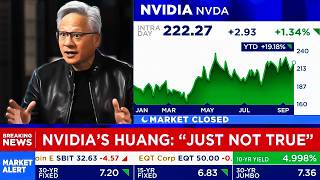
Here's Jensen at all. It's complete nonsense. We love working with OpenAI. We are incredibly honored and delighted to be able to invest in their next round. And so they we're we're uh privileged that they're inviting us to invest uh for each one of their rounds. We would love to be invited and we would consider of course investing in it.
This is one one of the most consequential technology companies in history. Okay. There's there's no controversy at all. I'm not sure if you if you caught the very very top of that or not, but that's what Jensen Wong sai. An interview of Jensen Hong is scheduled to air this evening. I'll try to post another video later tonight and share what we learned from Jensen in the interview.
So, be on the lookout for that. In case you missed the two videos I posted overnight, OpenAI's Altman posted on X yesterday essentially refuting the Reuters article that was published on Monday. Altman posted, quote, "We love working with Nvidia and they make the best AI chips in the world. We hope to be a gigantic customer for a very long time.
I don't get where all this insanity is coming from." This was after Reuters published an article claiming that OpenAI is looking for alternatives to Nvidia chips for inference. Today, Nvidia systems are the best on the market for inference. I'm glad that Jensen is doing an interview today and hopefully will help clear up all the confusion from this past weekend.
I explained in detail what's going on in all three of the videos I posted yesterday, so feel free to check those out if you want the full story. But to keep things short, Jensen spoke with reporters in Taipei over the weekend on many topics. Two of the topics that were discussed were Nvidia participating in OpenAI's current funding round and also the $100 billion partnership between Nvidia and OpenAI that was announced back in September.
As I said yesterday, these are two completely separate topics. Unfortunately, many media publications conflated Jensen's comments about one topic as being him talking about the other topic and vice versa, leading to a lot of confusion. Put simply, Jensen said that Nvidia will invest a large sum of money in Open AI, but nowhere near $100 billion.
He said that while specifically talking about OpenAI's current funding round, which is completely separate from the $100 billion partnership that was announced back in September, and on the topic of the $100 billion partnership, Jensen told reporters that it was never a commitment. That is correct, and it is not a change from what was announced back in September.
If you go back to the press release from September, you will notice a few things. First, the first phase of the partnership doesn't even start until the second half of 2026. Secondly, Nvidia said they intend to invest up to $100 billion in Open AI. The key phrase is up to maybe it will be 100 billion, maybe 70 billion, maybe 80 billion.
That remains to be seen. And what determines how much money Nvidia will invest in Open AI under the partnership? It depends on how many gigawatts of Nvidia systems that Open AAI deploys. Nvidia told us in September that they intend to invest $10 billion in Open AI with each gigawatt of Nvidia systems that gets deployed.
But here's the thing. The first gigawatt of Vero Rubin Systems under this partnership doesn't even come online until the second half of 2026. And at this current moment in time, Jensen cannot tell us the specific amount of money that Nvidia will ultimately invest in OpenAI under the partnership because that amount is dependent upon how many gigawatts of Nvidia systems that OpenAI will deploy.
Jensen doesn't yet know how many gigawatts will be deployed. That's up to Open AI. Therefore, Jensen cannot yet tell us a definitive number of how much Nvidia will invest in OpenAI under the partnership. Now, going back to the current funding round, we should soon learn how much Nvidia will invest in OpenAI's current funding round.
and that is completely separate from the $100 billion partnership that was announced back in September. Many news outlets have conflated the two topics, mistaking Jensen's comments about one topic as being his comments about the other. This has caused a lot of confusion. Looking ahead, we have Alphabet earnings on February 4th and Amazon earnings on February 5th.
What these companies say about capex guidance, supply constraints, and their overall 'm expecting Alphabet to have strong capex guidance given all the recent success of Gemini. And that's a positive for Nvidia. Even though Gemini 3 was trained on Google's TPUs, Google is also a large buyer of Nvidia's newest systems because they offer that capacity to their cloud customers.
On Alphabet's last earnings, call company leadership told us that they expected to remain in a tight demand supply environment in Q4 and 2026. Leadership told us they are seeing substantial demand for both TPU and GPU based solutions and they are investing to meet that demand. Alphabet told us they expected full year 2025 capex to be in the range of 91 to $93 billion.
They also told us that they expect a significant increase in capex in 2026. I'm also expecting strong capex guidance from Amazon given AWS executives commenting about bringing online multiple gawatts of capacity in 2026. On Amazon's last earnings call, we learned that year-to- date capex was $89.9 billion and they expected full year 2025 capex to be $125 billion.
That implies a guide of $35.1 billion in capex for Q4. Last earning season, Amazon leadership told us they were adding capacity aggressively, monetizing capacity as fast as it comes online, and seeing demand absorb new capacity immediately. Let's see if we get similar commentary on this earnings call.
Overall, I'm expecting both Alphabet and Amazon's earnings calls to reinforce that AI demand is very strong and both companies will invest to meet that demand. We also have iron earnings on February 5th. in these videos 've seen in a while. And that is the perspective from which I talk about the company.
This is not hype. forecasts in a meaningful way. But I'm not expecting any meaningful change in Iron's AI cloud revenue to show up on this specific earnings report. That's something to look forward to in future quarters. As for this specific earnings report, I'll be looking for progress updates on Iron's data center buildout, the transition of their existing data centers from Bitcoin mining to AI cloud.
and I'll be on the lookout for any updates to AI cloud revenue forecasts or any changes to timelines. As a reminder, we're expecting 23,000 GPUs to be operational by the end of Q1 2026. Then we're expecting the Horizon 1 through four data centers at Iron's children site to come online throughout the year as part of Iron's 9.7 billion deal with Microsoft.
And then we're expecting another 40,000 GPUs to come online in two of Iron's British Columbia data centers by the end of 2026. Putting all of that together, Iron is projecting that they will reach an AI cloud ARR of $3.4 billion by the end of 2026. That implies roughly $850 million in quarterly AI cloud revenue starting in Q1 of calendar 2027.
That's more than 3.5x Iron's total quarterly revenue on their most recent earnings report. Iron is an Nvidia preferred partner, which means they should have access to the newest Nvidia systems early cycle. Iron has nearly 3 gawatt of secured renewable power. Iron is vertically integrated which means that they build, own and operate the data centers themselves.
They're not simply a middleman in between the owners of the data centers and the end customers like many Neoclouds are. This allows iron to better control costs, capture greater margin across the entire vertically integrated stack, and it substantially reduces the risk of iron missing a deadline. Iron has a track record of delivering on what they promise.
And as long as the world is both compute constrained and constrained on power, Iron will most likely sell whatever capacity they can bring online. ignore the noise, both the irrational hype and the unreasonable pessimism and . As for timing, Q2 of calendar 2026 is likely the first quarter we will start to see a notable jump in Iron's AI cloud revenue, but for now, we need to be patient.
There will also be pullbacks in the stock along the way, and we need to be prepared for those. I'm bullish on Iron this year and likely will be for most of 2027 as well. I'll update my thoughts on Iron as time goes on and we gradually gain greater visibility into the future. then we have Nvidia GTC March 16th through the 19th with a keynote from Jensen Huang scheduled for March 16th.
I am very much looking forward to GTC this year. As for Nvidia earnings, I'm expecting strong results given the swift production ramp of Blackwell Ultra. We also , which bodess well for guidance. And we know that Vera Rubin is in full production right now, which bodess well for what will happen in the short term.
That said, s I said in yesterday's videos, Nvidia continues to deliver very strong earnings growth. Nvidia's multiple has compressed substantially and therefore i. It really is that simple. Nvidia is trading at a forward PE in the low 20s. That's basically a market multiple and . I think the recent lackluster price action in Nvidia stock is a temporary dislocation that will eventually be resolved.
We've seen this happen multiple times in the past. The stock consolidates. Nvidia continues delivering strong earnings growth. Market participants finally realize that the stock is simply too cheap given the growth that's ahead and the stock ultimately moves higher. It really is that simple. . Of course, I expect .
I also don't think that most analysts are adequately factoring in growth from some of Nvidia's other business segments into their long-term estimates, especially physical AI.



댓글 0