원문 보기
In my last video, I talked about Michael Bury's billion dollar bet against Nvidia and Palantir. I failed to mention that he is not the only famous financier who speaks about this. And when you find out who else is saying this, his prognosis seems much more serious. So, for a quick review: Michael Bury opened billion-dollar positions against Nvidia and Palantir, essentially betting on the collapse of artificial intelligence.
He then closed his funds so they couldn't be tracked, and his main argument is that a significant portion of AI spending is companies funding each other in a circular fashion without any real external demand, which is called cyclical funding. And it turns out he's not the only serious financial expert who thinks so.
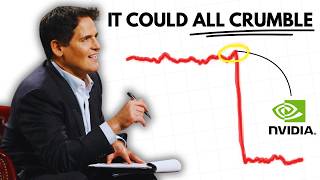
You'll never guess who supports him. Mark Cuban. Yes, that's Mark Cuban. In late July, he wrote: "This is very similar to the dot-com crash, but instead of an IPO, Nvidia itself acts as a source of funding for everyone and everyone." That's what he meant. In the dot-com era, any Internet company could go public and make a lot of money, regardless of whether its business actually worked.
All you had to do was add " dot com" to the name. Cuban was a prime example of this, selling broadcast.com to Yahoo in 1999 for $5.7 billion . So, in the late 90s, the IPO market itself pumped money into these unproven companies. Cuban says Nvidia is playing that role today . Instead of Wall Street handing out money through IPOs, Nvidia itself provides funding, revenue guarantees, and investment deals to virtually anyone building AI infrastructure.
And he warns of what will happen if this system breaks down. One breakthrough by another chipmaker or one misstep—and everything will start to fall apart. Too much power is concentrated in one company. But is there anything real behind this, other than the social media posts of two grown men ? Yes, of course.
Nvidia ended the last quarter with $42.3 billion in private investment plus commitments for another $27 billion. And just look where that money goes. For example, one direction is CoreWeave, a company backed by Nvidia. Last quarter, CoreWeave generated $2.1 billion in revenue but spent $6.8 billion on data center expansion.
Nebius, another company, earned 399 million and spent 2.5 billion . These companies spend three to six times more than they earn, and this is largely financed by the company that sells them the chips. This is not a theory, it is clearly stated in the documents. On July 27, just a few weeks ago, Nvidia shares fell about 5% in a single day on these concerns, losing about $250 billion in market value in a single trading day.
On top of that, you also need to understand that these issues are not just two billionaires talking about them. For example, Seaport Research analyst Jay Goldberg presented a different perspective on the matter. He used history to show the problems we see today, drawing parallels with Lucent Technologies and its behavior during the dot-com bubble.
In the late 90s, Lucent wasn't just selling telecommunications equipment, it was lending billions to startups that were buying it. The biggest example was a $2 billion financing deal with Winstar Communications, which Lucent called a long-term strategic relationship. When Winstar could not cope with the payments, Lucent terminated the cooperation, and within a few weeks Winstar went bankrupt, owing Lucent about $800 million , which was never repaid.
And it wasn't just Winstar. Across the industry as a whole, during the dot-com boom, about four dozen telecommunications startups went bankrupt over a period of several years, all of them financed by the same lending from suppliers, and all of them collapsed when that money ran out. Lucent itself never recovered.
Its revenue fell by 70%, and it was eventually absorbed by a competitor. Many analysts compare Nvidia to Lucent and the events that unfolded almost 30 years ago. Admittedly, Nvidia is a much stronger and more profitable company than Lucent ever was, but the basic idea—when a chip or hardware manufacturer finances the ability of its own customers to buy its own products—is essentially the same scheme .
There are many proponents on both sides of the debate, but Burry and others like him take it to a new level. In one of Michael's recent posts, made the same week the market hit another record high, he wrote: "I continue to believe we may be close to a peak and a potential 1987-like crash ." By 1987, he means "Black Monday," which occurred on October 19, 1987 .
This is the opening scene from The Wolf of Wall Street, when the Dow lost 23% of its value in a single trading day. Not in months, but in one day . This is the record for the worst one-day drop in the index's history, and Burry's logic is based to some extent on this event. He argues that rising markets with low volatility are actually forcing certain funds to increase risk as the situation appears calm.
So, the quieter and higher the indicators rise, the more unstable the entire structure beneath them becomes. And in a way, it's worth giving Burry credit. He doesn't hide from what's really happening. In the same post, Buey admitted that every one of his short bets at the time had been profitable, except for the bet against Nvidia.
He has stated outright that he will walk away from any deal that goes against him, emphasizing that shorting is not for everyone. I have to play for relegation, others better not do that . The next serious test is coming very soon: Nvidia is due to report earnings on August 26, and right now all analysts are still recommending buying these stocks.
So, what does this bring us to? This isn't just one billionaire sounding the alarm, and here's the part that directly affects you, especially if you've ever bought shares in Palantir or Nvidia. Nvidia, Apple, Microsoft, Amazon, Google, Meta, and Tesla now make up about a third of the entire S&P 500 index.
Nvidia alone is actually larger than Meta and Tesla combined. So if you have a retirement account, if you own a share of an S&P 500 index fund , even if your account is invested in the safe, boring, and diversified way everyone advises, a huge chunk of it quietly depends on whether this tiny group of companies remains successful.
This is the fear that Bewey was talking about: " If these data centers don't make a profit, we'll have pension funds and insurance premiums that can't be paid." So, in summary, this is not a story about a few billionaires betting against each other. This is a story about what lies at the heart of many ordinary people's retirement accounts, whether they know it or not.
And here's what will actually happen if things go wrong. Let's go back to the Lucent story we mentioned earlier. This was not the decline of one company, but the collapse of several dozen telecom startups in a short period of time, as soon as the financial tap that kept them afloat was turned off. This is the main risk of circular financing.
It's not that one company fails quietly, it's that the entire network that supports each other burns down at one point. Even if one large part of the Nvidia, OpenAI, Oracle, CoreWeave structure were to seriously stumble, the concerns are not just about share prices, but also whether the same funding that holds the entire rest of the network together will hold up.
But we also have to be fair to the other side of this story. And Nvidia's actual profits continued to exceed expectations all this time. The semiconductor sector has grown by 50% this year, despite all these caveats. It's worth remembering that every truly transformative technology in history seemed overrated and overhyped while it was developing.
Railroads in the 1800s, electricity, or the early internet—this is exactly the bubble to which Kuban compares the current situation. Some of those bubbles burst with a bang, but they left behind infrastructure that the world has enjoyed for decades. So, the main dilemma now is whether this is a bubble about to burst, or whether this is simply a difficult stage in the development of a truly transformative technology.
So where does this leave us? It's not just one billionaire talking about this. It's Barry, Mark Cuban, and even Wall Street analysts, plus two global financial institutions—all of them pointing to similar concerns. The vast sums behind this bubble are circulating among the same small group of companies.
Whether this is a real bubble or just the beginning of a new industry is an open question, and Nvidia's quarterly report on the 26th could be the first real test. I'll be covering this as soon as the report is out, so please like and subscribe to the channel if you want to see how things develop. Oh, and one more thing .
During the last video, I noticed that over 85% of the viewers were not subscribed. If you are among them, please take a moment and click the subscribe button.




댓글 0