저자: VijayKedia · 외국인
요약 보기
Vijay Kedia의 투자 철학을 소개. 지식·용기·인내 3원칙과 SMILE(Small, Medium 경험, Large 포부, Extra large 시장, 정직한 경영진) 프레임워크 설명. Cera Sanitary Ware 사례(2004~2008 및 이후 약 16,800배 수익) 언급. 트레이딩은 도박, 투자는 사업으로 봐야 한다는 관점. 종목 매도는 스토리 변화 또는 과도한 밸류에이션(Atul Auto PE 45) 때 판단. 특정 종목 가격 방향 예측 발언 없음.
다듬은 글
Hi Friends, This is Manthan Thapa from Triple A Easy Trading and Investing with Manthan Thapa. So today we are mastering the market with Mr. BJ Kedia Investing Wisdom. Today we are going to discover the journey of great investor BJ Kedia from his early struggle to mastering the stock market. Learning has exclusive smile for framework for identifying multibaggers.
The Critical Role of Courage and Patience and Why Treating Investing as a Marathon is Essential for Long-Term Wealth Creation. So let's start. So today we are going to talk about a legendary investor whose philosophy has inspired countless people. Vijay Keria is a name that knows the art of converting small investments into huge wealth.
Let us understand this method of his closely. See, before any strategy, this one line of Vijay Kedia lays the foundation of his entire thinking. For them, the stock market is not a battlefield where victory is achieved through aggression. No, not at all. This is a place where humility and respect for the market are paramount.
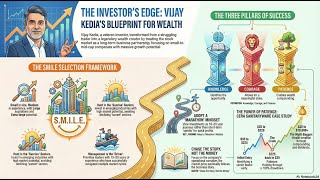
So let us further understand Kedia's investment knowledge in these five parts. We will unravel the layers of his philosophy one by one. First and foremost, before selecting any stock or doing any analysis, KDIA believes that an investor needs to build his mindset on three strong pillars. This is the foundation on which the building of long-term success rests.
So these are the three pillars: knowledge, courage and patience. See, knowledge will help you find the right company. Patience will give you the strength to last longer. But according to Kedia, the thing that is most important and the most difficult to master is courage. Not just the courage to survive when the market is falling, but also the courage to invest a significant amount of money by trusting your analysis.
And Vijay Kedia explains this very thing with a very powerful example. He says courage is like swimming. No matter how many books you read, you cannot learn to swim unless you get into the water. The meaning is clear that theory and knowledge are useless unless one has the courage to put it into practice and face the ups and downs of the market.
So now that's enough theory. Let us now see how this philosophy works in the real world and for this there can be no better case study than the case of Cera Sanitary Ware which was a true test of Kedia's belief. Just try to experience this journey. Invested in 20045 and 4 years later in the recession of 2008 the stock came back to the same price.
4 years of waiting and no result. Then, as the stock gained momentum, it fell to almost half its 2017 peak. To survive in such a situation is the test of true courage. So what was the result of that patience and courage ? An incredible return that is mind-blowing to think about. Returns of approximately 16,800 times after suggesting bonuses.
This is the multibagger that gave a new identity to his career. But wait, the story does not end here. The increase in the share price is there. On top of that, the dividends earned over the years alone have returned five times their initial investment. Just think, whatever holding he had, in a way, became free.
So now that we understand their mindset, the question arises: how do they find such companies ? This is where his famous smile framework comes in. A very simple yet equally powerful toolkit. Let us understand this one by one. S means small in size , because small companies have a lot of scope for growth.
M means medium in experience. This means that the management must have seen at least one or two recessions. I means honesty of management which is most important for the insect. L means big aspirations. Because if the management itself does not think big then how will the company become big? And finally, E means Extra Large Market Potential so that the growth of the company never stops.
And all this brings us to the most fundamental principle of Vijay Kedia's philosophy. That is, the results are exactly the same depending on how one looks at the market. See, only two types of mentality work in the market. On one side is the business mindset that focuses on management and long-term growth, and on the other side is the millennial mindset that chases tips and daily prices.
Kedia's argument is quite clear. If the market is treated like a casino, then in the end it is the house i.e. the casino that wins. And KDI says this very clearly. Meaning, as is the perspective, so is the result. If you consider it a serious business then you will get business-like returns. And if we consider it just a game or a gamble then the results will be the same.
So what is the final and biggest lesson for all of us from a brilliant career like Kedia? That is, this journey never ends. Often we hear and read success stories. But Calia insists that real and deep learning comes from stories of failure. Which also includes their own mistakes. Like losing money in a delisted company.
It is these failures that teach us what not to do, and this last point is the essence of his entire philosophy. Success is not a destination. He always considers himself a work in progress. A person who is constantly learning, making mistakes, recovering from them and just moving forward. This humility keeps him grounded.
So we will end today's conversation with this one question. A question every investor should ask themselves. Do they have the courage to build wealth or just a desire to get rich quick ? Please think about this. So today we are going to talk about an investor whose name is taken with great respect in the stock market.
Vijay Kedia. His journey has also been very interesting. Started by trading in Kolkata Stock Exchange where instead of making money, he lost it. But after about 10 years he took a big decision. He said goodbye to trading and focused completely on investing and today we will try to understand what is his secret sauce?
What is that thinking? What is the strategy that helped him identify many multibagger stocks like Cera Sanitary Ware and Atul Auto. If we see, his entire philosophy actually stands on three pillars. Knowledge, courage and patience. Ok? So let us understand these pillars one by one. Let's start with the first and most important pillar, knowledge, which means thousands of companies are listed.
After all, how do they find the right company ? This is the biggest question. This is where his very famous formula comes in handy, which he calls SMILE. Good. SMILE is an acronym and each letter of it tells about a quality which they look for first in any company. Smile sounds very positive. Let's decode it.
So start with S. Yes. S means small in size. They choose companies that are small in their sector. Yes. But it is very important to clarify one thing here. We do n't mean penny stocks at all. Good. This means those companies which have small market cap but have full potential to become leaders in their sector in future.
Like us, when they chose Cera Sanitary Ware or Atul Auto, they were very small companies in their respective sectors. Small end size sounds good. Meaning there is a lot of room for growth. But in smaller companies, the risk is equally high. How can we, as ordinary investors, determine whether this small company will become the future Sera or sink?
This is a very good question and this is where the second letter of SMILE, M, i.e. Medium and Experience, comes into play. He says that even if the company is small, its management or promoter must have at least 15 to 20 years of experience in his field. We argue that such management has seen many business cycles.
He knows how to sail through many ups and downs and difficult situations. Any new management will probably be caught in the storm already. Meaning, the company is small but experienced in running it. It became a kind of safety net. Ok? S and M understood. Now let's come to L. L is large in aspiration.
That means the promoter should have a big thinking. He should have the hunger to take his company from a local player to the national and then global stage. But this is not a subjective thing. Any promoter will say in an interview that his thinking is very big. He wants to conquer the world. How does Kedia ji actually test this?
Do they track the promoter's past actions? Absolutely. It is based not just on what is said but on what is done. Has management set and achieved difficult targets in the past? Do they constantly talk about expansion and entering new markets and follow through ? This is clearly visible from his annual reports, his interviews and his actions.
And finally comes E, which is perhaps the most important, Extra Large Market Potential. Meaning the size of that industry should be very big. Much bigger. He has a very famous saying. I hunt fish in the sea, not crocodiles in the pond. Meaning if the company is good, the management is good. But the industry it is in is small, so the company will not be able to grow beyond a certain limit.
They choose sectors where demand is likely to persist for years. And his emphasis on management is so much that he says there are three rules of success. Management, management and management. He gave a very good example whether the car is Mercedes or Alto. If the driver is good, he will definitely take you to your destination safely.
But if the driver is drunk, then an accident is certain to happen even in Mercedes. perfect. And with this thought in mind, he always bets on sunrise sectors i.e. sectors that will grow rapidly in the future and stays away from sunset sectors. And another interesting thing that surprises many people is that if they can clearly see the growth story of the company and the size of the market, then they do not pay much attention to things like PE ratio in the initial stages.
This is completely opposite to traditional investment thinking. All the gurus of value investing teach that buy cheap, PE should be low. Doesn't this mean that you are taking the risk of buying the stock at any price? There must be some upper price for this. He argues that the PE of a fast-growing small company will always appear higher.
Because the market is pricing future growth today. If you invest only by looking at low PE, you will never be able to become a part of India's biggest growth stories. Yes, their emphasis is on whether the growth is coming with profits or not and most importantly the debt on the company should be minimal.
Debt is a huge red flag for them. Ok? So by following the Smile formula and looking at the quality of management, we found a good company. But I think 90% of people stop there. Knowing a good company is one thing and having the courage to invest a large part of your savings in it is quite another. This is perhaps where his other pillar, courage, comes into play.
Isn't it? You got it absolutely right. He says that knowledge is most important. But courage without knowledge is a double-edged sword that can cut your own throat. But after knowledge, courage is what differentiates an average investor from a great investor. What does it mean? Please explain a little more.
This means batting with conviction. Just finding a good company is not enough. It is equally important to invest a reasonable amount in it as per your capacity. Many people later say that hey I bought MRF shares for ₹100. But if I ask how many shares were taken? So the answer comes 10 shares. Even if it increases 500 times, it still doesn't change your life.
Vijay Kedia believes that when you find a diamond, you should pick it up in a larger quantity. He told a story to explain its importance. A huge machine broke down which the top engineers of the city were unable to repair. Then a village mechanic came and just hit a hammer at the right place and the machine started working.
When it came to paying the bill, he made the bill for ₹10,000. The factory owner said, ₹10,000 for one hammer blow? The mechanic replied, it costs only ₹1 to hit with a hammer. ₹9,999 is where the hammering is. And it's a wonderful story and that's the essence of courage. Knowledge tells you where to strike the hammer.
But courage gives you the strength to swing that hammer with full force. The real difficulty comes when you have to invest 15 or 20% of your hard-earned money in a single stock. This is called concentrated batting. This is very difficult psychologically because if that one bet goes wrong, the loss is huge.
But big returns are also made from such bold decisions. And then comes the third and perhaps the most difficult pillar in today's age of instant noodles: patience. He says that he buys any stock for eternity as long as its story remains intact. This sounds very easy but is the most difficult to do. The best example of this is their case study of Cera Sanitary Ware.
He bought the shares around 2004-5 for around ₹35. In the massive rally of 2008, the stock went up to ₹225. His money had increased 6-7 times in just a few years. There will be a festive atmosphere at that time. Absolutely. But then came the global recession of 2008 and the stock came back to ₹35. Imagine all their profits that were visible on paper vanished overnight.
They came back to their purchase price. At that time anyone's heart would be shaken. 99% of the people will sell their assets in panic so that they can at least save their capital. And that's the difference. He did not sell the shares. Why? Because he had full faith in India's housing story, the company's management and its product.
He knew that the recession is there today, but will not be there tomorrow. But people won't stop building houses and bathrooms. He finally sold his last share after 18 years and by then, that one investment had given a return of more than 16,000 times, including dividends and bonus shares. Wait a minute, this number is hard to digest.
₹16,000 times. Meaning, if someone had invested just ₹10,000, it would have become ₹16 crore. How is this possible? Just by being patient? Just by being patient and sticking to the right story. Another example of his regarding patience is very interesting. He says that if you are on a 2-hour flight from Kolkata to Mumbai, then after just 1 hour you start feeling anxious about when you will reach.
But if you are on a 14-hour flight to Canada, your discomfort will start after 12 hours. Wow, that means your destination determines your patience. Exactly, if your goal is big then you will not be afraid of small fluctuations i.e. air turbulence. That's why he does n't even try to time the market. His argument is that if the train reaches its destination 15 minutes earlier, will you get down at the middle station?
No. Because you have to reach your destination and not race with the train timetable. Ok? So now a very important question arises. If they don't set any price or time targets, when do they actually sell? If a stock is bought indefinitely, what is the exit point? For this she gives a very beautiful example from Ramayana.
Vibhishana left Ravana's golden Lanka when he saw that Ravana's focus had changed. He is arrogant and has taken the wrong path. Similarly, when Vijay Kedia feels that the company's management has deviated from its core work or there has been a fundamental change in the company's story, he exits that investment.
Regardless of the price , profit or loss is secondary. The primary reason is the change in the story. But there is an exception to this which he himself told. He sold Atul Auto shares because its valuation had become very high. Its PE ratio had reached 45. Whereas a much bigger and established company like Bajaj Auto had a PE of around 22-25.
So here they did not wait for the story to change but decided to exit at a very high valuation. This does n't seem to be a bit different from his philosophy of eternity. This is a very important news. This means that he is not rigid about principles but takes decisions according to the circumstances.
If the valuation of a company becomes so high that it seems beyond any logic, meaning the market is giving it the growth of the future year 2030 today itself, then it is wise to book some profit there. This is the result of his experience. So overall, if we look at Vijay Kedia's strategy, it is a powerful combination of three things.
The Smile formula involves identifying the right opportunity , then having the courage to invest a large sum of money , and finally having the patience to stick with the company's story over the years. And above all this he has a core philosophy. She considers trading a kind of gambling and investing a serious business.
He believes that if you look at the market like a business, it will give you business-like results. If you consider it gambling then the result will be the same. This is a game of perspective. Vijay Kedia says that it can take a lifetime to learn from your mistakes. But by learning from the mistakes of others, you can move forward very quickly.
And this leaves one thought. What investment mistake someone else made recently taught a big lesson.
댓글 0