저자: EdYardeni · 외국인
요약 보기
스태그플레이션 우려는 과도하며 1분기 GDP 둔화는 수입 증가와 재고 감소 영향이 크고 최종수요는 강하다고 봄. 근원 서비스 인플레이션(슈퍼코어)은 3.5% 수준이나 둔화 추세, 자동차 관련 보험·수리비가 문제. 연준 금리인하 두 차례 기대는 올해는 없다고 보며 되돌려야 한다고 주장. S&P500은 PE 과열 우려로 조정 또는 휴지기 가능하나 실적 기반 상승을 전제로 2024년말 5400, 2025년 6000, 2026년 6500 전망. 중동·러시아-우크라이나 지정학 리스크는 원유 공급 차질이 없으면 제한적이라 봄.
다듬은 글
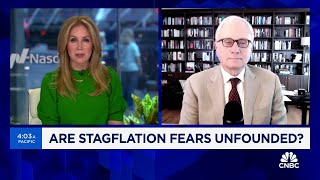
This week, as fears mount over the economy heading toward stagflation, our next guest says the current economic scenario is nothing like the stagflation of the late 1970s. For more on the markets ahead of a busy week with earnings and the Fed's policy meeting, we bring in Ed Yardeni, president of Yardeni Research.
Ed, the idea that this is not going to be like the 1970s stagflation is a good one to hear on a Monday morning. Explain.
Yeah, I want you to feel better. Last week, when we got the GDP report, the knee-jerk reaction was that the data was stagflationary, because real GDP was up only 1.6%. But a lot of that was because we imported more and saw less inventory accumulation. Final demand in the economy was still very strong. There were also concerns about the pickup in inflation during the first quarter. Some of it was January and February effects, but we still have a problem with the so-called super core inflation rate, which is the consumption deflator for services excluding energy and shelter. It has stuck around 3.5% recently, but I think it's going to come down.
One of the problems on the inflation side is auto-related: auto repairs and insurance have been a real problem. I don't know that the Fed can do much to repair your car or offer you auto insurance, but that's bound to slow down. It has been on fire for so long. All in all, the economy is still doing well on a year-over-year basis, and we're still seeing a moderating trend in inflation. So I don't think this is stagflation at all.
You also don't think the markets are going to continue to melt up, and from your perspective that's a good thing. The idea is that the market may pause for a while.
Yeah. Just because I would like that doesn't mean it's going to happen. But I was concerned that the market was going up too fast and being led by the valuation multiple. The forward P/E on the S&P 500 went up to 21, and now we're back down to about 20. That hasn't been much of a correction in the P/E, but I wouldn't mind if it stayed here for a while, and it turns out to be an earnings-led bull market from here. For now, the market could very well just pause. There are still expectations in the market for two rate cuts, and I think we need to be disabused of that notion, because I don't think there will be any rate cuts this year. But the market is also looking a year ahead, and sometime into next year there could be a couple of rate cuts.
What surprises me is that you have a pretty strong forecast, even though you're talking about a pause. You have a strong forecast for where the S&P will be at the end of this year, not to mention 2025 and 2026. Let's lay that out. Let's bring back up the S&P 500. You can see how far we've come since November.
Yeah, it's been extraordinary. It's been my opinion since November 2022 that we're in a bull market. The bull market had a nice run from that point through last August. Then we saw a correction for a while, and we made a low on October 27th of last year. After that it was an almost vertical ascent, and it felt like a melt-up scenario. I think it's going to be a pause for a while, but the underlying earnings story is still solid. I think the valuation multiple is a bit high, but earnings can lead this market up to 5,400 by the end of this year, 6,000 next year, and 6,500 in 2026. Those forecasts aren't really that bold when you look at the percent changes, but they sound pretty good.
Yeah, they sound pretty good. I guess you're calling for a pause, not a pullback. What's a big pullback surprise?
Well, we have had a pullback. From the peak on March 28th, the market came down below its 50-day moving average and was down 5.5%. I was thinking we could get a 5 to 10% correction, not an official correction of 10% or more. We may very well have seen it. From here on there are still geopolitical uncertainties. The market suddenly seems to act as though all is well in the Middle East and between Russia and Ukraine. What the market may figure out is that even if these situations continue to deteriorate, as long as the supply of oil coming out of the Strait of Hormuz isn't affected, there's plenty of oil available even in a geopolitical crisis.



Comments 0