원문 보기
I want to come back just to a company Nvidia. You met with Jensen Wong. You know, he's a great American semi project. And then we just learned that you guys may be even tougher than the Biden administration on where they're able to sell things. And I'm trying to figure out what does it take? What does it take to get on your good side?
Yeah. Why have sectoral tariffs on semiconductors when we're trying to build up AI here, Peter? Well, uh, not not my lane, uh, which is a little bit of a copout in the sense I know you want hard answers to hard questions because I know you like I'll give you American I'll give you the I'll give you the the the landscape here.
um AI is is the next frontier uh for control of this world both economically and from a military point of view. So the question of chips uh in terms of where they go and and how they get there is very much an important one to both the military and economic security of this country. So we have to think very very carefully uh about what's going on and I would ask you to simply be a little patient.
Um, we're going through the the process of investigating this whole chips issue. It's very complicated because there's three different layers basically. The high-end high-end high-end AI chips, the mid ones, and then the bulk commodity ones. We got to figure out what's best uh not just for uh for America but for for the rest of the world uh with respect to maintaining uh peace and prosperity because um AI as you know um it's a it's it's a mixed bag in terms of our future.
Emily Wilkins caught up with Jensen Wong on his way in. Hey Emily. Hey Carl. Well yeah a lot of CEOs on the hill today. a lot of lawmakers speaking with them about AI in the future, which is exactly what brought Jensen Hong here today as well to talk about how the US needs to remain competitive when it comes to AI.
I caught up with him for a few minutes and I asked him a little bit about how tariffs were impacting everything. There should always be policy that that enables us, supports and accelerate the ability for us to onshore manufacturing, but with willpower and and with the the resources of our country, I'm certain we can manufacture on shore.
What's your reaction to the Wall Street Journal saying Huawei is advancing to catch up to your highest level chips? There's no question that Huawei is one of the most formidable technology companies in the world and they're incredible in computing. their incredible networking technology and software capabilities uh all of the essential uh capabilities to advance AI and they have they've made enormous progress in the last several years.
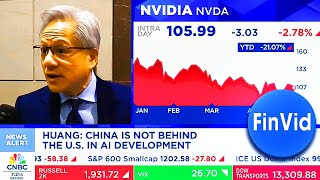
Uh whatever whatever policy uh the administr administration puts together really should enable us to accelerate uh the development of AI enable us to compete on a global global stage. How far could you ask one more like how far behind do you think China is? Uh China is not behind. I anybody ahead of you.
China's right behind us. I mean they're we're very very close. Uh but remember this is a long-term this is an infinite race. There's no you know in the in the world of life. There's no those you know there's no twominut end of the quarter. There's there's no such thing. And so we're going to compete for a long time.
And just reme remember that this is this is a country with great will and they have great technical capabilities. 50% of the world's AI researchers are Chinese and and so this is a uh this is an industry that that we will have to compete for. Huang will be visiting the White House later today to continue to talk about AI as well as tariffs.
Of course, the White House is currently been put being putting together a plan for what their path forward with AI will look like, guys. Yeah. Emily, very interesting comments from Jensen Wong there. You know, echoing, I think, what any number of people who follow us closely have been uh saying lately in terms of China's abilities.
Um I would assume he's going to share the same um with the administration, with uh uh with um with Congress as well, in part because he's dealing with the possibility of sectoral tariffs that conceivably could hamper our ability in this country to continue to advance at the same pace. Exactly. And and Wong, you know, he kind of spoke to me about the fact that he has invested and does want to invest in the US, but when it comes to AI, it's not just a matter of AI specifically.
It's a much broader ecosystem that has to be able to support it. From the skills to the energy to, of course, the tariffs and to be able to build these factories here in the US. If Trump really wants to be able to onshore as he said he does, there is some questions about exactly what the outcome of his tariffs are going to be and whether you are going to be able to have that manufacturing return to the US in the way that he wants.
I I guess I'm just wondering on the incentives if they're if they are aligned. Nvidia I mean obviously Nvidia is a big US company and and wants the US to win but China remains an important market for Nvidia after we saw that big write down when the chips were banned. Sarah, no, it's absolutely correct.
I think there are a lot of questions as far as what the impact of tariffs are going to be and if the US is going to really be able to remain competitive. There are certainly concerns among lawmakers who I speak with about the US's ability to remain ahead of China. As you heard him say, China is only right behind us.
They have a lot of capabilities. Um, and I think you've seen a lot of changes right now in how the various administrations have approached AI. Biden had a plan that he put forward, but the Trump administration has basically reversed a lot of that. We don't know exactly what's next or what it looks like.
And when I talk to folks in the AI industry, they say that that really needs to be there for the US to have a seat at the table and to continue to be a leader globally when it comes to AI standards and and what the policies and rules of the road are. Yeah, we talk a lot about their lead in China in EVs.
Today, a big note out of Morgan Stanley about their lead in uh robotics and humanoids. I'm going to talk about Microsoft and Meta's earnings and capex later in the video, but first I want to address the China situation. We've spoken many times on this channel about Huawei over the past couple weeks.
Huawei is reportedly developing a chip comparable to Nvidia's H100 and Huawei also has an answer to Nvidia's Blackwell, the Cloud Matrix 384. While Nvidia's Blackwell racks contain 72 GPUs, Huawei's cloud matrix consists of 384 GPUs. According to semi- analysis, the trade-off is simple. Having five times the number of chips, more than makes up for each chip being one-third the performance of an Nvidia Blackwell GPU.
And today, the Financial Times is reporting that Huawei has delivered cloud matrix clusters to Chinese clients that are cut off from buying Nvidia's products. Jensen is right in saying that Huawei is a formidable competitor in AI. Also yesterday, before market close, Reuters reported that the administration is considering a change to the AI diffusion rule that is set to go into effect on May 15th.
Reuters claims that the administration is looking to do away with the tiered country system of the AI diffusion rule and to instead use countries access to high-end Nvidia chips as leverage in trade negotiations. I think the implications are twofold for Nvidia. I think market participants would initially perceive the change as a short-term negative for Nvidia because the countries involved would be temporarily restricted from purchasing Nvidia's chips.
But at the same time, I think the change could be a long-term positive for Nvidia, assuming that the administration is able to eventually reach trade deals with all of the countries involved. If that were to happen, then the end result would be Nvidia being allowed to sell freely to those countries without there being a total limit on how many chips they can sell to each of the countries.
Now, let's get back to the clips, and I'll provide more context as we go. Shares of Nvidia under some pressure today after that report. Trump officials are considering a change to that AI diffusion rule. That's a Biden era chip curve that divides countries access into tiers. Trump officials now reportedly weighing country bycountry deals instead.
Our dear DBosa has more on the impact on Nvidia in today's tech. Hey D. Hey Carl. So if this move goes ahead, it means that the president's deal first diplomacy, it is coming for chips and the AI trade. Basically using semis as leverage in bra in broader trade talks. But there of course are no deals yet.
And the prospect of dealbydeal chip access that is unsettling investors. Jensen Hong, he's at Capitol Hill today. The White House later, he spoke to the stakes to our Emily Wilkins which increasingly centers around the race with China. China's right behind us. I mean, they're we're very very close. Uh and but remember, this is a long-term this is an infinite race.
We're going to compete for a long time. And just remember that this is this is a country with great will and they have great technical capabilities. 50% of the world's AI researchers are Chinese and and so this is a uh this is an industry that that we will have to compete for. Adding to a growing list of performative launches from Chinese tech giants, there was China's Xiaomi overnight releasing its first open- source reasoning model, another one that competes with larger models like America's open AIs in public benchmarks.
Now, China's momentum can also be seen in stock performance. Take a look. Since Trump's inauguration, the K web basket of Chinese internet stocks, it's up about 9% versus a more than 12% decline for the NASDAQ. Alibaba, that's up 40%. Nvidia, it's fallen more than 20. It's all in the numbers there, guys.
Finally, guys, earlier this week, we talked about a growing split when it comes to AI policy within tech circles. Now, the Trump side firmly focused on containment. That's tariffs, export controls, now potentially one-off chip deals. There's an increasing chorus on the other side, including Jensen Hong, who are arguing for the diffusion of American AI around the world.
Wong reiterated that today and I you guys at least to me it feels like those voices are growing in order to try and protect American AI as China gets closer and closer. Yeah. Which also sort of brings up the point that investors have around Nvidia which is what does the Chinese market look like for Nvidia?
Remember that surprised $5.5 billion write down they took because of excess inventory on the H20s after the export controls. H how much how much business at this point is Nvidia doing with China and and is the assumption that that's just going to continue to decrease as this race heats up. So there's China right which we know now is more than a $5 billion hit which is really interesting because it essentially means that Nvidia is unable to sell those chips largely the H20s elsewhere in the world.
But this AI diffusion rule some are arguing is even more consequential because this is other countries around the world and Nvidia gets a lot of its revenue and profits abroad. This is this rule that Trump is reportedly considering changing would not would take away the tears. Okay? Like basically you have certain countries that get x amount of chips, certain countries that don't, etc., etc.
This would basically make it so it has to happen on a dealbydeal basis. And guys, we've had a preview of what that looks like, right? In the broader trade talks, really tough. So, if AI trade, Nvidia chips, AMD chips are subject to that kind of policy, that's really, you know, worrying. That's very bearish for Nvidia investors.
It means that China is not the only problem. Countries around the world are going to be subject to the same kind of negotiations, the same kind of uncertainty. Meanwhile, I mean, the comments from Jensen Wong today, uh, D trying to convince the administration to loosen up on some of these export controls, but at the same time saying that China's right behind us in the AI race.
Those two comments kind of conflict, do they not? I I mean, look at what he said about Huawei. That was pretty breathtaking. A lot of, you know, folks here, a lot of investors, a lot of people who are in Nvidia will not like to hear that. He basically said that Huawei, I can't remember the exact words, but saying that they are a formidable force.
This is something that we've been saying, we've been reporting on for weeks, the amount of progress that we're seeing out of Huawei. In some cases, they're cobbling things together to get as much compute power as say an Nvidia. In other cases, they're making real strides when it comes to scalability and getting Chinese companies to use their chips.
Um, and then you look at the smartphone. Carl, I know you've talked about this a lot. You see it in many different areas. EVs as well. But the Chinese threat is real. And you know, we bring this up not to say that, you know, China is going to catch up. We want China to catch up, but that the US needs to be focused and continue to innovate.
At least that's what the people tell me in tech who are arguing against containment. Dan, I'm not sure which is the bigger deal here, the the beats big Azure quarter for Microsoft, big margin quarter for Meta, or the doubling down from Zuckerberg on data center hardware at a time when there are questions about whether big tech is going to pull back.
What do you think? Yeah, I think what you heard from Zuckerberg, I mean, those are those are capex words that are going to be heard around the world and especially around the street because it just speaks to the worry that you're going to see big tech pull back. They're doubling down and I think you'll hear the same from the Dell on the call as well.
And this is just so important and crucial I think crucial to the the whole tech trade because that's where the spending the AI revolution is not getting slowed down because of tariffs and I think big tech is fueling that and you look at these numbers look this is a home run quarter across the board for big tech Aaron Judge like quarter I think what we saw from Meta as well as Microsoft now we still got to get you know Amazon and some others we're going to hear from Apple soon as well but on these cloud proud players that we're hearing from so far.
Is there enough confidence despite the uncertainties that even Meta referred to on the regulatory front and of course on the tariff front that that you think are going to give investors some confidence that wow if these big spenders continue to be confident maybe I can too? Yeah, I John that's a great set.
I think the tech trade changes after these results because as an investor the the thing that I've heard over the last 3 four weeks is are they going to pull back can I have confidence in numbers second half and you look at what we're seeing from the hyperscalers and we've talked about in our checks in in some ways there's actually an acceleration and and you could say just a more and more resilient it just shows enterprises are going full steam ahead because you don't want to lose your spot in line bullish for when it comes to Google and obviously we saw GCP you know obviously what we're seeing with Azure the 200 bit beep and I think many thought they were actually going to miss and this is obviously huge barometer going into Amazon where I think you're going to have strong AWS numbers tomorrow that is if you're a bull you just checked every box here in terms of what you're seeing you'll see some caution regulatory of course but relative to this category 5 storm that we've seen software big tech you know really holding up rocker Jialter So the takeaway here for me then from what you're saying Dan is whether it's Microsoft whether it's Meta it's really how AI is driving growth across these companies businesses how how key then between today and then with the rest of the hyperscaler and meggaap tech names that we get tomorrow whether it's Amazon or whether it's Apple how key then are the comments and the results we get here uh to sustaining the idea that AI is a secular growth story and thus perhaps despite macro uncertainty a defensive story.
Yeah, Morgan, I I think the what you heard today on these calls and I think in terms of the press release and what you're going to hear in the calls that just speaks so loudly because it shows if there was a time to pull back, they were going to pull back here. They're not. They're doubling down. And I think what it shows is the resiliency of this AI revolution.
We've talked about I mean we're we're only 5% in to to what the spending is going to look like here. And we talk about it's two trillion that you're ultimately going to see in terms of all this AI revolution. Big tech everyone's looking at the big tech players and what you heard from them from digital advertising to hyperscaler to AI to cloud not pulling back.
And if you're a tech bull, I think this is going to put some sort of gasoline in this in this tech bull rally that I see going into the next few weeks despite uncertainty when it comes to tariffs and everything we're seeing. It comes down to what you what they're seeing in the field. They talk about a little bit increase in capex and do you think that's um is that part of why the stocks up?
Do you think that's money well spent? Definitely money well spent. It comes from this point of strength that they're at right now is that they can go more aggressively. He outlined five key areas of their uh growth plan and all of those have an AI component to it. And so this capex piece is kind of confirming to investors how do you get there on these five growth areas.
You invest more into capex. I would say this just to zero in on that capex number is that I this is really good what happened with Meta tonight. I expect the stock to continue to gain strength uh tomorrow. Uh but the data point around capex, I think it's probably going to be considered as we look at Microsoft and earnings and Qualcomm tonight.
I think that that that data point is probably going to be the one that rises to the top amongst tech investors because of course not all AI data points are created equal and that one is pretty strong raising it by 9%. And I have to tell you the the in the tonight's earnings report Meta did not just reiterate its colossal 2025 capital expenditure forecast.
It raised it to 64 to 72 billion up from 60 to 65 billion. It would be very good for yes Nvidia. It's gigantic not just for Meta but for the entire AI complex which has been hit very hard over the past 3 months because of fears that the mega cap tech would cut back their spending. It does not look to be the case.
Meta is certainly not doing that. The company said specifically that its new capex outlook reflects additional data center investments to support artificial intelligent efforts. In tonight's call, Zuker did an excellent and thorough job of describing the many different opportunities the company sees in AI and explaining why the company is eager to make these major AI related investments.
You bet against Zuckerberg at your own peril. We got fantastic news for Nvidia today from both Meta and Microsoft. Meta doubled down on their AI ambitions by raising their capex guidance up to a range of 64 to 72 billion, which is up from the previously announced 60 to $65 billion. This comes one day after Meta announced a new standalone Meta AI app.
It appears that Meta wants to compete with Open AI and they will need a lot of compute from Nvidia in order to do it. Additionally, Microsoft reiterated that they're seeing strong demand for AI and they even said on the earnings call that AI demand is growing faster than what they could supply. Microsoft expects Q4 capex to increase sequentially from Q3 and Microsoft second half capex guidance remains unchanged.
Microsoft CFO Amy Hood said that fiscal 2026 capex will include quote a greater mix of short-lived assets. That means more CPUs and GPUs, which is great news for Nvidia. This is in line with what they told us on their last earnings call. As Microsoft's fiscal 26 begins, they will shift their mix of spending away from the external costs of the data centers such as land construction and utilities toward assets inside the data centers such as CPUs and GPUs.
As a reminder, Microsoft's fiscal 2026 begins in July. Also consider this, Microsoft CFO said they expect Q4 capex to increase on a sequential basis. That means they expect capex to be more in Q4 than it was in Q3. Now, look at this screenshot from Microsoft spreadsheet showing their capex for the fiscal year.
Notice that if they spend more on capex than they did in Q3, then that would be about $21.5 billion on the low end. That would bring the total for the year up to $85.5 billion on the low end, which is much more than the $80 billion Microsoft previously announced. Both Meta and Microsoft beat estimates on the top and bottom lines, which is why we're seeing both stocks higher in after hours.
This is not only positive for tech and data center stocks, it is also very positive for the broader market. And so as long as we don't get any negative news between now and tomorrow morning, I would expect a green day in much of the market tomorrow. Again, that's if we don't get any negative news before then.
By the way, I'm starting a new daily stock market update series where I cover the important stock market news of the day and help get you prepared for the trading day ahead. Be on the lookout for more market updates each morning in the days ahead. Overall, I'm very pleased with the news from both Meta and Microsoft today.
Now, we have Amazon and Apple scheduled to report earnings tomorrow. As for Amazon, I'm expecting the company to maintain their capex guidance, given that the AWSVP of global data centers recently said that there have been no fundamental changes to Amazon's expansion plans. And so, if Amazon maintains its capex guidance, then we will have survived yet another earnings season in which none of the hyperscalers reduce their capex plans.
And that would be very good news for Nvidia. Now, when it comes to Nvidia, market participants will start a focus on a couple of potential upcoming headwinds. Semiconductor tariffs and the upcoming AI diffusion rule on May 15th. Even so, despite the short-term uneasiness around tariffs and the negative news flow, I'm still bullish on the long-term future of Nvidia.
We are seeing very strong consumer AI demand from OpenAI, XAI, Google Meta, and others. Nvidia still maintains a competitive moat across both hardware and software, and companies will still experience a 40x in AI factory revenue when they upgrade from Hopper to Blackwell equipped with Nvidia Dynamo.
And so, in the short term, we could see some volatility in the weeks ahead. But from a long-term perspective, I am still optimistic about Nvidia's future. At least that's my view of the situation. Remember to stay calm in this market. Remember to maintain a long-term perspective and do not make any hasty or irrational decisions.
With all of that being said, I hope you all have a great rest of the day. And I'm curious to hear your thoughts about Nvidia in the comments below.



댓글 0