저자: 미상 · 외국인
요약 보기
찰리 멍거의 투자 철학을 소개하는 영상. 거시경제 예측은 무의미한 소음이며 기업의 경쟁력·현금창출력·경영진 품질 등 신호에 집중해야 한다고 주장. 뮤추얼·인덱스 펀드는 수수료, 클로짓 인덱싱, 경력 리스크, 대형화 제약 등 구조적 한계로 평범한 수익에 머문다고 비판. 개인투자자는 집중투자·인내·대담함·소음 무시의 자유를 가진다고 강조. 5단계 원칙(역량범위 내 투자, 소수 우량기업 선별, 적정가·저평가 시 매수, 장기 보유, 소음 무시)을 제시. 코카콜라·아메리칸익스프레스·애플 등 버핏·멍거 사례 언급.
다듬은 글
All right, let's talk about investing. Today, we're going to rip up the conventional playbook. We're diving head first into the brutally sensible world of Charlie Munger to figure out why he was so convinced that most investment funds are basically designed to fail and how you, yeah, you, the individual investor, might actually be holding all the ace cards.
So, let me ask you something. Does investing feel, I don't know, like a super high stress game that you just can't seem to win? Are you always trying to outguess the market, predict the economy, and stay one step ahead of all the talking heads on TV? If any of that sounds familiar, you might be playing the wrong game entirely.
You know, for most people, the game looks something like this. You're glued to stock charts, trying to forecast where interest rates are going, trying to guess the Fed's next secret move, predicting the next big recession, all while reacting to every single scary headline that pops up. Charlie Munger looked at all this and basically thought, "What a bizarre and frankly useless way to spend your time." And that right there, that brings us perfectly to our first big myth.
Let's call it the macro illusion. It's this idea that you can get ahead by focusing on the big picture economy. Well, as we're about to see, that's almost always a losing strategy. I mean, nobody said it better or, you know, more bluntly than Mer himself. He said, "People waste an astonishing amount of time thinking about things that are completely unknowable and then they wonder why their investment results look like a car wreck." That's a pretty powerful warning against pretending you own a crystal ball, right?
So, here's the big takeaway. You have to learn to shift your focus from what Munger would call the noise to the signal. The noise, that's all the stuff you can't possibly control or predict, right? The Fed's next decision, unemployment numbers, whatever the latest geopolitical drama is, it's just static.
The signal on the other hand comes from the actual business itself. What's its competitive advantage? How good is it at making cash? Is a management smart and honest? Those are the things you can actually dig into and understand. Okay, you ready for myth number two? Let's get into what I call the great fund fallacy.
This is a big one. It tackles that common belief that just putting your money into mutual funds or index funds is automatically the safest and smartest choice. But Munger would have a very pointed question about that. I'm willing to bet someone at some point told you that putting your money in funds was the safe thing to do.
But have you ever stopped to ask safe from what exactly? Are they safe from mediocre returns? Safe from getting eaten alive by fees? Or are they just safe from the hassle of having to think for yourself? And that question gets right to the heart of Munger's whole argument. He was convinced that quote the worst risk of all is not understanding what you're doing.
And funds by their very design can create this dangerous gap between you and your money where it replaces actual genuine understanding with this cozy but ultimately false sense of security. This leads to a massive fundamental problem that Munger called the other people's money problem. It's all about misaligned incentives.
See, a fund manager's goal is often just to grow the total assets in the fund. so they can collect more fees. Your goal, on the other hand, is to grow your own personal wealth. Those are two very different things. And that conflict is why so many funds just don't perform well. So this basic conflict of interest, it creates these huge structural problems that pretty much do most funds to just being well mediocre.
First up, you've got closet indexing. That's when a fund owns hundreds of stocks just so they don't look too different from the S&P 500. You're paying high fees for them to basically be an index fund. Then there's career risk. A fund manager is terrified of having one bad quarter. They'd rather lose your money slowly over 10 years than risk looking bad for 3 months.
They also get forced into bad decisions by investors. They have to buy when markets are high cuz money's pouring in and sell when markets are low cuz everyone's panicking. And finally, their huge size is a major handicap. They're just too big to invest in some of the best, most agile companies out there.
But okay, enough of the bad news because here is the good news. The really good news. While all those big funds are trapped by their own rules and their own size, you the individual investor, you have a set of what we can honestly call superpowers. Real advantages that those institutions can only dream about.
So, let's break down these four freedoms. Number one is the freedom to concentrate. Unlike a fund that has to own hundreds of stocks, you can put a serious amount of your money into your few absolute best ideas. Number two, you have the freedom to be patient. You can sit on cash for months, even years, waiting for that perfect opportunity without any pressure from a boss to put the money to work.
Number three, the freedom to be bold. When everyone else is panicking and the market's crashing, you can step in and buy aggressively when things are cheap. And maybe the best of all, number four, the freedom to ignore the noise. Your only job is to make good decisions for you. You don't have to write quarterly reports to anyone.
And when you put it side by side like this, the difference in mindset is just it's night and day, isn't it? The fund manager lives in what the great investor Ben Graham called the voting machine. It's a short-term popularity contest. But you can live in the weighing machine where all that matters is the long-term value of a business.
They have to act like a bureaucrat, but you get to act like an owner. They're paid to be terrified of volatility, but you can learn to see it as your best friend, an opportunity to buy. It's a whole different game. And look, this isn't just some abstract theory. Mer and Buffett lived this stuff for decades.
They had the freedom to be bold and buy a huge stake in Coca-Cola in the late8s when the market was acting crazy. They had the patience to load up on American Express after a huge scandal rocked the company. They ignored all the noise and bought Apple when Wall Street was convinced its best days were over.
These were incredible opportunities hiding in plain sight. Opportunities that most funds were completely unable to grab because of their own internal rules. All right, so how do we take all these ideas and actually put them into practice? Let's boil it all down to the Munger way. A brutally sensible nofluff framework for building real wealth.
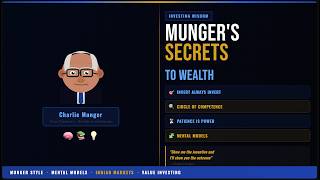
Now, the game plan itself is beautifully simple. But listen, simple does not mean easy. It boils down to just five steps. Step one, stay inside what you know, your circle of competence. Don't venture out. Step two, find a small handful of truly wonderful businesses. You don't need hundreds. Step three, and this is key, be patient and only buy them when the price is fair, or even better, foolishly cheap.
Step four, hold on. Just hold on to them for as long as they stay great businesses. And the final most important step, ignore almost everything else. Just tune out all that noise we talked about. You know, if I had to pick one single quote that just nails this entire philosophy, it would have to be this one.
You don't need the whole market. You don't need the whole index. You need a handful of great businesses and the discipline to hold them while the world loses its mind. That's it. It's all about concentration, patience, and just being the calm, rational person in a world full of irrationality. So, I want to leave you with this one final thought.
The entire massive multi-trillion dollar investment industry is built to convince you to outsource your thinking. It's just easier that way. It feels safer and hey, it keeps the whole machine running. But after listening to Munger's logic, the real question you have to ask yourself is what could you achieve if you decided to take that thinking back?
Comments 0