저자: PabloGil · 외국인
요약 보기
Ray Dalio·Warren Buffett의 경고를 인용해 금융 사이클 최종 단계 진입 가능성을 주장. 글로벌 부채 약 340조달러(GDP 대비 320%+), 달러 구매력 1995년 대비 53% 하락, 미국 시가총액/GDP 역사적 고점, 버핏 현금 약 3,820억달러(자산 35~37%), 자사주 매입 5분기 중단을 근거로 제시. 실물자산(금, 부동산) 선호, 미국 비중 축소, 일본·신흥국·유럽 선호 및 섹터/종목 선별 필요성을 언급.
다듬은 글
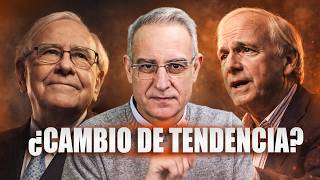
Throughout my 40 years as a professional investor I have been fortunate enough to follow role models who know infinitely more than I do, and in my case I have two idols, they are on screen, Ray Dalio and Warren Buffett. Each with their own style, one macro, the other value investing, in any case two benchmarks who have achieved excellence in their style and who have systematically and for a very long time beaten the return offered by traditional indices.
I just finished reading one of the reports presented by Ray Dalio with a warning: the system is in its final phase and your portfolio may not be ready. When I finished reading it I thought, it's worth making a video and sharing everything I just read with those of you who follow me. Among other things, while I was reading I noted down some phrases and one of them was, if you think the worst thing that can happen in the stock market is a 20% correction you are very short-sighted.
Ray Dalio just reminded us of something that almost no one wants to hear: that during the last 500 years, when the system enters its final phase, it is not just a market that falls, but the entire order. And when that happens, financial wealth disappears much faster than people would like to imagine.
All investors tend to make the same mistake: we think the past is permanent. That is, if you've seen the S&P 500 as the best stock market for 10 or 15 years, you think it will continue to be so. If the 60/40 portfolio between fixed income and equities was solid in the past and performed reasonably well in all environments , that's not necessarily true.
And when you've seen that all the recent crises have recovered very quickly, you assume that this recovery will be present in the future, but that doesn't always happen. And I think Ray Dalio does a devastating exercise that explains very well these kinds of beliefs that we tend to hold in our minds that are not true.
He says, "Think about it: if at the beginning of the 1900s you had invested in the 10 greatest powers in the world, seven would have practically wiped out all your wealth at some point during the century. Seven out of 10. We're not talking about volatility, we're talking about disappearance. And before that happened, everything seemed stable, globalized, prosperous.
It sounds a lot like the belief we have right now. In this video, the goal is to talk about what you see here. Obviously, I've parodied it here, Ray Dalio saying the system is in its final stage. It's true that he said that. And Warren Buffett responding, 'Why do you think I have over $350 billion in cash?' That's also true.
In other words, everything you see on screen is completely true. So the million-dollar question is, what are we going to see in this video? First, why should you listen to these two masters of investing? Many young people tend to criticize simply because they've been around for a while." Investing for a few years instead of taking as a reference point people who have been beating the market for decades.
On the other hand, what mistake do almost all investors tend to make ? Not understanding that many times the problem doesn't come from the stock market, but from debt. And that there are some data points that make us think when we see them on a screen , but if we don't see them on a screen, we're not aware of them.
I hope to surprise you with several of those charts. And finally, knowing or having an opinion on whether or not we are in the final phase of this cycle and, if so, how we can protect our wealth? So let's get on with this text, we're going to talk about all these things and argue why I think what I think.
First of all, the importance of listening to someone like Ray Dalio. Well, Ray Dalio is n't some social media pundit . He's the founder of Bridgewater Associates, which is the largest hedge fund in the world, or has been for decades. You can see in that chart that it has more than 120 billion. of dollars under management.
It's absolutely staggering. Investors don't put their money in someone who's bad. Obviously, to have so many assets under management and be the benchmark fund, you have to be excellent at managing them. Therefore, we're talking about someone who has been in the world of asset management for decades, who has had the opportunity to experience very complex situations like the 1987 crash, the dot-com bubble, the 2008 crisis, and multiple monetary cycles.
That's more than 50 years studying long cycles of both debt and power. And when someone with that experience talks about the final phase, they're not talking about a simple recession; they're talking about changes in the global order. And that's why it's worth listening to him. The other candidate to give us lessons, in my opinion, is Warren Buffett.
And here too we can ask ourselves why we should listen to this individual. Well, because he's not just another manager; he's the investor who has achieved one of the highest compound returns in history for six consecutive decades. Since 1965, Berkshire Hathaway It has multiplied its shareholders' capital at a rate far exceeding that of the S&P 500.
Look at the S&P 500 return and the return of Warren Buffett's fund on screen. We're not talking about a lucky or brilliant decade; we're talking about more than 50 years of beating the market. It has survived the inflation of the 1970s, the 1987 crash, the tech bubble, the 2008 financial crisis, and the pandemic.
When someone with that track record decides to raise their liquidity level to historic highs, it's not by chance. He may make mistakes, like everyone else, but ignoring him doesn't seem particularly prudent. Um, the next thing we have to consider is that while many investors chase the market's momentum or inertia, regardless of the multiples , Warren Buffett is doing the opposite.
Through his Berkshire Hathaway fund, he has been a net seller for three consecutive years. In that period, he has reduced his stock market exposure by about $184 billion . It's not an isolated move; it's a long-term strategy. Uh, if we want to talk about truly impressive figures, uh, Berkshire Hathaway uh, closed the quarter with over $382 billion in cash or invested in Treasury bills, very short-term US debt.
That's what we call, in effect, being in effective cash. The total balance sheet is around $1.1 trillion. That means it has approximately 35 to 37% of all its assets uninvested, in cash or cash equivalents. More than a third of Warren Buffett's empire is in cash. That's an extraordinarily high proportion for this fund, uh, so it 's sending us a very clear message.
Uh, furthermore, it hasn't bought back its own shares for the fifth consecutive quarter. In the past, Buffett used buybacks when he saw that his stock was clearly cheap. He's not even buying back his own shares. Hm, that's also a sign. In the end, uh, it doesn't mean that he's going to There could be an immediate crash.
But when Dalio talks about the late phase of the cycle, and Buffett accumulates record cash and stops buying back shares, and they don't participate in the investor euphoria but are instead prudent, well, they 're telling you something. Uh, before we continue, uh, I want to remind you that you have a free course on March 2nd, 3rd, 4th, and 5th , where I'm going to teach you how to improve your investment returns with a relative analysis tool .
And now, the problem, uh, we often think it's in the stock market, but it's not, it's in the debt. Because the truth is that major cycles don't begin with wars, they begin with debt, always the same. Lots of credit, soaring financial assets, think about what we've been experiencing in recent years, a feeling of wealth, governments on the brink, and suddenly the moment arrives when promises can no longer be kept, and the system has two possible outcomes, always the same: either I default, that is, I don't pay, I don't return to my creditors what they lent me and the interest they owed.
I owe them, or the other option is to print money. The debt in the United States, as you can see, exceeds 38 trillion and is growing at an unprecedented rate, but this is merely a reflection of what is happening globally. The graph above shows that global debt has already reached levels close to 340 trillion dollars, and represents, even despite recent economic growth, more than 320% of GDP.
These are staggering amounts. And as you can see, the general trend we've been observing with this indebtedness is not dependent on cycles; it's not something we've used to combat a pandemic or a crisis, a recession, but rather, as you can clearly see in the graphs, we've made it endemic to the system.
When we have such a large debt, we were talking earlier about how one of the solutions is default, which no one wants to accept—that's what Greece did—or printing money. And that leads us to what we call the M2, which is the growth of the money supply. In this example, we are only looking at the growth of that money supply in the United States.
As you can see, to combat the effects of the pandemic, the injection of liquidity was historic. In a year and a half, we created more than 20% of all the dollars in circulation, and although some of that liquidity was then drained starting in 2022, we are already reaching new highs again. Therefore, the trend is unstoppable; the process of printing money as a mechanism to solve all our problems remains in effect, it hasn't changed, but it has been accelerating more and more over the years.
And, to the extent that we always choose this second option, the truth is that we are causing an effect on the purchasing power of the money we print. Or, to put it another way, we don't officially go bankrupt; what we do is silently impoverish ourselves . And this is what this graph shows. Basically, we talk about impoverishment when we refer to the loss of the purchasing power of our money or of the purchasing power of our fiat money.
Fiat: dollar, euro, pound, Australian yen, Mexican peso, any currency. Look at the dollar. If we look from 1995 to June 2025, we discover that we have lost 53% of the purchasing power of the US dollar. It's outrageous. In other words, if you've left your money parked for the last 30 years under a mattress or on a nightstand without investing it, it's worth or buys half of what it used to .
It's a brutal impoverishment, not over centuries, but in just 30 years. I think this data should make us think for ourselves. Today, financial wealth is enormous compared to real wealth. How can I compare this? Well, Warren Buffett's chart helps to understand this concept. What does this chart show?
What we're saying is that we measure how much the financial market capitalizes , in this case the American stock market, relative to how big the US economy is. There has to be There's a relationship between the two. GDP measures the size of the economy, while market capitalization tells me how much the sum of all the shares that make up the stock exchange is worth in dollar terms.
Well, as you can see, the market has a trend with return points to equilibrium axes, deviations—one standard deviation, two standard deviations, and so on down. And the current situation, although calculated for September 2030, considering that the stock market has done very little in this period, from September to the present, we can say that it's at a very similar level.
It's the highest level, the level most deviated from the equilibrium point in recent memory, much more than what was reached in 2000 or in 2021, which perhaps explains why Warren Buffett, through his fund, prefers to hold more liquidity than he has ever held before. This already gives an idea of the difference between financial wealth expressed in the stock market and real wealth expressed in GDP, but there's more to it than just the stock market.
We could talk about other financial assets that also express financial wealth, such as bonds, deposits, funds, and so on. If we all tried to convert that wealth into real assets at the same time, it would be like a global liquidity crisis. Why? Because there isn't enough tangible wealth to back all the financial promises we've created.
And that's the heart of what we call the great cycle. When we get the feeling that cash is no longer safe—and this usually happens in the final stages of the cycle—cash loses a lot of purchasing power, something we've already seen with the depreciation of the dollar. In that environment, it's very common to see bonds suffer, taxes rise, controls appear, and most importantly, real assets hold up better than other financial assets.
And this isn't something that will seem strange to you either. Gold trading very close to all-time highs after... of extraordinarily good performance. And on the other hand, we can see the real estate market, which, although its upward trend has slowed , is at peak prices, and not only in the United States, although what we're seeing here is the American market.
In many countries around the world, we have real estate asset prices at all-time highs and with the feeling that they're not going to stop rising. It's not magic; it's the historical mechanics of economic cycles, it's that simple. The next question, and it's perhaps the most important, is whether or not we're already in that final phase of the cycle.
If we were, it would be difficult to identify because until it explodes, we're usually unaware that the movement has begun. But what we do know is the prelude we typically find before that happens, and in this case, it's very unnerving to see that for that to happen, global debt needs to be at its peak, which we already have; the world order needs to be in full transition, which we also know is already happening; and there needs to be a struggle for the Global hegemony between the power that has been leading the empire until now and the candidate to occupy that position, which is China—that is, this struggle for hegemony between the United States and China is something that usually happens in the final stages of cycles, and that large investors begin to be cautious while the rest of the investors don't see the problem coming and are in a phase of euphoria.
So the feeling we have is, "I have n't started the process yet, but all the ticks I have to make before it begins, the truth is, I already have it on the table." This isn't a normal environment; it's an environment of change, and changes in the order of things are the most dangerous moments for those who are unprepared.
Here you have the chart. I told you I was going to comment not only on whether or not we were in that crucial phase. You 've already seen that, based on ticks of things that have to happen, we have four out of four, and the question is, are we seeing it in the market? No, this is the MSCI ACWI, this is the The stock market index is one of the most global there is, and when you look at it, we're at all-time highs with a feeling of absolute tranquility.
We see conditions of extreme overbought trading, very close to the upper band of the upward trend that began in 2009, without any seemingly worrying patterns, without any clear sign that the market is about to turn around. But as Ray Dalio and Warren Buffett say, pinpointing the exact moment is almost impossible.
The idea is that when certain circumstances arise, one has to start being conservative, has to start reducing risk instead of increasing it, in anticipation of what might happen in the coming quarters. One of the things I think is interesting to show you—I told you there were some charts that would catch your attention—is that not all stock markets perform equally well or equally badly.
Not all are as expensive relative to GDP as we've seen in the case of the United States. And if we look at this chart, it's very clear, is n't it? You say, "Wow, the Taiwanese stock market, compared to its..." "The size of its GDP is completely out of control." It's true that it's a stock market that usually trades at the top.
We see other stock markets that were leaders at one time, like the Singapore stock market, which is currently lagging far behind, and a brutal improvement in the short term from South Korea, how it's rising vertically. The United States would appear here in blue as the second most expensive stock market in terms of GDP, then would come Japan, and then there's a group of stock markets, as you can see below, that are actually valued at much lower GDPs.
The second chart that I think is crucial for you to understand before reaching the conclusion is this one: we're talking about sector rotation. Why is it crucial? Firstly, because I think we're entering a market where doing stock picking correctly will pay off very well. Stock picking is the selective choice of which assets we want to have in our portfolio.
Hmm, let's see, there are times when you can say, "I'll buy a global ETF because there's going to be a structural upward trend," and with that, I've done my job. And other times when you say, No, I want to own these specific sectors, these specific stocks, these specific assets, and the rest I don't want, or I'm even going to sell them—that is, I'm going to short them—and I'm making a relative position.
When we look at the S&P 500 over the years 2011 to 2025, we see that it fluctuates a lot. That is, the sectors that are leading, although sometimes they have two consecutive years at the top, normally rotate, and sectors that perhaps performed very well, like the Real Estate sector in 2014, then have a very weak performance in 2025; in fact, one of the worst sectors.
You can see where the S&P 500 is in gray, okay? It doesn't have to be in the middle because, as you know, not all sectors have the same market capitalization, but the rotation you see here shows that for each year there is a winner, and within each sector there are X number of stocks that perform very well.
Well, others do it very badly; there's the example of Intel versus Nvidia, for instance. I think it's time to do a powerful exercise in selecting winners versus losers, because cyclical changes work very well. As a manager of a $500 million fund between 2000 and 2013, I discovered this. For example, in 2008, when the financial system collapsed and we were only investing in banks, we ended up gaining 4% even though the sector fell by more than 90%.
How? By selling the bad stocks and buying the least bad, in what we called relative analysis. And that's what I'm going to teach you, as I mentioned before, if you join the live stream on March 5th. There's a completely free event on the 2nd, 3rd, and 4th, and the live stream on the 5th, where I'm going to teach you how to select the best sectors and stocks simply by using relative analysis.
And it's not just for the stock market, it also... To find out whether it's better to be in Bitcoin or Ethereum, or in gold or silver, or in oil or natural gas, and any other asset that might interest you. Don't miss it, it's completely free. Take advantage of the link in the video description. And now, I think it's time to talk about the conclusions.
For decades, we 've become accustomed to thinking that the system always fixes itself. And that leads us to underestimate the risks. It's true that the work of governments and central banks over the last 15 years has greatly reduced risk exposure because they've implemented ultra-expansionary monetary and fiscal policies that have prevented major crises from having the impact they should have on financial markets.
And that means many investors no longer pay as much attention to risk management, which, as Ray Dalio says, is what makes the difference between those who survive and those who die in crises. On the other hand, I think the question is n't whether the world is going to change. The question is whether, when If things change, your wealth will be on the right side of the cycle.
Because one of the things I've learned is that crises are the best long-term investment opportunities. It's when you really manage to enter the market at very positive, very, very cheap valuations, and if you do it right, you can really build a huge fortune. But to be able to take advantage of crises, you need to survive them, and the only way to survive them is to see them coming.
Right now, because I was saying I was going to tell you how... Or am I going to prepare myself for what I consider to be the next big crisis, and it's something that I like to see that not only I believe it, but that great figures and idols of investment are already warning of that risk. I think it's time to equalize the weight in equities, not overweight the United States.
I think that American hegemony is over. I find other stock markets much more attractive; you know that one of my bets is on Japan. Um, but I prefer emerging markets and European markets to American markets. On the other hand, I think, as I said before, that we are in a moment of stock picking, of having to select which sectors, which stocks we want to be in, and above all, I want to have real assets, because what I believe is that in the face of the next crisis they will try to apply the same old solution, print more money, further depreciate the purchasing power of the dollar, the euro, etc., and therefore, I want to be in real assets, such as gold, such as real estate, because I have the feeling that they are winning horses in the market we operate in and it is a way to protect yourself against the dilution of financial wealth that could come after a major crisis.
I hope this reflection has helped you; I know many of you will say, "Ugh, here we go with the negativity again." Gentlemen, these two, and benchmarks of the market, I believe have been demonstrating their excellence for decades. Uh, not listening seems like a lack of common sense to me . Well, they may be more right, they may be less right, but when they both agree, when they both have that conservative stance to the maximum, I think it is worth observing, learning from, and preparing for.
I'm not saying sell, I'm saying prepare and have an escape plan designed in advance so that when the difficult moment arrives, decision-making is simple instead of rushed and late. Good luck to everyone with their investments, and we'll see you in the next broadcast. Goodbye and see you later.
Comments 0