원문 보기
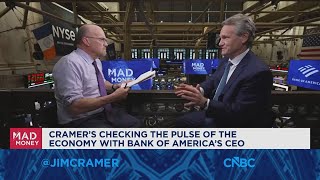
You know, there is so much speculation about the state of consumers today. I don't like to speculate. I prefer to go straight to the source. And no one feels the pulse of the consumer and the economy better than Bank of America, the country's second- largest bank by assets, which, by the way, has shown a nice 14% year-to-date growth.
Earlier today, I had the opportunity to speak with Brian Moynihan, Chairman and CEO of Bank of America, right here at the New York Stock Exchange. Our conversation comes on the eve of the 25th anniversary of 9/11, and Bank of America is making new commitments to organizations that honor the victims, rescuers, and their families.
Look. I want to talk about September 11th. We are on the eve of this date. I think your bank, as a philanthropist and a commercial enterprise, is largely responsible for the revival of this place. Why don't you tell me about Bank of America and your role in this amazing change in downtown ? If you think about Bank of America, this building is an important part of the tragic legacy of September 11, because it was the epicenter of American financial markets, and our task was to restore its operation.
This was our task, because we had to launch the securities market. But if we look back at history, Merrill Lynch is now part of our company. There was FleetBoston, which did fast-paced business, and then there was Bank of America. There was US Trust, and all these companies are now part of one. Looking back, the stories of my colleagues about how they survived that day are simply amazing.
And the reaction was instant. We will not let them break us. We will fight back . We will open again. We will bring America back to life. And all of us who worked in this industry and were fierce competitors came together to decide how to get the securities markets back up and running . A lot of corporate issuers said, we're going to buy back a bunch of shares on Monday.
We launched it, the market recovered, it was hard work, and then there was more work , but it was a story of resilience, of national unity, incredible personal stories of recovery and resilience, and also terrible stories of loss and grief. Um, it's just, you know, I think about it a lot because I was literally driving here when the plane crashed, and, I, I, and you just think about it.
This was terrorism at its worst , because they took something as mundane as flying and turned it into an act of terrorism, and America felt in danger. And President Bush, the city, the stock exchange, all the financial services companies, the whole area of Lower Manhattan recovered, and you've seen this ever since .
It's a lively place now. My daughter lived here for many years. The children are running around here again. This is a completely different place than it was immediately after those events. It seemed like it would never recover. And then we even built our house in Bryant Park, in a place that wasn't very developed at the time , you know, near Times Square.
We built that house with what were called Liberty bonds to help rebuild Manhattan because no one wanted to invest in it. And we built this house and eventually moved into it sometime in 2007 or 2008, or whenever it was. So think about how quickly a 51- story skyscraper was built. So, we are not alone, but we and our company have supported veterans, rescuers, and we recently announced another grant for the Tunnels to the Towers organization.
And we've worked hard over the last 15 years, allocating probably $100 million to help veterans and first responders. I always felt you were a soft person, boy. Well, we are strict businessmen, but sometimes it is not easy for us. I...You are like that. You are like that. Now let's talk about the present.
We are living in an extraordinary moment. You have the best data. And this data shows that things are going quite well in the country. Yes. So think about what the figures would be if we took the opposite. What would be the indicators of problems? Consumers wouldn't spend money. In August, consumers spent about 4% more than in August last year, which was also a pretty good month because it was after the day of release and recovery.
Last quarter, this figure was 5%. So everything is evolving. This is consistent with indicators of a strong , growing economy . The second is credit. Our credit statistics are the best in recent years. Debt write-offs and late payments on credit cards. You hear about record credit card debt, but the economy is, you know , 40% bigger than it has been since '19.
Everyone compares it. So what you're seeing is a return to a normal trend. And if you look at business, business lending is very strong. People use lines of credit to invest. It's been a little slower to recover after the pandemic because of trade uncertainty, tariffs— you name it, the current issue.
But, you know, they are strong, their credit rating is high, they have potential. It's more expensive , and the area most affected by higher rates is small and medium-sized businesses that borrow money under lines of credit. This largely affects mortgage rates, but it actually affects the structure of short-term rates.
So that's true, but they keep borrowing. They use these lines. The quality of loans is good. They understood a world where many things are changing. They have, in essence, found their way forward. They are still worried about gas prices and how it affects the cost of goods, but everything we see is normal.
Capital markets had a simply stunning second quarter. Fantastically. Year-over-year figures are excellent stock growth numbers. Yes, our profits increased by 30% and everything in that spirit. You know, we had a great neighborhood. What's interesting is that it will be difficult to maintain this level of growth rate, but the aggregate level of the S& P and others has been maintained, and that's good for the wealth management business.
Commissions for investment banking services fluctuate a bit, but you know, there is a lot of activity . Last year , for comparison, the quarter was also good. But we are very pleased with the growth in deposits , lending—all the things that keep the American economy going, and consumers spending, having jobs, and wages growing.
We see wages rising in the low-income group because we see their incomes. In low incomes, we had that K-shaped structure, now we are getting a little closer. The latest figures we have are very encouraging for the less well-off people in the country. Yes. So, there is an accessibility issue , and it is real for people.
Gas prices went up a dollar a gallon or so on Labor Day— that really affects people's minds, as do rents and things like that. You've seen some of these things soften over time. And what we are seeing now is a catch-up in wage growth. After Covid, there was a period—remember, we all talked about the “ great layoff” —when wage growth was very rapid, then it slowed down, and now it has resumed again.
What is encouraging is that we see two things when we divide our data into three income groups: lower, middle, and higher. In the low-income stratum, wages have increased by approximately 3.5–4%. And you see how the costs go up along with that . This is very good, because this is a large number of people, and it means that they are quite confident in their position.
Unemployment is very low. New unemployment claims are skyrocketing, but finding a job is not as difficult now as it used to be in the country. The fact is that they are trying to present the lending situation as if we should be worried. But the pie is getting bigger. One of the statistics that drives me crazy is the Fed's reports on these delays.
But if you were written off as a debtor two years ago, you still remain in the Fed's data. If you have reported to the bureau that you have a charge-off, the reality is that the level of charge-offs that are flowing through the profit and loss statements of banks and the people who provide credit is the lowest it has been in many years.
And that's great because we're going to be as aggressive with credit scoring as we can while remaining prudent and responsible. So what could go wrong? There is a whole list of horrors. The war in Iran will not end quickly. The war between Ukraine and Russia will not end quickly. There could be an escalation of problems in Southeast Asia or something similar.
There's a lot to say, but in the meantime, the U.S. economy is projected to grow by an average of two percent this year. And we don't see anything that would prevent this. Even with the Fed raising rates, we still see the economy continuing to grow. Good. You've always hired a huge number of people in the summer.
It was a wonderful time. Everyone knows you have a great program. Have you reduced the number of people you make offers to because of AI? Or maybe AI has made every person so productive that you just want to keep hiring ? We hire about 2,000 summer interns per year, 2,000 university students within a defined recruitment program.
So, 400 educational institutions, 2,000 students, 2,000 in the summer. We haven't changed anything. We are now more careful when we think about the career paths of these young people. We direct them to where there are opportunities and move them around a little more between departments. Redistribution, as we call it.
It's management's responsibility to show them places they can go , because yes, the AI methods used in investment banking today make analytics more effective. But there are thousands and thousands of other tasks that talented team members can perform, plus we can simply achieve greater productivity and more business.
So what's interesting? I think the leaders I talk to—I mean CEOs and others, and my team—we're all trying to deal with the impact of this on the people factor, because ultimately, we need talent. It takes a lot of talent. And I loved how Dara from Uber aptly said two years ago: "You're not going to lose your job today; you're going to lose it...you might lose your job to someone who knows how to use it." That's why he told you: study it, make it your tool.
The world is ahead of you; Manage it. They are enthusiastic, and when we move on to the next set of new hires, these are people who have been using AI all their college years. You made the leap. So they don't understand what we're talking about when we call AI something that will change their lives.
They say, "I'm already using it." So, it has all its pros, cons, all the discussions in the educational process, how children use it, and all that. Universities and schools are now dealing with this . But the fact is that these kids know how to use it, and that's great because they will make us better.
OK. Now, are you concerned about getting more young people into savings? For example, we read about Robinhood, which has 28 million accounts. Is it a threat to Bank of America when some of these companies attract people through crypto or gambling and then they move into IRAs and 401k? Should Bank of America be worried about this?
Well, we have Merrill Edge—a great product, and the Merrill Edge customer base is growing by about 10% every year. The average starting balance is over $100,000. So this is a more serious investor, we work with this audience, and this is our point of view. I was talking to your colleague about the last time I rang the bell, I think it was in 2006.
We announced zero commission on stock transactions at Bank of America Securities. Everyone thinks this is a new concept. We did this back then because we had a so-called online broker, and we are very satisfied with this business. I think the main thing is to teach people how to budget, save, and then save for retirement.
I was talking to a young guy the other day and he said someone advised him to max out his 401k and I said, "That's the answer." Maximize your 401k. This is important. I know you pay more attention to cybersecurity than any other company in the world . How are you feeling? I mean, how do you feel about what machines can do to us, about how they can break the system?
The situation seems more dangerous than it actually is. You can tell me, because you are a person who has seen everything. Well, we're lucky to have a very talented group of over 3,000 people working on this full-time. There is a feeling throughout our company that this is task number one, the most important job.
Don't argue about the costs that are shared between business line managers. Don't argue, just agree. They work closely with the industry. Our industry, banking and financial services, is really doing very well with this and working hard . These new tools raise interesting questions. It's incredible how quickly they find vulnerabilities, they're masters at it.
So we use them in collaboration with leading-edge model developers and others to understand how to apply them to software— open, closed, or proprietary. I was talking to an expert in this field the other day. He said, " Brian, remember that this will also help you strengthen your systems faster." Now you're thinking, "Oh God, vulnerabilities, fix, faster, faster." There will come a time when they will help you discover what you have missed.
Are there any incredibly exciting stories going on right now? They're a bit like science fiction, with all these obsessions and other things we have to contend with. And I think the companies that are building these models are starting to realize that they have to be much more careful with the limitations and are trying to figure out how to slow it down.
And this is not about slowing down ingenuity, but about containing negative aspects. We have to do this, right? You can be a leader in this because you are a leader in cybersecurity and many other areas, including banking. I want to thank Brian Moynihan, Chairman and CEO of Bank of America, BAC . Great promotion.
Fantastic work. Thank you. Thank you. Next: Did Jersey Mike's live up to expectations in its first public earnings report? Kramer will review this with the press right after the break. . Got .





댓글 0