저자: 미상 · 외국인
요약 보기
피터 린치 투자 원칙을 소개하는 교육 영상이다. 결론: 개인 투자자도 전문가만큼 종목을 고를 수 있으며, 잘 아는 기업에 투자하라는 메시지다. 린치의 경력: 1977~1990년 펀드 운용, 운용자산 2천만 달러를 140억 달러로 키워 펀드 가치 2900% 상승. 1989년 책 출간. 투자 원칙: 전문가 추종 중단, 일상에서 아는 기업 투자, 시장 예측 금지, 기업 자체를 알아야 함. 투자 성공 조건으로 인내심·상식·고통 내성·열린 마음·끈기·겸손·직접 조사 능력·실수 인정을 제시. 기업 6가지 분류: 저성장(이익 성장률 2~4%, 배당 중심), 우량(연 10~12% 성장), 고성장(연 20~25% 이상, 소형·신생), 경기순환(경기에 따라 이익 등락), 턴어라운드(일시적 부진 후 회복), 자산주(자산가치 대비 저평가). 분류는 고정되지 않음. 선호 기업 특성 13가지: 단순하거나 우스꽝스러운 이름, 평범한 제품, 불쾌하거나 지저분한 사업, 분사(스핀오프), 기관·애널리스트 미커버, 폐기물·마피아 연관 이미지, 장례 서비스 같은 기피 업종, 성장 산업, 지역 독점(니치), 반복 소비 제품, 기술을 투자가 아닌 활용하는 기업, 내부자 지분 매입, 자사주 매입. 밸류에이션: PER 분석(업종별로 비교), PER이 이익성장률과 같으면 적정, 절반이면 좋고 두 배면 부정적. 이익 증가 요인 5가지(비용 절감, 가격 인상, 신시장 진출, 기존 시장 판매 확대, 적자 사업 제거). '기업 스토리'를 만들어 이를 제3자에게 간단히 설명할 수 있어야 함. 분산: 3~10개 종목이 평균 투자자에게 적당. 우량주가 40% 오르면 매도 후 다른 우량주로 교체 같은 자금 순환 전략 제시. 매도 기준: 저성장주는 2년 연속 점유율 하락 시, 우량주는 이익 둔화·비용 절감 한계 시, 경기순환주는 수요 감소·재고 누적 시, 고성장주는 핵심 임원 이탈·성장률 둔화 시, 턴어라운드주는 회복 지표 정체 시, 자산주는 자산 매각 가격 하락 시 매도 고려. 마지막으로 주가 25% 하락을 매도 신호가 아닌 매수 기회로 보는 사고방식 전환을 강조한다. 영상은 특정 종목에 대한 가격 전망이나 목표가를 제시하지 않는다.
다듬은 글
So, for 13 years, Peter Lynch was responsible for managing the most profitable equity fund in the world during that period. His son and I managed the fund between 1977 and 1990. Peter achieved an incredible 2900 percent increase in the fund's value when he started managing it. He managed assets of $20 million, and in the end, that value became $14 billion.
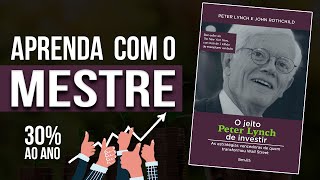
All this success made Peter very famous and attracted the attention of many investors to his strategy and investment. With all this, he decided to write his book in 1989, here in Portuguese, called "The Peter Lynch Way of Investing." Peter managed to introduce his investment concepts well, using simple language and a certain degree of humor that makes understanding easier.
If you want to understand Peter Lynch's investment principles, watch this video where I will try to explain the concepts of one of the best investment books ever written. So, leave a like and subscribe to the channel because here you will always find content like this that helps you increase your knowledge about investments.
It's good that Peter Lynch... It's very clear right at the beginning of the book his number one rule of investing: stop listening to the professionals. In his own words, 20 years in this business have convinced me that any normal person, using the usual three percent of their brain capacity, can select stocks as well as, if not better than, the average professional in the market.
Lente also highlights a series of reasons why you shouldn't follow the institutional investor. The first reason is that they might be wrong; the second is that even if they are right, you'll never know when they'll change their mind and sell a particular stock; and the third is that you may have better sources of information, and these sources may be all around you.
Timberg stocks are a big target for Lente. Timberg is a term originating from baseball and in the stock market means that a stock has appreciated tenfold. According to Lente, to achieve good results, as he says, a person needs to use their common sense. He says he has spent thousands of hours talking to his analysts and fund managers, but he really does find good companies in normal situations, just like anyone else would.
He cites an example of when he was enchanted by the Taco Bell burrito and paid close attention to... This company, which seemed like a good opportunity, see one of its phrases that summarizes this concept well: why wait? And with analysis from brokerage firm XYZ, comment on the shares of that cosmetics company.
If you work in the area and know everything about it, the brokerage analyst doesn't. He'll see the evolution of the cosmetics company until the prices have at least doubled. And in the first part of the book (link), it lists some conditions to become a successful investor. The first is that you only invest in things that won't affect your daily life in the near future.
The second condition is that you must have some specific characteristics such as patience, common sense, pain tolerance, open-mindedness, persistence, humility, the ability to conduct your own research and admit mistakes. And the third condition you must have is never try to predict market movements; instead, focus on getting to know the company you are investing in.
Secondly, investing without knowing a business is like playing poker without looking at the cards on the table. Later in the book (link), there are still six categories of companies. The first is slow-growth companies; these are companies whose profits are growing at the same rate as the economy, varying between 2 and 4 percent per year.
This happens and is very... Large companies that don't have much room to grow also tend to pay good dividends, which is why investors should invest in this type of company. Another type of company is reliable companies; in this category are good companies with solid earnings per share growing around ten to twelve percent per year.
Generally, these companies manage to survive periods of crisis very well. Another category of companies are fast-growing companies; these are small, new, and aggressive companies that grow around 20 to 25 percent per year or even more. These are companies that investors dedicate more time to searching for and analyzing because, if these companies are selected correctly, they can provide good profitability.
Another type of category is cyclical companies; this includes companies whose profits rise and fall when the economy grows or contracts, such as companies in the automotive sector. Generally, the price of these shares tends to grow very well soon after a recession period. Another type of company category is turnaround companies; these are companies with temporarily bad profits but with prospects for good recovery in the future.
And the last type of company is hidden assets; this type of stock has a lower price considering the value of the assets. A company is considered a "real estate company" as long as its assets can be sold at their book value. It's worth noting that these classifications are not permanent; for example, a fast-growing company can become a robust company or a recovery company.
Therefore, constant analysis by the investor is important to identify which category the company falls into and make the best possible decision. Regarding the type of company, some believe that the simpler the better, which is why he argues that he prefers to invest in a panty factory rather than a communications satellite.
When someone argues that any idiot can run this business, it's not considered a good thing because eventually the idiot will end up managing it. There are also 13 other characteristics that Lente considers important in analyzing a company. The first characteristic is that the company has a simple name, or better yet, a ridiculous one.
Lente loves companies with names that don't attract attention. The idea here is that nobody is interested in these companies simply because they don't have a good name, and this allows great opportunities to arise in these companies. The second characteristic is that this company produces or does something trivial.
Besides having a simple name, the company should produce something simple, like bottle caps, cans, exhaust pipes, etc. And spin-offs— I like them easier to understand and that they can bring... Good returns. The third characteristic: this company does something unpleasant. Better than just being a boring company is an action of a boring and unpleasant company, something that makes people distance themselves from the design and the business.
Here, Lente cites Safe Clean, a company that in its time visited gas stations and offered equipment to clean funny parts. The fourth characteristic is a fruit-decision company. Decision-making is a process where companies emerge from the division of a company into two or more parts. The fifth characteristic: institutional investors do not own shares in the company, and analysts do not cover the shares.
If you find a company that has no institutional investors and is not followed by analysts, you have possibly found a winning stock. Lente states in the book that when he visited a company and discovered the analyst had only appeared three years prior, he could hardly hide his enthusiasm. The sixth characteristic: this company is involved with toxic waste or the mafia.
Link likes companies that do simple and unpleasant things, so he cites the waste management sector. According to him, it is difficult to find a more profitable business, and in the case of being involved with the mafia, Lente states that even a rumor of this is enough to distance investors. The seventh characteristic: this is the...
Something discouraging about this is that the link cites as an example an American company that provided funeral services. Because it was a discouraging business, it was rejected by investors for a long time, even though it had good fundamentals. The eighth characteristic is that of a growing sector of activity.
According to Peter, a growing company doesn't have competition problems; you don't have to protect yourself from potential competitors because hardly anyone is interested in entering this field, and this provides room for the company to grow without many problems, thus generating great opportunities for investors.
The ninth characteristic is that this company has a niche. Having a niche for a lens is a company that has a competitive advantage in a specific location. He cites as an example a quarry in a city; for local residents, it will always be more advantageous to buy from that quarry than from another city.
The tenth characteristic is that people need to continue buying the product. Razor blades, medicines, cigarettes are examples of products that the same person needs to consume several times. This gives more solidity to the business than companies that need to constantly invent new products. The eleventh characteristic is that this company is a user of technology instead of investing in it.
Computer companies that struggle to survive are... An endless price war: why not invest in companies that benefit from it? This allows the company to always have increasing profits if it is well managed. The twelfth characteristic is that these people who are part of the company buy their shares to see the future.
There is no better way to assess the likely success of a stock than for the company's own members to be putting their money into the business. There is also another long- term benefit: this also makes shareholder remuneration a priority. And the last characteristic is that this company is recovering its shares.
Buying back shares is the best and simplest way for a company to reward its shareholders. If a company buys back its shares, it removes part of the shares from the market, and this can have a good effect on earnings per share. If your company buys back half of its shares, and the profits remain constant, earnings per share double.
This can have a positive effect. And to avoid choosing companies that will not bring good returns, the author evaluates the profits of companies. He highlights in this book the analysis of the P/E ratio, which is obtained by dividing the price per share by the earnings per share. A low P/E ratio may indicate that a company is being sold at a discount price; P/E values tend to be lower.
For slow-growing companies and larger companies, for fast-growing companies, including scientific companies, the link also warns that the P/E ratio should be analyzed according to the company's category; we shouldn't compare apples to oranges. There's another tip the link gives us about the P/E ratio: the P/E ratio of any company that is being properly priced will be equal to its earnings growth rate.
If the P/E ratio is less than the earnings growth rate, you may have found a bargain. In general, a P/E ratio half the growth rate is good, while one that is double the growth rate is negative. The link also cites five factors for increasing company profits: reducing costs, raising prices, revitalizing and expanding into new markets, selling more products to existing markets, or eliminating unprofitable operations.
These factors should be taken into account when you are building the company's story. The company's story is nothing more than the arguments that show why the company will increase its profits. To build the story, you must first find out which of the six categories the company is in, then you must know the MC/P ratio to know if the company is being sold.
at a discounted price and lastly, you should seek as much information as possible in order to understand what can bring growth to the company's profits in the future. The expert suggests reading annual reports; sometimes it's important to show accounting assets. Contact the relationship department and, if possible, visit the company headquarters.
The story should be simple and short; you should be able to explain to your neighbor or friend why you decided to invest in this company. From there, it's necessary to know how this story is unfolding as the company discloses information and its results. Interlink is an advocate of diversification; for him, you should have many stocks when there are situations where you have an informational advantage or have discovered an interesting company that meets all the criteria of a good company.
However, he warns that it's not good to diversify just for the sake of diversification; you need to know a business you are investing in. For the average investor, he says he would feel comfortable with three to ten stocks in his portfolio. Furthermore, he emphasizes that if you want to have a timber company in your portfolio, the more stocks you have, the more chance you have of finding a timber company, and also the more flexibility you have to rotate your resources among the various types of stocks.
This is the central point in the investment policy. Regarding milk, he never said that more than thirty to forty percent of companies are fast-growing; the rest he divided into other categories, with ten to twenty percent being reliable companies, ten to twenty percent being cyclical companies, and the rest being turnaround companies.
See this excerpt from the book that summarizes his strategy well. I believe a good strategy is to generate resources among the stocks according to the price evolution in relation to the story you formulated. For example, if a reliable company has a forty percent appreciation of its shares, which is all I expect from a company of this type, and there is nothing different about the company, and it makes me think that good surprises are to come, I sell the shares and replace them with another reliable company that I think is good and that has not yet appreciated further.
At the end of the book, Lente also establishes some criteria for selling shares. The second to sixth categories of companies that we have already discussed are slow-growth companies, which should be sold when the company has lost market share for two consecutive years, is hiring a new advertising company, and when there is no product created and the company seems to be dormant.
You should also be on alert when there are two business acquisitions and there is no... Nothing to do with the core business, and also when the company went from a lifeless position with millions in cash to a position with no cash and millions in debt, be wary of reputable companies. If the company has a profit margin of 15 while similar companies have a profit margin of 10, also check how much a company director earns.
If you bought shares in recent years when the profit growth rate has been falling, or if the company is only growing because of cost cutting, and also when the growth rate has to be reduced, and even if the company has maintained profits and cut expenses, the opportunities for cost cutting are limited.
Civic companies: see if the demand for the product is falling; this means the company is trying to cut costs but cannot compete with other producers and other countries. Also, see this increase in inventory volume and if the company cannot get rid of it. Fast-growing company: see if top executives or important employees have left the company for a rival.
Also, look if the company has a profit margin of 30 while profit projections for the next two years are for growth of fifteen to twenty percent. Recovery company: see if the lives that were falling in the last four quarters have started to grow again and also if inventory is rising. Double the sales speed.
Also check if the company's equity is inflated in relation to light projections in companies with hidden assets. See if the division or land that wanted to be sold for 20 million was sold for 12 million. Also check if the company has a debt surge that could reduce the value of assets. And to close this video, I would like to present what, for me, is one of the best concepts presented in Peter Lynch's book.
The goal here is to change the mindset. There are more than 7 factors related to market downturns. On days when a drop in stock prices is just a tragedy, if you sell at that price and never buy more shares again, moments of decline, if well used, are opportunities to obtain many bargains. I see that Peter Lynch says, "If you can't convince yourself that when my stocks are 25% down I'm a buyer, and eliminate the fatal thought that when my stocks are 25% down you 're a seller, then you'll never make a decent profit from stocks." And these are the principles presented in the book, "The Peter Lynch Way of Investing." Certainly, there are many more things to be addressed, but you'll only understand by reading the book.
Everything this mega- investor has to teach us is definitely worth reading. I hope you enjoyed the video. Until next time, and a big hug!

댓글 0