저자: Seth · 외국인
요약 보기
마이클 베리가 캐터필러(CAT) 신규 공매도를 공개했다는 소식을 중심으로, 캐터필러의 AI 데이터센터 발전기 수요에 따른 프리미엄 밸류에이션이 과열이라고 진단한다. 주가는 1년간 150% 이상 상승해 PSR 30년래 최고, 선행 PER 약 31배로 경기민감주치고 과도하다고 주장한다. 매출은 경기순환 영향을 받고 관세로 2.6억 달러 비용 부담과 영업이익률 하락(약 20%→17%)이 있다는 점을 리스크로 든다. 다만 데이터센터 전력수요라는 구조적 테마의 장기 성장 가능성도 함께 언급한다.
다듬은 글
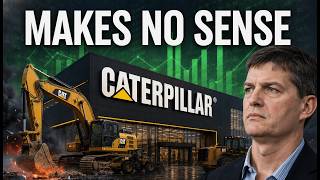
Caterpillar shares are trading at a record high—over $1,000 a share—but the market values them as a software giant, not a heavy industrial manufacturer . Now legendary investor Michael Berry has shocked Wall Street by selling stocks short for the first time in history. Historically, he has been a powerful bull in the heavy industrials market, often holding long positions in Caterpillar stock.
But his sudden move to short positions tells us that something is fundamentally wrong with how the market values this company. He revealed his position in the Substack newsletter “Cassandra Unchained,” explaining that the business in no way supports this assessment. We are witnessing a historic break where a cyclical tractor manufacturer is being evaluated as a game of picks and shovels for artificial intelligence.
We will analyze both sides of this deal to see whether Berry is right or whether he is missing a large-scale structural transformation in global infrastructure. Michael Berry is best known for his massive bet against the subprime mortgage crisis, but his latest moves demonstrate a broader focus on what he calls the artificial intelligence bubble.
On the last day of June, he disclosed a new short position in Caterpillar worth just over $1,060 per share. This came at the same time as new short bets against chip giant Nvidia, semiconductor equipment maker Applied Materials and the semiconductor stock index known as SOXX. He was historically right to take some of these steps, including warning about overvaluations of high-performance technologies.
But Caterpillar is a completely different creature compared to the tech giants. This is a 90- year-old manufacturer of bulldozers and mining equipment that has long been his favorite. For him, a bearish trend means that he sees systemic overstretch in the market. The stock has risen more than 150% over the past year, moving from a cyclical heavy industrial valuation to a software-like premium .
Berry noted that the semiconductor index has the largest stretch relative to its 200-day moving average since the peak of the dot-com bubble. He believes that the massive capital spending plans announced by global chipmakers are actually the beginning of the end. By selling short positions in Caterpillar, he is betting that physical construction of data centers and factories is approaching its cyclical peak.
Now, a broader basket of short positions, and what Berry is really saying is that investors are simultaneously crowning too many companies as winners in the AI space. He is also shorting Tesla, Micron, and Palantir, indicating widespread skepticism about the current tech boom. His experience in identifying overextended trends is why institutional investors closely follow his reporting.
However, some on Wall Street believe his bearish bet is misplaced this time. Now we have to look at why Caterpillar is performing so incredibly well in the first place . The market doesn't just buy tractors. He is betting on the enormous energy needs of artificial intelligence. Big tech companies are building massive data center campuses that require unprecedented amounts of electricity.
With aging electrical grids unable to handle the load, these data centers are increasingly relying on local power generators. Caterpillar is a world leader in the production of powerful diesel and gas generators. Wall Street analysts argue that this is a structural theme, not just a temporary hype. They believe Caterpillar has every opportunity to capture a huge share of this energy infrastructure market.
The stock also benefited from its recent addition to the Russell top 50 index, which prompted passive mutual funds and index trackers to buy up the stock. This created a huge wave of buying pressure that pushed the stock to a record high. Some analysts are setting price targets that suggest the business has fundamentally changed from a cyclical builder to a secular technology utility company.
They believe that the structural shift to local energy supply will support the premium valuation for many years. This structural theme is becoming a powerful driver of industrial stocks across the sector. And of course, welcome back to the channel, everyone. I am Seth, and this is my digital clone. I love finding amazing undervalued stocks and I often go against market sentiment.
If you like what you hear, please consider subscribing to stay up to date and also straight to the point. To understand the bullish scenario, we need to look at how these massive data centers are built. Every new facility requires heavy excavation, site preparation, and foundation work before even a single chip can be installed.
This means that Caterpillar excavators and bulldozers are the first machines on earth. When you combine this early construction demand with long-term on-site backup generator sales, you can see why investors are so excited. The company's core business of selling and renting heavy equipment remains incredibly stable, supported by strong dealer inventories and steady demand.
This is a highly profitable business with a wide economic moat, making it a very high-quality company. But the main debate is whether this quality justifies paying a premium that we have never seen in the history of the industrial sector . If the underlying business cannot support this price, then the current valuation is built on sand.
We must analyze whether growth forecasts are realistic or whether they are driven by market euphoria. Many retail investors buy at the top, hoping the momentum will last forever. However, professional analysts are beginning to urge caution as cyclical indicators begin to peak. We need to analyze the actual numbers to see who has the stronger argument.
When we look at historical and projected revenue growth, the numbers tell a very specific story. Caterpillar is a mature cyclical company that has historically grown its revenue close to the pace of global economic growth. In the first quarter of last year, we saw revenue decline 10 % year-over-year to just over $14 billion as dealers reduced their inventory.
However, the company showed a steady recovery until the third quarter of last year, when sales rose 10% to more than $17 billion . This recovery was driven by strong sales of equipment directly to end users in the construction and mining industries. For the full year, the company's revenue remains stable, but projected growth rates over the next few years are expected to return to single digits.
This is the essence of Berry's argument. Even though demand for electricity for data centers is growing rapidly, it represents only a portion of Caterpillar's overall business. The vast majority of their revenues still come from traditional construction, road building, and global mining operations. These sectors are very sensitive to interest rates and general economic conditions.
Wall Street's forecast of continued double-digit growth seems to ignore the cyclical reality of the global construction market. We must remember that heavy equipment purchases are capital-intensive and easily postponed during economic downturns. When the construction sector slows down, dealers' inventory quickly builds up , leading to significant price declines.
We have seen this cycle several times over the past 40 years. Believing that this time things will be different is a classic mistake made during market peaks. Growth projections should be based on reality, not speculative future scenarios. Let's look at how global economic policy affects these numbers.
Another key factor influencing the dynamics of stocks and their public image is political support. Former President Donald Trump has repeatedly publicly praised Caterpillar, calling the company incredible during his speeches on economic development and manufacturing in the United States. He praised the company's role in what he called the ongoing construction boom in the United States.
This political balance has historically bolstered investor confidence, as the company is seen as a key indicator of America's industrial might. However, the political landscape also poses significant risks that the market may be ignoring. Earlier this year, Caterpillar said trade policies and tariffs could cost the company about $2.6 billion .
The company imports a huge amount of raw materials and specialized parts for its domestic manufacturing plants. When tariffs are introduced , they directly put pressure on the rate of profit. In fact, according to their recent earnings reports, the company's operating profit margin has shrunk from nearly 20 % to just over 17% due to rising production costs and the impact of tariffs.
While Trump has called on companies like Caterpillar and John Deere to lower the cost of equipment for farmers, his trade policies have simultaneously increased their operating costs. This double-edged sword is a major risk factor for a global exporter like Caterpillar. Their international sales are subject to corresponding tariffs and currency barriers, which can quickly erode domestic profits.
If global trade tensions escalate, the company's supply chain could face serious disruptions . We must also consider how these political factors affect the allocation of institutional capital. Some large funds are starting to reduce their exposure to industrial exporters due to these growing geopolitical risks.
Political praise may make headlines, but it is the underlying tariff costs that actually show up on the balance sheet. This is a critical risk factor that Berry likely factors into his bearish thesis. This brings us directly to the assessment indicators that form the basis of our institutional analysis.
Caterpillar's price-to-sales ratio recently hit a 30- year high, reflecting extreme optimism. The stock is currently trading at a forward price-to- earnings ratio of approximately 31 times projected earnings. By comparison, a mature industrial company typically trades at a forward multiple of 15 to 18 times earnings.
Paying over 30 times earnings for a highly cyclical business means there is absolutely no margin of safety. If we analyze operating cash flow to sales, the company's profitability has historically been excellent, consistently within 10-15 percent. But if you look at the price/ operating cash flow ratio, it is also trading at historical extremes.
The gap between today's stock price and fundamental fair value is wider than we've seen in decades. Even some of the more optimistic Wall Street analysts have price targets that indicate a potential near-term decline to around $910. If the global economy slows or if technology companies cut their capital spending on data centers, Caterpillar's valuation could quickly return to its historical average.
This supports Berry's view that stocks are very vulnerable to a significant correction. We should also analyze the company's return on invested capital to see if it is generating enough value to justify this premium. While their return on capital is high, it is not high enough to support a valuation similar to that of software.
Cash flow generation is stable, but it cannot grow fast enough to meet current market expectations. When you buy cyclical stocks at peak earnings and peak multiples, you are setting yourself up for low long-term returns. This is a simple mathematical reality that the market is currently ignoring. We need to focus on the money, not the narrative, to protect our portfolios.
In conclusion, Caterpillar is undoubtedly an outstanding company with a dominant market position and excellent profitability. However, the current share price seems to reflect the volatile level of hype surrounding AI infrastructure. Michael Berry's decision to short the stock highlights the dangers of paying software- like valuations for cyclical industrials.
Investors must weigh the long-term growth in data center electricity demand with the cyclical realities of global construction and rising tariff costs. We must make our own informed decisions , as this is solely my opinion and my personal path. Therefore, you should always do your own research first.
Thanks for watching. I sincerely respect every viewer who takes the time to seek out objective , data-based analysis .


Comments 0