저자: MarcFaber · 외국인
요약 보기
영상은 Marc Faber의 인도 시장 20% 폭락 경고를 검증한다. 인도 Nifty의 선행 PER 19~19.5배로 밸류에이션이 높고, 2026년 1~5월 외국인 순매도가 2025년 전체를 넘었으며, MSCI 신흥국 지수 내 인도 비중이 20%대에서 12% 미만으로 떨어졌다고 설명. 달러 기준 인도 시장은 지난 12개월간 하락했으나 유럽·브라질 대비 부진. 진행자는 Faber의 과거 예측 실패(2009 하이퍼인플레이션, 2012 경기침체 등)를 들어 경고를 맹신하지 말고 데이터 기반으로 판단하라고 권고.
다듬은 글
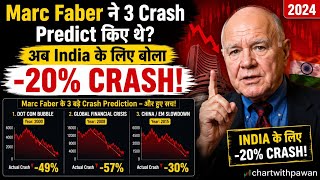
So let's see what the market is saying. Welcome to Chart V Pawan's Financial Markets Futures. A claim is spreading like wildfire on social media these days about a legendary investor who had predicted the 1987 market crash, the 1990 Japan crash and the 2007 US housing bubble. Now he is directly warning about the crash of the Indian market.
Sounds like a very dark prophecy. Isn't it? So let us deeply investigate the complete truth of these viral claims in this analysis. Now it is very easy to panic after seeing such a scary headline. But to avoid any kind of fair money-mongering, we have to think a little logically. We need to examine this specific investor's entire 45-year track record and his hundreds of predictions based on exact data and facts.
Only then will we be able to understand how much weight this claim has and how much is just noise. So first of all it is very important to know who is this Mark Faber? He is a renowned Swiss investor who has been specializing in emerging markets since the 1970s. The world knows him for his contrarian views.
That is, when everyone is bullish in the market, it is often bearish. And they also have a newsletter whose name perfectly suits their personality. The Gloom Boom and Dum Report. That is why he is called Doctor Dum in the market. This legendary status of his in the market did not happen overnight. This was confirmed by that famous day of October 1987 which the world calls Black Monday.
He advised his clients to withdraw their money from the stock market just before the crash and as soon as the market opened, the Jones suddenly fell by 22 to 23% in a single day. That one right call saved his clients from huge losses and made him a big star in the market. It is not that he had hit only one target.
While it's a little difficult to verify predictions like the 1990 Japan Crash, they genuinely have some calls that turned out to be absolutely true. Such as predicting the rise in gold prices in 2001, correctly identifying the weakness of the US dollar in 2002 and giving brilliant advice to Swiss pension funds to withdraw their money from the US market just before the 2008 housing crisis.
This clearly shows that they definitely have the ability to look at the market in a different and deeper way. But and this is a very big but. The viral social media posts that are creating an atmosphere of fear these days cleverly hide their major predictive failures. When we look at those flop predictions, it completely changes how we should judge their warnings today.
For example, just look at his prediction from 2009. He had said publicly with 100% confidence that due to zero interest rates, there will be terrible hyperinflation in America just like in Zimbabwe. The same Zimbabwe where inflation had reached 89 sextillion percent. But what happened in the actual reality?
US inflation remained fairly normal, between 1.5 and 3%. It was such a big and scary prophecy that it flopped badly on the ground. If you look at their data and track record, it is full of messages and wrong calls. In 2008, he claimed that recovery would take 5 to 10 years. But the SNP 500 increased by 48% in just 2 years.
In 2012, he literally guaranteed a global recession. But the world economy remained stable. He called Obama's re-election a market crash. The upside market went up 31%. Another Black Monday warning was given in 2013. But even that year the market continued to grow. Meaning, when their predictions were causing havoc in the market, in reality the market was absolutely rocketing.
This represents a very interesting financial and psychological concept. Which is called the broken clock effect. What happens is that when an analyst consistently predicts disasters and crashes year after year, a market crash will inevitably occur, and when it does, the media portrays him as a genius just to gain views, and all his past wrong calls are conveniently forgotten.
Even a stopped clock tells the correct time twice a day. Right? So now that we understand this background, let's move straight to their India 2026 warning. After all, what is the data actually saying and is there really any truth in what it says ? In his recent business interviews, Favre has very clearly stated that India has entered a bear market and the market may fall further by 20% from the existing levels.
But the thing to notice is that he is not saying that the Indian economy is weak or is performing poorly. Their main issue is simply expensive stock valuations. And he uses a solid and truly worrying metric to back up this point. Nifty is currently trading at 19 to 19.5 times forward earnings ratio.
Look, this is a highly expensive valuation zone that we have not seen since the post-Covid boom. So practically this data point definitely gives a strong foundation to their warning. Along with this, he keeps another crucial data point. Activity of foreign institutional investors. FIIs are exiting the market in large numbers.
They have sold more Indian equities in the first 5 months of 2026 than they did in the entire year 2025. The effect of this continuous selling has been that India's weight in the MSCI Emerging Markets Index, which was earlier at a peak of 20%, has now fallen dramatically to below 12%. Apart from this, it is also very important to understand the angle of dollar and rupee terms.
He strongly emphasizes that even though the Indian market appears to be doing well in rupee terms, the Indian market has actually fallen in dollar terms in the last 12 months. Just compare it with the rest of the world. Europe's Stoxx 50 index is up 30%. The Brazilian market is up 55%. Whereas in comparison, the Indian market is essentially severely underperforming.
So what is his final advice after this entire analysis? The same one that has been honestly advising for the last 30 years that investors should move their money out of stocks and into cash, bonds, and precious metals like gold and silver. He believes the real trigger button for this 20% crash will be pressed the day corporate earnings start missing estimates.
Then these expensive valuations will not be sustainable. Now the question arises of the reality check. Putting together both parts of our investigation, the data and the history, how should an investor interpret this scary 20% crash prediction ? To understand this properly, we have to separate the message from the messenger.
Look, on one hand, the hard data that we have in front of us that valuations are genuinely high and FIs are actually withdrawing money from the market is an absolutely true and verifiable fact. But on the other hand, just because Marc Faber predicted a crash. It would be a big mistake to consider that crash as absolutely set in stone.
Their entire history is filled with such permanent bearish predictions that have always proven wrong. So the most logical approach is that we should respect the data completely. Clearly acknowledge the high valuations of the market and keep in mind the selling trend of institutions. But take any drastic decision regarding your portfolio only on the basis of data and independent thinking and not by listening to the fear monitoring of some analyst whose name itself is famous for predicting disaster.
And with this thought, this analysis raises a very important question. The data is quite clear that valuations are high. But what do you think of yourself, given this messenger's past false alarms ? Will the Indian market really see a genuine major market correction or is this just another loud overhyped headline that will be forgotten in history like many such predictions before it.
Definitely think about this. Thank you so much for joining us for today's Deeply Data Driven discussion.
Comments 0