저자: 미상 · 외국인
요약 보기
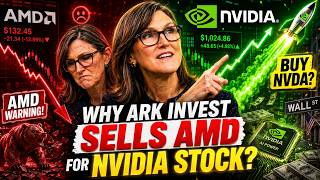
ARK의 캐시 우드가 AMD 비중을 줄이고 엔비디아를 매수 중이라는 점을 언급하며, AMD는 추론 AI와 데이터센터 CPU 수요로 성장 여지가 크다고 봄. 엔비디아는 PER이 낮고 매출 고성장(전분기 85%, 다음 분기 95% 예상)이라 더 매력적이라 평가. 애플의 엔비디아 AI 가속기 채택도 언급. 마벨은 데이터센터 연결 수요 호조로 성장하나 주가가 급등해 밸류에이션 부담이 크고 고객 집중 리스크가 있어 신중 관점 제시.
다듬은 글
Cathy Wood of Ark Investment has established herself as an advocate for stocks with potentially revolutionary technologies. As of the end of April, her flagship Ark Innovation ETF had mixed outcomes, rising 49% over the previous year, but falling 8.7% on average over the previous five. However, her movements are usually noticeable.
She has recently been purchasing shares of competitor Nvidia while reducing her investment in Advanced Micro Devices. Let's see if investors ought to do the same. Although Wood has reduced her ownership of AMD, it is still her fifth largest asset. The stock's valuation has increased to 35.5 times 2027 analyst expectations due to its fourfold increase over the last year.
Her recent choice to grab a portion of the income was probably influenced by it. Nonetheless, AMD is situated at the nexus of two potent developments in artificial intelligence that should support its future performance. Inference is the first, and its graphics processing units, GPUs, are ideally positioned to gain market share.
Nvidia's CUDA software excels in training, which is more technically hard than inference, and its chiplet design packs in more memory, which is crucial for inference. The business has committed to two significant GPU agreements, each believed to be worth $100 billion. Furthermore, Anthropic is expected to employ its next generation semiconductors.
AMD now appears to be a formidable alternative for inference, having previously been an afterthought to Nvidia in AI model training. Additionally, Igen AI presents a significant possibility for the organization. AI agents require sequential reasoning and the ability to work with external tools, both of which GPU struggle with.
However, GPUs are excellent at supplying the muscle to train AI models and do inference. Central processing units, CPUs, which function as a computer's brain, are responsible for that task. Consequently, it is anticipated that the GPU to CPU ratio will decrease from 8.1 with training to 1.1 with a genic AI.
Given that AMD is a market leader in data center CPUs and has continuously overtaken competitor Intel, this is a tremendous opportunity for AMD. AMD has projected that this industry will grow to $120 billion in the upcoming years, while Nvidia believes it might reach $200 billion. With just under than $35 billion in total revenue in 2025, AMD is poised for rapid expansion in the years to come.
Because of this, I believe the stock is still a smart investment. It's understandable why one would be drawn to Nvidia, given that the company is now selling at a forward PE ratio of just 16 times fiscal 2028, ending January 2028 analyst projections. In addition to being inexpensive, the company is expanding quickly.
Its revenue increased by 85% to $81.6 billion in the previous quarter, and it predicted a 95% increase in revenue to $91 billion in the second quarter. Nvidia is gearing itself for inference and agentic AI, but it is still the unchallenged champion in AI model training. While the company's acquisition of Groq included language processing units LPUs intended for inference, it has also developed its own arm-based CPUs.
It provides a unique solution in this field by cleverly combining its GPU with LPUs to handle the prefill and decode phases of inference independently. Nvidia can now provide end-to-end servers devoted to particular AI workloads such as training, inference, and agentic AI in addition to its networking portfolio.
Which stock is better to purchase? Nvidia seems like the more appealing semiconductor stock right now in my opinion given its value and ongoing growth. However, given AMD's enormous future potential, I believe investors can own both. Apple is using Nvidia's AI accelerators to power Apple intelligence features and its redesigned Siri virtual assistant, which is a change from the status quo and brings the two tech behemoths closer together after more than 10 years of little business collaboration.
Apple said at the Worldwide Developers Conference WWDC that it is for the first time extending its privacy-focused cloud architecture for Apple intelligence, private cloud compute PCC, outside of its own data centers. Apple's own silicon was utilized in the PCC data centers until recently. In order to support new Apple intelligence workloads on Google Cloud servers outfitted with Nvidia GPUs, Apple has recently expanded its partnership with Google and Nvidia.
Nvidia claimed in a blog post on Tuesday that its confidential computing GPUs are utilized for server-side inference for Apple foundation models and for confidential inference in Apple's PCC. According to the business, Nvidia confidential computing technology offers a hardware-based security layer for AI workloads, safeguarding data throughout processing by isolating processes in trusted execution contexts and confirming system integrity prior to transmitting sensitive information.
From a significant hardware collaboration, the relationship between Apple and Nvidia developed into a protracted corporate conflict. In the 2000s, Mac computers relied heavily on Nvidia's GPUs. However, following what Apple claimed were a specific set of chips that led to Mac malfunctions, disputes over product design and control, licensing disputes, and Apple's larger plan to lessen reliance on outside chip manufacturers, Apple moved away from them.
After switching to GPUs from Advanced Micro Devices by 2015, Apple introduced Apple Silicon in 2020, including its own GPU designs and removing reliance on other graphics providers for the majority of Macs. Apple has mostly resisted becoming a significant direct consumer of Nvidia's AI chips, in contrast to Microsoft, Amazon, Meta, and Google.
Instead, it relies on Google's TPUs and rented Nvidia GPU capacity through cloud providers for some AI training workloads. According to Moor Insights & Amp Strategy CEO Patrick Moorhead, Nvidia seems to have benefited from the development. Nvidia and Apple have reconciled. Without a doubt, Nvidia prevailed in that standoff.
It's been a long time since I recall Apple giving in after harboring resentment for around 10 years. It just illustrates the worth, strength, and opportunity. Moorehead commented on X that Nvidia maintains its technology. During an on-stage speech at the Computex convention in Taipei last week, Nvidia CEO Jensen Huang of Marvell Technology addressed the CEO of Marvell saying, "Ladies and gentlemen, this is the next trillion-dollar company." One of the most significant increases in the chip designer stock has ever occurred as a result of the endorsement, which came from perhaps the most powerful person in artificial intelligence, AI.
The day following Huang's statement, Marvell's stock increased by almost 32% the largest one-day rise in the company's history, and by Thursday, it had reached a record high. Then, the atmosphere changed. The stock fell around 16% in Friday's sector-wide sell-off, which was the biggest decline among major chip stocks.
The announcement that Marvell will join the S&P 500 later this month caused it to rise back toward $300 on Monday. However, as of this writing, it has dropped more than 11% on Tuesday. The stock has more than tripled in 2026 alone, outpacing the S&P 500 in gain even after this whipsawing. Is it possible for Marvell's market value to increase from $225 billion to $1 trillion?
After such a crazy week, is the growth stock worth purchasing? Marvell creates the high-speed optical links and switches that enable hundreds of AI chips to exchange data rapidly within data centers, as well as specialized processors made for specific cloud clients. And lately, the company's primary focus has been on its work for cloud clients.
In fiscal 2024, it accounted for 40% of total sales. In fiscal 2025, it was 72%. In fiscal 2026, it was 74%. And in the fiscal first quarter of 2027, which concluded on May 2nd, 2026, it reached 76%. And this change has been accompanied by extraordinarily rapid growth. Marvell reported record revenue of $8.2 billion for fiscal 2026, up 42% from the previous year.
Sales of data centers alone increased by roughly 47% to $6.1 billion. In the most recent quarter, the momentum persisted. Data center revenue increased by 27% to $1.83 billion. While fiscal Q1 revenue increased by 28% to a record $2.42 billion. The greatest and fastest-growing component of that data center industry is connectivity, which the CEO of Nvidia highlighted.
During the firm's fiscal first quarter results call, Marvell chairman and CEO Matt Murphy stated, "Demand for our interconnect products continues to accelerate." The company also increased its projected growth for that business to more than 70% in fiscal 2027. Additionally, the CEO mentioned a strengthening partnership with Nvidia in the areas of optical networking and bespoke silicon.
Much less than $1 trillion. However, Marvell and the trillion-dollar club are still far off. As of this writing, the company's market value is approximately $225 billion. Furthermore, it was less than $280 billion even at the record high set last week. The stock would need to more than treble from here to reach $1 trillion, which would probably take years of the kind of growth the company is aiming for with few setbacks.
Additionally, the stock's valuation already takes a lot into account. The stock is trading at a price-to-earnings ratio that is not too far from 90 even on its adjusted profits. Additionally, there are dangers unique to the company. Marvell's success is largely dependent on a few set of large cloud customers and their desire to continue investing on custom AI chips as data centers currently account for nearly 3/4 of the company's sales.
The growth narrative might end abruptly if that investment slows down or if a significant client creates a chip in the future without Marvell Technology. Huang could be one of the most reliable voices in AI. However, a forecast is not a certainty even from a CEO with his experience. Marvell's business is doing well and it appears that the company is crucial to connection in the AI future.
However, the stock has already had tremendous success and the last week demonstrated how rapidly attitude can change. Investors would wish to exercise caution for the time being. This appears to be a high-risk investment since despite its enticing story, the price has risen significantly.


댓글 0