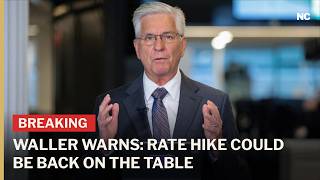
저자: ChristopherWaller · 외국인
요약 보기
연준 이사 Waller는 경제 성장과 노동시장은 양호하며 물가는 아직 목표 2%를 상회(3개월 근원 PCE 3.05%)하지만 하락 추세라고 진단. 에너지·관세발 인플레는 대부분 반영됐다고 봄. 8월 물가 지표가 둔화를 확인하면 현 금리 유지, 물가가 높게 나오면 금리 인상을 검토하겠다는 조건부 입장. 비시장 서비스 가격(증권 중개수수료 등)의 측정 방식 변경이 PCE를 소폭 낮출 것으로 예상.
다듬은 글
More broadly, one signal of continued growth in business spending was another improvement in July in sentiment among purchasing managers in non-manufacturing companies to a level that I would also call stable. New orders for these firms, which make up the majority of businesses in the economy, continued to rise in July, and the index of supply problems continued to improve.
Today we will receive the results of the August survey in the non-manufacturing sector. So we'll see if this trend continues. Combining the various components of the economy, I expect real GDP to grow by just over 2% this year. This is a quite decent result, considering all the uncertainties I mentioned .
Now let's move on to the labor market, which is also in satisfactory condition. Although there were signs of weakening labor demand relative to supply in the second half of 2025, these signs have disappeared. Job creation , while somewhat erratic, has increased by an average of 60,000 per month this year as of July.
This is close to, or probably slightly above, estimates of what is needed to match slow labor force growth, largely due to much lower net immigration . Employment growth has spread to most sectors of the economy in recent months, and the unemployment rate fell slightly to 4.1% in July . This is a historically low figure, slightly below the median long-term equilibrium rate projected by FOMC participants.
Layoffs and initial unemployment claims are also at low levels. I expect similar figures tomorrow when we get the August employment report. Since economic activity and the labor market are in good shape , they are not a determining factor in my decision on the appropriate parameters of monetary policy.
However, they provide an important backdrop for the aspect of the forecast on which I am now focused— inflation—and my judgment of the extent to which the current policy stance is conducive to returning inflation to 2%. More on this later. Inflation is currently well above the FOMC's 2% target and has been above it for 5 and a half years.
In July, prices based on the Personal Consumption Expenditures ( PCE) index rose 0.2%. And core prices, excluding food and energy, increased by 0.2%. While I was pleased to see this monthly core inflation figure as it continued the trend of lower monthly readings we saw earlier in the year, what caught my attention in the latest PCE report was that non-market services prices accounted for about half of the increase in core PCE prices.
As you probably know, I don't like to single out individual categories in my PCE inflation estimate, but non-market services have always been a problem for me because they are estimated rather than real price changes. So, ignoring this factor, I think core inflation looks even better than last month's numbers suggest.
PCE prices are now up 3.7% year-over-year over the past 12 months, and core PCE inflation is 3.3%. While it is important to recognize this 12-month increase because of the real impact on businesses and consumers, it is not the best guide to the current state of inflation. I say this because, despite the uncertainty about the geopolitical factors that have driven up prices, I do not see increased energy prices and tariffs as a significant source of ongoing inflationary pressure.
The data suggests that the price impact of tariffs is largely already factored into inflation, and my previous concern that higher energy prices would spread to many goods and services has not yet materialized. After these price shocks, to understand the current inflation trend, it is worth focusing on more recent data, such as how inflation measured over the past three months has changed over the year.
To deal with the volatility of energy prices, I will focus on core inflation excluding food and energy, which is usually a good guide to future inflation. Three-month core inflation is now 3.05% for July, a level that still falls short of the FOMC's 2 % target. Nevertheless, it is important to note the trend .
Three-month inflation has been steadily falling from 4.76 % in February to today's 3.05%. This is a significant change in the three-month inflation rate. This is a significant improvement. And the speed of this downward trajectory is encouraging. One factor that I expect will slightly reduce reported inflation is the expected change in the way the Department of Commerce assesses commissions paid to stock traders and related professionals.
This change in the estimation of non-market prices, which I expect to be made soon, could lower 12-month PCE inflation by a few tenths of a percentage point. Given my comments on pricing non-market services, I see this as a welcome correction to the measurements. At the same time, I see certain risks of rising inflation.
Energy prices have risen again and remain significantly higher than in early 2026, and the economy faces both price pressures on technology goods related to the development of AI and the possibility of further tariff increases. But unlike the period of high inflation after the pandemic, wage growth, taking into account labor productivity growth, is generally consistent with the expectation that inflation continues to decline to 2%.
I also consider the fact that public views on future inflation may deteriorate after a prolonged period of inflation above the FOMC target. Fortunately , the Fed has a very good track record of meeting its commitments, and we have not seen a significant increase in long-term inflation expectations. But this should be recognized as a risk that the FOMC should be prepared to act on if long-term expectations begin to rise and progress in fighting inflation reverses.
So, this brings me to my monetary policy outlook, which I announced at the beginning of these remarks. Today, the labor market is stable, employment is close to its maximum sustainable level, and inflation is slowly but surely moving towards the 2% target. We will get another employment report tomorrow and another inflation figure before the next FOMC meeting.
I don't expect employment data to deviate significantly from what we've seen before. Therefore, my decision on the appropriate policy stance will depend largely on what we learn about August inflation. If there is further progress towards our 2% goal, I am ready to support keeping the policy rate at the current level.
But if inflation turns out to be high, I will consider raising the rate. I believe that policy is currently only slightly constraining aggregate demand, and it may not take a big acceleration in inflation to push me to support tighter policy. If there is evidence that progress towards 2% inflation has stalled in August, a small adjustment to our position will help ensure its recovery.
In conclusion, I want to talk about central bank communication, which I consider an important part of the monetary policy process. I distinguish three types of communication that are relevant to monetary policy, and how I personally try to convey my views to the public. First, I try to explain why I have taken my current position on politics.
If I vote to keep rates, I explain how current economic conditions influenced my decision. I was happy to support the FOMC's decision in late July to hold rates, as the data at the time allowed me to assess the real economy as strong, and we were finally seeing hints of the beginning of disinflation.
So I was willing to be patient and see if disinflation would continue. The second way I communicate is by explaining how future economic data will shape my future policy decisions. In short, I'm trying to describe my response function. When I think about future data, I say that if I get it in a certain form, I will advocate for setting policy in a certain way.
The key point here is that this is not a commitment to specific political action. This is a conditional statement of policy. A different economic outcome would prompt me to advocate for different political actions. In my remarks today, I outlined what would be needed to support a prolonged pause, as well as what would compel me to support tightening the policy.
By reporting your reaction function, consumers, businesses, and investors can better understand how I will vote given a range of outcomes and factor this into their planning. Is this response function perfect? No. But years of working as a professional economist and politician have given me a solid understanding of how policy should respond to shocks.
In that sense, I see myself as a home plate umpire in baseball. The pitcher is trying to get the batter out of the game. The batter is trying to hit the ball or earn a base. Both want to play, but they can't do so until they learn about the umpire's strike zone. The strike zone is a function of the umpire's reaction.
If the ball flies here, it's a strike. If the ball flies here, it's a pain. Players don't expect a perfect strike zone from an umpire. They just need a rough idea of its parameters and a guarantee that it won't change with each feed. Perfection is not necessary for them to play well. So when it comes to my response function, I don't let perfection become the enemy of the good.
The third and final type of communication is forward guidance, which sets a path for the future interest rate that is essentially independent of incoming data. This type of communication is most appropriate when the rate is at the effective lower bound and additional signals are needed to guide market expectations.
For example, in September 2021, it was clear to me that we needed to raise the rate to combat inflation, which was accelerating. But since this could only happen after the asset purchases were terminated, I supported the forward guidance and clearly signaled the end of these purchases, setting the stage for a rate hike in 2022.
With the message to the markets that a rate hike was imminent, market interest rates began to rise. By March 2022, the two-year Treasury yield had risen by 200 basis points, even though we had not even moved the rate from the effective lower bound yet. So, in this example, the forward guidance helped strengthen economic conditions long before we actually raised the policy rate.
But it is important to remember that these measures were taken when the discount rate was close to zero . I agree with Chairman Worth that forward guidance is not appropriate now or in many other situations, but when it is truly needed, I believe it should be used. I think I've said enough on this. So, Howard, let's move on to your questions, which I'm sure will be more meaningful than most of my answers.
Thank you, Chris. Let's move here, to the chairs. Please. Thank you again for the detailed and, as always, provocative speech . Let me start by saying that this has put a lot of responsibility on the CPI, and I'm sure the CPI forecasts are now just jumping up and down and changing all the time. So let's break this down a little more, if we can.
The PCE target, a 2% inflation target, is set based on personal consumption expenditures. This works differently than the CPI. So you need to convert the CPI to PCE. Tell us a little more about what you will be looking at on September 11th when the next CPI data is released to say, "yes, this is bad" or "yes, things are continuing to improve." So, once we get the CPI and the PPI in a day, we have a pretty accurate idea of what the PCE figure will be .
That's why we can focus on these two indicators, as they indicate quite clearly what will happen. Now. I have been arguing for over a year that tariffs will exhaust their one-time impact on the price level and that by the summer we will see a rapid decline in inflation. The energy price shock at the beginning of the year created some uncertainty about this.
But if we go back to January 2025, core PCE inflation was around 2.3%. We were not too far from the goal . So if we get this reduction that I was talking about, which is almost a whole percentage point, we should start seeing pretty low numbers. I think that's what we're going to start seeing . As I said, so far energy prices have not affected other goods and prices.
So I expect that next month we will get acceptable CPI and PPI figures. Right. Now I will be accused of depending on individual data points. I think you've already started doing that. But what I'm trying to emphasize is that if you only focus on the trend, you will always miss the turning point. Turning points are not reflected in the trend.
That's the whole idea. So when you reach what you consider to be a turning point, you have to pay more attention to the current data if you want to catch it. In my speech in July, that's exactly what I was trying to prove: that we may be at a tipping point regarding inflation. It could go up, but I thought it would potentially start to go down.
Two indicators were obtained , and they look exactly like this. I'm willing to wait, be patient, and see if the third one comes. But if the trend changes, then, you know, it will be time to act and raise the stakes. So, regarding the CPI, will the underlying figure matter compared to the overall one?
Of course, the basic one, because the general index is often too " noisy" to predict future inflation. This does not mean that we should ignore energy sources or food. I never said that. But to understand where inflation is headed, we take this into account, particularly given the volatility of energy prices this year.
This is a perfect example of why it's worth looking beyond the overall index and focusing on the underlying one. OK. In order not to depend too much on individual data, could you give a guideline for the three-month CPI: what level do you think would tip you in one direction or another? Yes. I mean, if the rate is high, and I'll leave the definition of "high" to you.
OK. Then you will understand that two indicators are not enough. This has happened to us in the past. We had soft summer numbers , and then inflation went up again. For example, I got burned on this in 2024. So I don't want to give specific numbers, but if we see signs of a decline in this three-month figure, which is currently 3.03...If we can get it down to about 2.8, then that's quite acceptable.
Then you have to start taking action. For now, just continue to stick to your current position. So, let's talk a little bit about the change in PCE methodology. And also about the index that Chairman Powell presented in Jackson Hole last week, where he focused on the share of the PCE consumer basket, which grew by more than 3%.
True? So, is this index a good index, and what is the risk that we will be targeting the CPI in September when the PCE, which you are actually targeting, could be revised down in two weeks and down. Yes, that's exactly what I mean . We all expect the revision to lead to a decline. So if that's coupled with real data, you could see a significant decline in core PCE.
So if it's 2.10, it'll be 3.3, it'll drop to somewhere around 3.1, and then if we get good data, it'll drop below three on an annualized basis, and even lower in three months. Is n't that right? That's what I mean . I'm willing to take the risk to see, you know, I'm paraphrasing John Lennon here. Give disinflation a chance, okay?
And we can wait for one meeting. I just don't see any reason why we should do this. The mistake that can be made is that if we are actually at a turning point and disinflation is starting, as we have long thought, or at least I have long thought, that it would happen. You raise rates in a disinflationary environment.
Mhm. You are too late, or you are relying too much on the past. That 's why I say: look at the cost of waiting for one meeting. A 25 basis point increase now will not bring the CPI down to 2%. Of course. So I think it's risk management. You want to take a risk to see if disinflation continues. But I don't take much risk.
Of course. So, in July, when you were talking about this, it seemed like your position was leaning towards an increase in the near term. Your position seems to be shifting towards Yes, because that's exactly what I mean . In July, we saw about six months of growth in core PCE . Instead of decreasing, it was increasing.
So the trend showed that the situation looks bad, so be ready to act. But we got a soft report, and that's when the question arose: Can we wait one session to see if this continues? And I felt that yes, we can. And this was confirmed. We received another rather mild report. As I said, if you exclude non-market services, this figure was about 0.12, right?
OK. Maybe we'll see if we get another one like that . Right. And to make it clear to the audience, these non-market services, such as broker commissions, depend on stock market prices. They are not supply and demand in the economy. And it also depends on the quantity. It's like saying that if you buy more shares, you pay more.
Their overall commissions are increasing. So you're mixing up price and quantity when you look at this. So, that's why I, you know, welcome efforts to somehow fix this situation. This wasn't a problem in the past, but for some reason over the last year it has become . I mean, these professional financial commissions account for almost all of this growth in non-market services.
So it's strange that one thing drives half of PCE, even though it's not even a real price. Maybe it's worth just putting it aside, although I don't like to do that, but this is one of those times when it's worth at least keeping an eye on it. Let me move on to a few other aspects of what you just said about inflation: growth above 2 %—that's good for the economy, that's above the long-term trend, right?
So the question is whether this is a non-inflationary type of growth, or whether it is stretching the output gap to the point where it creates internal pressure for inflation to rise due to overstretched productive capacity. Yes. I mean, if you increase your production capacity, the potential output increases.
So this isn't inflation, right? We always knew this, this is not a new discovery by the Fed . The Fed and research staff have been doing this forever. When you take production growth, you look at the potential and assess where you stand relative to it. If potential is growing and approaching the actual level, then the output gap or excess demand is not so bad.
Not bad. So you can observe disinflation even with fairly good growth. So, do you think the potential is growing now? I think so. We've been seeing this for the last few years. We see growth increasing. Productivity has increased for many reasons besides AI. This started before AI. Mhm. AI will likely contribute to this over time as well.
I think this is amazing technology. I see my wife coding with it all day long. It's just incredible what she can do with it . What is her best program at the moment? What exactly? What is her best program? I can't say. I don't want to advertise what my wife does. Because I'll probably get arrested. So, I just watch what she does , and I'm really impressed with how she works with code and stuff.
So I think so. I recently heard a joke, paraphrasing Robert Solow's phrase: we see AI everywhere except in earnings reports. Of course. So at some point, we think, it will manifest, but so far it hasn't. Another aspect: you mentioned that you think the current monetary policy is somewhat restrictive, but not too restrictive.
You and the Fed chairman seem to agree on this issue. Here's what he said in Jackson Hole: "The current policy does n't seem to be limiting anything." This is a strong opinion that supposedly indicates that perhaps the stakes need to be raised. Yes. I've talked about this before. There is a difference between financial conditions on Wall Street and Main Street.
Mortgage rates aren't low, are they? Car loan rates are also not low. How do credit spreads or corporate bond rates affect average Americans? They will ask, "What does this get me?" I mean, I don't understand. So I have already expressed the view that what appears to be an easing of financial conditions is actually just a reflection of stock market prices.
I'm looking at macro data. That's what worries me. If I see that the housing market is in decline and new cars have become almost a luxury item, rather than a common thing for the middle class, this does not mean that financial conditions are easy, because most of the shares are not owned by the bottom half or even three-quarters of the population.
They are concentrated in the hands of the top 25% of the population by income level. So, given this differentiation in outcomes among households, do you think that the current level of policy could get us back to 2%? Yes. Good. I think so . At least let's try and see. As I said, I'm not advocating waiting until next year, but let's just wait and see if there is progress.
Let me move on to another question, if I may, it's pretty clear. Okay, great. I hope so. So, um, bond markets, uh, rising yields, and let me start by saying, I know you're not in the business of fiscal policy , but like, let's say, from less informed to more informed, taxpayer to taxpayer, uh, what do you think about the U.S.
national debt right now? Because, and I want to give some context. Everyone in your shoes always says, you know, $40 trillion, 6% debt to GDP, uh, three trillion dollars a year is being paid out as interest right now. This is not sustainable. "Unstable " is a very strong word, but it's also somewhat empty, because it begs the question: within what time frame, right?
So, are we on the brink of an abyss or not? And if not, where is she? You know, when it comes to fiscal policy, I mean, you have a deficit of about 6% nominally, half of which is interest. I don't know the exact numbers, so no...Yes. But that means you have about a 3% structural deficit. You can't do this all the time.
You simply can't . So it's not so much about percentages. Drop the percentage. This is the structural part after the interest. It's as if you're simply spending more than you earn, fundamentally subtracting the interest payment. Most of the calculations you do show that you can't do this in the long run.
Now, does this mean you will fall into the abyss? Maybe not. You might just see what we're seeing now— profits start to rise because people are willing to say, "Listen, you have to pay me more to hold this debt." I will not stop funding. "I'll just get paid more." And this is what I argued is likely to start happening.
So profitability will likely increase due to fiscal issues, AI competition for funds. Remember, when AI first started to develop, they used their own internal resources. They didn't take anything from anyone. Now they are in the corporate bond markets, competing with the US Treasury. So I believe this is a factor that increases profitability.
And the last thing that no one focuses on is interesting research. US Treasury bonds, as the world's reserve currency and safe liquid asset, have earned a premium in the form of higher prices and lower yields . There was some interesting work done by Anna Lustig at Stanford Business School and some colleagues that suggests that this prize has disappeared, right?
Now it is negative. That's why...Yes. So that's another reason for this shield, and I gave a speech in Iceland a few years ago about the neutral rate, and that was my biggest concern about the rise in neutral interest rates -- that's the point where there's no longer a premium on safe, liquid U.S. government debt, and that makes me raise my estimate of the neutral rate, which means higher policy rates at any given level of inflation.
Maybe you're not as reserved as you thought and all that. Agree. Agree. Agree. So, you mentioned math, let's talk about math for a second. Mathematically, how difficult is it for the US to get out of the debt hole through economic growth? Well, it's not that difficult if you can reduce the structural deficit closer to zero.
I mean, that was the best idea since tax time, right? As I said, I'm only arguing that 3% structural deficit is unsustainable. How to fix this—I don't have any advice for you. OK? That's not my job, that's Congress' job to figure out how to fix it. I'm just curious how these lines intersect when looking at growth alone.
Yes, I mean, first of all, it's nominal growth . Remember, the debt-to- GDP ratio is debt to nominal GDP. And you know, the bad news about this argument is that you achieve this through inflation, right? Which is what the US government did after World War II. They devalued a huge portion of the debt through inflation.
This is not the best result. It doesn't make people richer. You want it to be real GDP growth. But, you know, that's what I'm talking about. If your deficit is growing by 6%, and economic growth is even 3%, and inflation is 2%, this ratio is growing. It still adds to it. It still adds to it. It's just arithmetic.
It's just arithmetic. There is nothing political here. It's just math. I mean, let's talk about profitability on a global scale , because there seems to be some...you hinted at it a little bit, but let's dig deeper. You know, there's a kind of positive story, right? which seems to be the one that the Treasury Secretary and the Fed Chairman are leaning towards, that all of this is the result of a sudden influx of investment ideas.
There is real competition for capital directed towards productive purposes, which means that there will be competition for available funds, and as a result, profitability will increase. Well, the bad news scenario is that demographic challenges, a certain fragmentation of the world order and higher inflation as a consequence of that, and then the fiscal deficits that are seen not only in the US but everywhere in the developed world right now, all of these are accumulating, and we are in for a difficult readjustment.
So far, it doesn't look like the Fed will lose control of inflation. The inflation premium doesn't stay stable, but how do you feel about it: " yeah, it's great because people are putting money into the business" or "life is just too expensive and we're digging ourselves a hole"? Yes. So, to be honest , in any standard model of economic growth, without going into detail, real interest rates are driven by two or three key factors.
One of them is population and labor force growth. Well, it's at zero. This will reduce profitability, right? And not push it up, right? If you have good growth, then you will see higher profitability because firms can afford to pay higher real rates. Their products or investments become more profitable, they can afford to pay higher rates, and that's a good indicator of growth as to why real rates are rising.
The third factor is what I just said. There is an income from the convenience of this debt, and it disappears. Well, that will raise the stakes. This is not a very good story. This is actually a bad story if you lose your income from convenience. So, that's part of the story, but I'm not convinced it's the whole story.
There are many other factors. But there is also the risk of a term premium. If you look at the growth, it's all a real risk term premium, right? This means that investors are saying, "I'm a little uncertain about where the world is going." I'm a little unsure about the dollar's status as a reserve currency.
Maybe I need to get a premium to hold these assets. And that's again not very good. But growth is certainly part of it. Yes. So, partly good news, partly bad news. And what we can control is probably a little more on the negative side, right? Fix some structural problems. Yes. If you fix some of them, it could make a big difference, right?
So, let me ask you about, uh, some recent action in the Treasury market . I think the Treasury Secretary and the Chairman received a lot of criticism in Asheville at the G20 about what's been going on, particularly the recent Treasury interventions, the yen, and also the reverse repurchases. Did any of this surprise you?
You know, what the Treasury does is the Treasury's business. You know, uh... As an economist, not a politician, I never believed that such short-term innovations would have a big effect. But, you know, if they want to do it—it's their right, whether they want to or not. Of course. Are there any implications for the Fed?
Well, if you think these interventions had a very short-term impact on long-term returns, then no, absolutely none. True. If they want to adjust something and it somehow works, then maybe there are some corrections in the decisions they made, and that's okay too. I have no problem with that. So, let's move on to what the chairman mentioned in Jackson Hole about his preference for getting unfiltered views of the market.
And if you have a Treasury that is more active in this , then it's probably a market distortion, right? So, it's about, uh, and he mentioned it too. This brings us to the issue of communication. This is the "hall of mirrors" problem, right? Are you looking at a pure market signal and an undistorted price, or are you in a situation where the Fed is talking to the markets, the markets are talking to the Fed, and you're not really getting an objective view of the world?
So, uh, is this a problem now? Are you in this cyclical world of the "hall of mirrors"? Well, I'll give an example to set the stage: as many of you know, I'm a weightlifter. Yes. And my wife is my weightlifting coach. Of course. That's right. Yes. And the first thing she told me when I started training was not to look in the mirror.
And I asked: why not? She said: because if you start looking in the mirror, you worry more about how you look than what you do. So don't look in the mirror. Focus on technique, do the exercise, and don't worry about how it looks from the outside. I'll tell you what it looks like. So it's about the same with the "hall of mirrors" problem in communications .
Just don't look in the mirror. And if you noticed in my speech, I said almost nothing about financial conditions. I look at macroeconomic data . Macrodani is not part of this " mirror maze". So if you focus on your work and the variables that really matter, you can look at the financial market as a kind of indicator of what's going on .
But ultimately, our mandate is price stability and full employment, not financial conditions. Here's how I've always avoided it: I just look at the macroeconomic data . So just don't look in the mirror. Former Deputy Chairman Rich Clarida seems to have made the same explanation several years ago. He wrote about this and pointed out that it was not a problem because you can compare data from markets with survey data, econometric data, and many other sources to see if they agree with each other.
So, in today's speech, you very clearly outlined what you call your response function. The Fed chairman at Jackson Hole said, "I'm not going to do it." Because it can't be perfect. You use a baseball metaphor to explain that it does n't have to be perfect. It just has to be, you know, general parametric to outline broad boundaries, right ?
So, what is the optimal way to do this? Yes. As I said, if you take any standard macro market model that is used for forecasting, you have to have a rule of thumb for how the Fed is going to react, otherwise you can't solve the model. You won't be able to make a prediction. So I think every forecasting firm on Wall Street has a built-in reaction function.
There are many different reaction functions that can be used, but the key is that they are consistent in how they respond to events. If inflation rises, you raise rates. If GDP growth is accelerating, look at inflation to see if it needs to be compensated. If unemployment rises significantly, rates may have to be lowered.
These are the basics of economics. You don't give any weird advice. That's what I mean by reaction. I'm simply using economic theory to determine what I should do as a central banker if unemployment exceeds its long-run maximum, or if inflation starts to rise or fall. But sometimes imperfection lies in the exact quantity .
I can't necessarily tell you what the exact number is, but at least qualitatively I can give you an indication of the direction in which things are going to go, right? Because, you know, it occurred to me that you're addressing not only the financial markets, but also the general public. Shaping public expectations .
So if we all act blindly, it's probably worse than if we had any information. Yes, you want to be certain, as I said, it's the same as with a strike zone. She is not perfect. This is not true, and it varies from judge to judge. Right. Right. Right. But the players just say, "Just tell me how it is." I don't care, as long as I just know what it is , and then I can keep playing.
So is the head, as you put it, is the head now allowing the ideal to get in the way of the good? Do you think so? Well, I think that's what his statement said. You know, it sounds like, "I'm not going to give you the answer because it's too complicated and we can't really do it." Of course. I mean, it's okay, but I just have a completely different perspective on it.
Of course. So let's talk about communications, uh, more broadly, because there was, uh , and I think you can look at it from two perspectives, you know? More than Kevin Warsh, more than a chairman, some say there's too much chatter, everything gets too confusing; One says one thing, another says another .
However, if we look back at the 1980s and 1990s, there were really serious political battles in the US over the transparency and secrecy of the Fed. There were bills introduced, there were efforts to open up the use of the Freedom of Information Act, and since then the trend has been to say more, not less, right?
Quite consistently. So are we at a point where you think this drive for transparency and more information, not less, has reached a point of diminishing returns, or is that a problem? Yes, I was looking at the academic literature from the 80s and 90s , that's where it all started. Yes. It's like: why do you want to surprise people?
What is the benefit of this ? I used this example for years when I taught intermediate-level macroeconomics . If you worked for the state department of transportation and were going to close three lanes of a highway for construction, right? You can do two things regarding communication. You can't stay silent and let people just drive into this construction zone where chaos awaits them .
Or you can put up signs in advance that warn: " Look out, renovation work is coming." " Look, there are alternative ways ." Which of these two worlds do you want to live in ? I think we all prefer to have information in advance to make better decisions. This is my position on communication: I don't want to call it " predictive guidance," but it's worth giving some idea of what's ahead so you can make any decisions that are important to you.
So if we expect this from the highway department, I think it's only logical to expect this from the central bank, right? Do you think that in our era, when suspicion has become the norm, it is worth hiding behind a wall and saying: “Listen, we will be better off this way. " Trust us if you'll just let us operate in secret." Well, that was the old model: just never explain anything and never apologize, right?
Oh, I wish you success in your attempts to return to that world. It just doesn't work. And this is not the best model for ensuring economic well-being. That's why I try to communicate as best as I can so that people can make the most informed decisions. Surprising people has never been my goal when planning activities.
That doesn't mean you won't be surprised. Sometimes it's inevitable, but my goal is not to try to say, " Look, every step I take is going to be a surprise." Um, let me sum it up . We're running out of time, but regarding the working groups: Fed Chairman Warsh announced the creation of five groups —communications, balance sheet , AI and productivity, inflation structure, and I forgot the fifth one.
Yes. Yes. So, many of these issues have been discussed for a long time. The fifth was "data." Many of them are quite new. AI and productivity are issues that are coming into focus for the first time. in a completely comprehensive way. Which of these topics do you think has the most " low-hanging fruit " in the form of practical recommendations from committees that the FOMC could take into account so that in six months or a year people will say, "Yes, this is a better way to do things." Yes.
I mean, the communication issues —we've been talking about them for my entire 17 years at the Fed, and as you just pointed out, it goes back to the 90s. I mean, there are small improvements that can be made, but we just had a complete review of the structure where we discussed communications, and you know , people have very strong views on how to communicate and what is right, just take the scenario analysis that Chairman Beni promoted last year.
There was resistance from people—I personally appreciated it, but the resistance was quite strong. So I'm not sure much new will come out of this . As for balance—I think this is where there will be the biggest differences of opinion on how to proceed. If you want to reduce the demand for reserves but stay within sufficient reserves, I don't mind.
But if you want to say that we should move to deficit reserves, I would be categorically against that. Regarding private data, great . We use private data all the time. But I worry that if you start making decisions based on private data that is not in the public domain, then the public, and certainly the market, will pay too much attention to what you say, thinking that there is something there that you know and I don't.
You also risk losing trust. If I can't verify your words with data, I'll have a trust issue. This is not very good for AI. Who knows? That is, it is still ahead, and we are not necessarily shaping monetary policy for two years ahead right now, right? Epic. Yes. And the inflation issue may be what's actually, to be honest, the most interesting. I mean, I don't know.

Comments 0