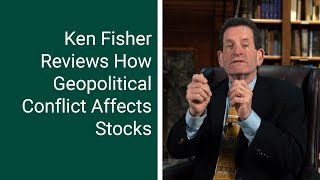
저자: KenFisher · 외국인
요약 보기
이스라엘-하마스 분쟁은 지역적이고 전세계 GDP의 0.5% 미만이라 강세장을 훼손하지 않을 가능성이 높다고 주장. 이란 개입 시 석유 리스크는 증산 여력으로 상쇄 가능. 전쟁 초기 공포는 통상 과장되며 '공포에 팔고 폭격에 사라'는 격언을 강조. 최악은 러시아·중국 개입 같은 극단적 시나리오뿐이라고 봄. 인도주의적 비극이지만 경제적으로는 강세장을 깨지 않는다는 결론.
다듬은 글
For pretty obvious reasons, I get asked pretty often, right now: "Does the Israel-Hamas Gaza Strip, whatever you want to call it, have the potential to derail the bull market that began in October of 2022?" I'm going to tell you: there's A and B. Most likely, and as it logically plays, it does not at all.
It is possible, which is what everybody fears, that it goes in ways that could. Let me put those two into perspective. A conflict, in and of itself, between a couple of countries, or even 3 or 4, that's geographically contained and has a demonstrable amount of GDP relative to the size of the global economy, can be measured pretty precisely as to its potential impact.
This one, as it stands, even if it extends to Lebanon, off the West Bank, totals less than a half of 1% of global GDP. And GDP there is not about to stop, it just gets crunchified some. This, as it exists, is a humanitarian tragedy, it's not an economic tragedy. This is a tragedy. But, as you can see from the beginning of it, on October 7th, market's up since then, oil's down since then.
There is nothing about it that derails what's going on. A big fear that a lot of people have is: what happens if it goes to Iran? The big fear there is oil. The big fear there is, if it goes beyond Iran, to some of Iran's other supporters. The odds of that are very, very low of it doing either of those.
But it's not impossible. The reality is, if it just goes to Iran, it will not do it. When I say "will not do it", I mean it will not derail the bull market. Iran is already heavily sanctioned. Their oil output as related to the global economy has been impacted by the sanctions in the past. It is up a little bit, but if it goes down, it will still be more than made up for by a host of other countries that, as we speak, are otherwise already in the process of increasing capacity.
That will more than make up for it. Global capacity of oil will rise next year regardless. If you think about other consequences, its contribution to global GDP is also tiny. Therefore, with those other consequences, it doesn't have that potential. I think the odds that its potential backers in the format of getting involvement from Russia or China, that's a real hard push to try to buy into and is extreme, sort of in the vein of, "any crazy thing could happen." But sometimes crazy things happen.
If that does, that would probably set the market back. Let me say a different phraseology about war to you in general. There is an age old saying about war —when I say age old, I mean age old—, that says: "Sell on the fear, buy on the bullets." In more recent vernacular, it might be: "Sell on the fear, buy on the bombs." But the fact of the matter is, once a war gets going well, with only exceptions being the most occasional full scale world war, market rise.
It's not that these things are good for the economy or good for stocks in and of themselves. It's that the fear of instability gets built in early and then springboards up when it turns out to not be the bloody disaster that people most feared it might be. That's almost certainly the most likely outcome for this entire tragic event of what's going on...
...as all the things that you read and hear about in Gaza are going on. It is a human tragedy from beginning to present and will be to end. There is no great, graceful, nice, kind, sweet, loving way out of all of this. There just isn't. But in terms of it derailing the bull market or derailing the global economy, that also just isn't.
Thank you for listening to me. I hope this was useful for you. Hi, this is Ken Fisher. Subscribe to the Fisher Investments YouTube channel if you like what you've seen. Click the bell to be notified as soon as we publish new videos.
Comments 0