원문 보기
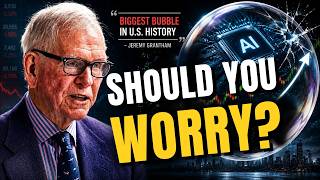
Jeremy Grantham believes today's market is the biggest investment bubble in U.S. history. Yet he isn't bearish on technology. In fact, he believes AI is one of history's defining innovations and could change almost everything. So why does he still think investors should be cautious? Here are five of his biggest takeaways.
Grantham says his advantage comes from taking a long-term view and looking for what others overlook. He believes investors naturally lean toward optimism and often assume today's winners will keep winning. He argues that history's greatest investment bubbles don't form around bad ideas—they form around the most important ones.
Railroads transformed transportation. The internet transformed communication. AI, he believes, could transform almost every industry. The problem is that once everyone recognizes a revolutionary technology, too much money flows into it. Prices become increasingly disconnected from fundamentals before the bubble eventually bursts.
He points to Amazon as an example. During the dot-com boom, its stock rose severalfold before falling about 92% in the crash. Years later, it became one of the world's most valuable companies. Grantham argues that the bigger and more obvious the idea, the bigger both the bubble and the eventual bust.
Based on historical indicators, he believes today's market resembles previous major bubbles and that the peak could be approaching. One of his clearest investment recommendations is to avoid U.S. stocks in favor of cheaper international markets, including emerging markets, Europe, Japan, Canada, and Australia.
He argues U.S. equities are even more expensive than they were during the dot-com bubble. If valuations eventually normalize, investors could experience a long period of weak returns similar to previous major bubbles. He also believes many investment firms rarely advise clients to leave overpriced markets because doing so conflicts with their business interests.
Despite warning about an AI-driven investment bubble, Grantham remains convinced AI will transform society. He says there is remarkably little agreement among experts about where AI is ultimately heading. Some believe it could create extraordinary prosperity, while others fear it could become dangerous if development outpaces safety.
Grantham agrees with researchers such as Geoffrey Hinton that AI should be designed to behave benevolently before development accelerates further, while acknowledging that defining "benevolent" is far from simple. He also questions whether intense commercial competition leaves enough room for safety to take priority, arguing that companies are investing enormous sums in a race to lead the AI industry.
When asked what he would do if he were starting again at age 33 with the goal of becoming wealthy, Grantham said he would immerse himself in AI, join a leading company, work at the frontier of the field, take meaningful risks, work hard, and think independently rather than simply following experts. For ordinary investors, however, his advice is much more conservative.
He suggests allocating around 60% to broad non-U.S. equity indexes, 5–10% to precious metals such as gold or silver, holding some real estate if it's convenient and sensible, and keeping the remainder in bonds. Grantham argues that many investors assume U.S. markets will continue leading simply because they have done so for many years.
History, he says, shows that market leadership eventually changes, yet investors often project today's trends too far into the future. He is also skeptical of residential property at today's prices. His reasoning is straightforward. If fewer people can afford to buy homes, there are fewer buyers available to keep bidding prices higher.
He also points to declining populations and lower rates of family formation in many developed countries as reasons long-term housing demand could weaken. Unless those trends reverse, he believes residential property may not deliver the strong returns many investors have come to expect. Those were five of Jeremy Grantham's biggest lessons on investing, market bubbles, and building long-term wealth.
Whether his predictions prove correct or not, one of his central messages is that investors often assume today's trends will continue indefinitely, while history shows market leadership eventually changes. If you'd like to watch the full interview, you'll find a link to the original podcast in the description below. Thanks for watching.
Comments 0