저자: CNBC Television · 외국인
요약 보기
연준이 수요일 FOMC에서 금리를 동결할 가능성이 높다는 모건스탠리 수석 이코노미스트 마이클 게이펜의 시각을 정리했다. 그는 이번에 인상하지 않더라도 추가 인상 가능성은 열어둬야 한다는 줄타기 메시지가 필요하다고 봤다. 금융여건 긴축과 시장 변동성이 연준의 판단에 일부 역할을 하고 있으며, 반대표 수와 성명 문구가 비둘기파·매파 성향을 가늠하는 핵심 지표가 될 것이라고 설명했다. 중동 분쟁으로 에너지 가격이 높은 수준을 유지하는 점도 인플레이션 위험으로 언급됐다. 다만 경제가 75~100bp 인상은 견딜 수 있지만 대폭 인상이 필요해지면 상황이 달라질 수 있다는 전망도 제시됐다.
다듬은 글
Interesting situation. As we mentioned, this is a huge week for investors with plenty of earnings reports and data to analyze. Additionally, on Wednesday we will learn the Fed's interest rate decision. The market is currently taking into account the pause and is leaning towards a rate hike at the December meeting .
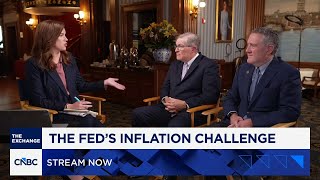
So, what should you look for in the FOMC statement and during the press conference? We are connected with Michael Gapen, chief economist at Morgan Stanley in the US. Nice to see you. Thank you for inviting me. So, you agree with the prevailing market expectation that there will be no rate hike this week .
This is interesting, because before the September meeting one could assume: you know what? The inflation data gave some room for maneuver, they may not have to raise rates this time, but Kevin Warsh's words in Jackson Hole set the agenda. This time, inflation figures turned out to be slightly higher, but judging by the words of other members of the Fed , the market does not expect anything.
So, what does this mean on Wednesday afternoon in terms of the outlook for the rest of the year? Yes, we agree with the market that the Fed will take a pause. I think the main task for them is to say that, on the one hand, there is no urgent need to raise rates again today, but we should expect further rate increases in the future.
This is a fine line, because you could ask: why didn't you raise the stakes today? I think they will say that they want to see fundamental trends, take time and assess the future direction of policy. So, I think that's the balance. They are maintaining the current rate, but this is not seen as a " hawkish pause" where the expectation is that rates will rise, we just didn't do that today .
Do you think they will comment on the recent volatility in the markets and the tightening of financial conditions that has occurred since the last meeting ? Yes, I think he can say that financial conditions have tightened. The market is certainly pricing in further increases. Therefore, we believe that in this regard, the market is partially doing the work for us.
Ultimately, they will have to decide whether to confirm these market expectations or not. But I still think it will come up, and I think it's fair to say: yes, one of the arguments against raising rates in successive meetings is the risk of excessively tightening financial conditions. So , a balance is needed here.
I think you understand that there are risks in any decision they choose: a consistent increase or a pause. Um, but I think you could argue that yes, it played a role in our vision of why we can proceed more gradually. You have a specific plan of action for how the statement, the vote, and other factors can be generally " dovey" or " hawkish." So what do you think is key to observation?
Well, the number of votes "against". So there were three votes against when they abstained from action in July. We think you'll see two " no" votes. But, as you noted, perhaps volatility in the markets will reduce that number. So, the closer the number of votes "against" is to zero, the more it sounds like a "dovey" position.
If there are three votes "against" in favor of the increase, this can be perceived as a "hawkish" position. And I suppose the wording in the statement matters . I would say that the old Fed would have given you a guideline with a sentence that further rate hikes were likely. Varsh probably won't want to do that, given his propensity against predictive benchmarks.
So how will he put it together? Therefore, something about the timely return of inflation, I think, should remain in the statement. And then, I think it's important how much it relies on whether financial conditions have tightened a lot, or on volatility in the stock markets, and how much spreads have widened.
The more he relies on it , the more " dovey" it will sound as well. And, of course, the energy picture has also changed since the September meeting. I mean, the conflict in the Middle East is no closer to ending. Oil and energy prices remain high , and at this point, this is definitely not a temporary phenomenon.
We're just This is JetBlue Profits. This is a big question mark for the economy next year— diesel prices and their impact . So I'm just wondering if you think he's factoring that into his vision, because there's a perception that if he doesn't do anything at this meeting, it's kind of a signal, " You know what?
We're going to let inflation go up, " and that's an excuse for bond yields to go up. Yes, I would disagree with that . I would be surprised if he did not emphasize the risks of secondary effects due to continued increases in energy prices. We are factoring some of this into our inflation forecast for next year.
I think many in the FOMC do this too. So the more he emphasizes this, the more " hawkish" it sounds . I don't think the Federal Reserve is out of the woods yet. I don't think they themselves think so. I guess the point here is whether they can raise rates in one sitting, evaluating the data as they go.
I think the answer is yes, but we'll see where the energy markets take us. Do you think the economy can remain resilient to current yield levels and perhaps a couple more hikes? Some say that in the first half of next year, positive factors will begin to fade. Of course. Yes, I think it's quite reasonable to think that the economy can withstand a total of 75-100 basis points of increase without much concern.
But if it becomes clear that the Fed needs to make, say, six or seven hikes to get us back to 2023 levels, then I think the situation will be different.


댓글 0