원문 보기
Let's dive right into this explainer. Today, we're taking a close look at the absolute financial royalty of Wall Street. We need to figure out if JPMorgan Chase's record-breaking performance makes it a financial fortress or if it's a stock sitting on a very dangerous fault line. We're peeling back the layers on a massive financial quarter, and honestly, it's packed with incredibly complex signals that we really need to unpack together.
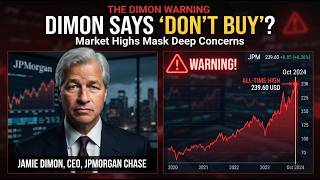
So, what does this all mean? While we're weighing CEO Jamie Dimon's recent pretty ominous macroeconomic warnings against a staggering earnings report that just sent the stock shooting up over 5%. On one hand, Dimon actually called it a particularly favorable environment. But on the other hand, in the exact same breath, he painted a much darker picture of what lies beneath the surface.
And that dichotomy right there, that's exactly the lens we're going to use to analyze this financial giant today. Okay, let's start with the fortress side of the story. $21.2 billion in net income in a single quarter. That's for Q2 of 2024. Just take a second to let that scale sink in. This wasn't just a good earnings report.
This was an absolute blowout that proves the sheer raw earning power of this institution. Revenue absolutely crushed Wall Street estimates hitting a jaw-dropping $57.3 billion. And what's absolutely crucial to understand here is the underlying strength. Because even after you strip out a massive $4.6 billion one-time gain from Visa shares, the core operating success is just undeniable.
Earnings per share jumped 17% year-over-year to $6.14. They didn't just inch past expectations, they literally leaped right over them. And you know what's crazy? This wasn't just one lucky division carrying all the weight. Every single arm of the bank broke records. This is a level of synchronization you rarely see in a financial institution of this size.
Usually, when a bank is this diversified, one lagging sector kind of drags the others down, but not here. J.P. Morgan did something truly remarkable by setting high water marks across the entire board. Section one, engines of growth firing on all cylinders. Just look at the explosion in equities trading.
We're talking a massive 86% year-over-year jump. This proves that the fortress balance sheet is, without a doubt, firing on all cylinders. While overall trading revenues were up an impressive 35%, that huge 86% surge shows exactly where market momentum was captured by J.P. Morgan's trading desks. And the commercial and investment bank really shined the brightest, pulling in massive fees as companies returned to mergers and raising capital.
Investment banking fees surged 30% to hit their highest levels since 2021. So, what's the takeaway here? It tells us that corporate confidence is back. Businesses are making moves, they're restructuring, they're expanding, and J.P. Morgan is right there collecting a premium at the toll booth for making it all happen.
Now, to round out the high notes, strong loan demands boosted consumer banking revenue by 8% with average consumer loans expanding by 10%. But, the real anchor here is asset and wealth management. They grew revenue by 19% and now sit on over $5 trillion in assets. Let me repeat that, $5 trillion. That is a massive, incredibly sticky revenue stream that locks in long-term profits for the bank.
But, here is where things take a dramatic pivot. Because when a CEO who famously navigated the 2008 financial crisis drops a warning like this during a record quarter, we need to stop and pay very close attention. Dimon didn't just celebrate the wins. He warned that risks are shifting below the surface like tectonic plates.
That is a very specific, and honestly, a very powerful image. It implies that while everything looks calm and solid above ground, this catastrophic energy is building up right out of sight. Section two, the fault line, tectonic warning shots. So, the crucial point to remember here is that any sudden shift in one of these four areas could trigger a chain reaction leading to a massive collision of events that completely disrupts a complacent market.
We're talking about geopolitical tensions, sticky inflation that just refuses to drop to target levels, massive global fiscal deficits, and elevated asset prices. Diamond is telling us loud and clear the market is far too relaxed right now given the specific combination of threats hovering over the global economy.
In fact, Diamond is so concerned about these elevated asset prices and risks that he explicitly stated he would completely avoid buying stocks or long-term US Treasuries at current valuations. Let that sink in for a second. The head of the most powerful bank in the world is publicly saying the current bull run faces serious headwinds and that the risks are, in his words, probably bigger than other people think.
This isn't just your generic Wall Street caution. This is a glaring red flashing light for investors. And this contrast is just fascinating to me. Despite spending a staggering $20 billion on tech and AI, Diamond is actually serving a harsh reality check to the market's accelerated timeline for AI dominance.
He fully believes AI is real, for sure, and that it will eventually pay off for the bank, which is exactly why they're investing so heavily. But when asked if it will pay off on the timetable the market expects right now, his answer was two words, "Definitely not." He's actively warning us that the AI hype cycle could face a really painful correction.
He's actually comparing it directly to the dot-com bubble where early darlings like Yahoo ultimately fell by the wayside. It perfectly illustrates the danger of overenthusiasm. Look, just because a technology is revolutionary doesn't mean the current valuations of the companies pioneering it are justified in the short term.
It's a stark reminder that the early winners don't always take all. Section three, the analyst scorecard and the verdict. With the stock trading near its 52-week high around $363, there's a pretty wide uncertainty in price targets right now. You've got Goldman Sachs feeling incredibly bullish at $420, while others see it dropping way down to 305.
This widespread really highlights a major concerns. We're talking about the key man risk of Diamond's eventual departure, along with climbing compensation and tech expenses. I mean, non-interest expenses jumped 15% this quarter. Running a fortress definitely isn't cheap. When you look at the consensus target, it suggests only about a 3% upside from current levels.
That kind of forces you to ask, are these record earnings already totally priced in? The stock is already up over 25% in the last year. So, if the analyst's average target is only between 374 to 377, you really have to seriously consider if that minimal premium is worth the tectonic risks Diamond just laid out for everyone.
Ultimately, you have to weigh these absolutely incredible profits against the stark macroeconomic warnings and decide for yourself. Is this fortress protected enough from the weather to survive the shifting landscape beneath it? JP Morgan Chase is undeniably a phenomenal, well-diversified machine. But, when the architect of that very machine warns you that the ground is shifting, well, it's probably time to pay attention.
So, is it a buy and hold forever, or is it time to brace for impact? That's the question you have to answer. Thanks for diving into this explainer with me, and I'll catch you on the next one.




Comments 0