원문 보기
Ethereum just skyrocketed from $1,900 to $2,600 in a matter of days. Half a trillion dollars returned to crypto, and the largest short liquidation in history proved how wrong the market's position was. Now everyone is asking the same question. Is this the beginning of the next bull market or another trap?
Tom Lee says the answer is obvious. The fundamentals have been screaming about this for months. Tokenization is already happening. AI agents are already on their way. Wall Street is building its infrastructure on Ethereum. But the price remained the same because everyone was afraid. Last week, everything changed, and according to Lee, this is just the beginning.
In this conversation, he explains what really triggered this move, why Ethereum is still wildly undervalued, and what four catalysts could propel it significantly higher by the end of the year. Let's get down to business. Tom, I thought I'd start with the events of last week. The largest short liquidation in crypto history, $500 billion in market cap added to the crypto market in a matter of days.
What is your reaction to this market movement and Ethereum rising from $1,900 to almost $2,600, surpassing Bitcoin? I think everyone has their own perspective, but our position this year is that crypto fundamentals are strengthening, which is a stark contrast to past “crypto-zymes” that were marked by closures, lack of capital, and shrinking use cases.
We know that tokenization is gaining a lot of popularity . Many well-known large financial institutions are creating tokenized products, in particular based on Ethereum. In addition, we see: as AI capabilities grow, it becomes obvious that AI agents do not want to use traditional financial systems, so cryptorails make a lot of sense.
So, for us, last week was what I would call a correction , as price is finally starting to recognize that we shouldn't be in a deep "crypto-zyme ." And, as you noted, the fact of the mass liquidation shows how misconfigured the market was . As the famous John Russell says, all rallies start with the shorts covering.
So for us, I think this is the beginning of a much bigger movement. There has been a lot of discussion about whether we will see a retracement or pullback in Ethereum and Bitcoin in general after this huge short squeeze. Are you expecting this, or do you think this is the beginning of a new “bull” market for the entire crypto industry?
You know, I think for those who are not on the subject right now, there is obviously a tactical question. And my answer to ever of it: if you look at past crypto cycles, if you could buy crypto 4 weeks before the low or a week after it, would you do it all the time? And the answer is obvious: everyone should buy 4 weeks before the minimum or a week after it.
So, if the low was last week, you buy the week after it. 4 weeks in advance at the very least. In any case, I think believe that if someone tries to guess the bottom and buy in the middle of a statistics that have been running for over a decade say that crypto makes major moves in 10 days. And if you miss the 10 best days, the return will be negative.
So, how many wonderful days were there in 2026? Only one. So, I think the growth potential of crypto by the end of the year is quite large. Here's what most people missed. While the crypto market was oscillating sideways and everyone was waiting for a drop, fundamentals were quietly improving. Tokenization has started to gain real momentum.
Large financial institutions have begun building their projects on Ethereum. AI continued to become more powerful, proving that machines could not use Visa networks. A quick word . Kalshi is worth considering because earn more to unlock a bunch of VIP bonuses like minimal . Last week—did the market finally go up?
Half a trillion dollars of market capitalization was recovered in a matter of days. The liquidation of short positions became the largest in crypto history, showing how wrong everyone was. When so many people take the wrong stance, the reversal becomes brutal. The essence of Lee's words is simple. All rallies start with covering short positions.
Shorts were betting on a continuation of the crypto winter. They were hit. Now a tactical question. Should I wait for a pullback or buy now? Lee's answer provides a clear guideline. The crypto market makes all its moves in 10 days. You will miss the 10 best days—and you will have a negative result. This is not a theory.
This has been true for a decade. So, if last week was a low, you buy the week after it. If there is a pullback, you buy to the final bottom. In any case, waiting is the most expensive choice. The market does not reward caution. It rewards participation in the game. If this helps you see the situation better, subscribe.
This allows these conversations to continue . There is a concept of " uncanny valley". There is a famous Japanese roboticist who wrote about the idea that if robots become too similar to humans, it makes us uncomfortable. And that's true. I think we will be very embarrassed when we see androids that are indistinguishable from humans.
The same will happen to the financial system and your money, as agent systems gain new capabilities. In fact, we already know that in many models, agents buy more tokens than humans. Therefore, the activity of agents is increasing. There will be a similar " ominous" moment regarding your money. Because once AI becomes part of the economy, they will become revenue-generating units, perhaps even taxes, and will work on our behalf.
But what's to stop them from making their own financial decisions, including accessing your accounts and performing transactions you may have already authorized? For me, this will be the " uncanny valley" of wealth: over time, it is possible that much of our individual wealth will be created by our delegated agents.
Will we trust them, if they operate through Visa and JP Morgan accounts, that they will not drain our resources? I think that's why we need crypto smart contracts, finality, and instant settlements—the very foundation of crypto to protect against agent system failures. What no one talks about. AI agents are already buying tokens.
They already manage assets and will soon need access to your financial accounts. And now—a scary question. If you give an agent permission to spend your money and he starts making unexpected decisions, what's to stop him from emptying your accounts? If it works on traditional rails through Visa, JP Morgan, through systems created for people, the answer is: nothing.
These rails were not designed to stop an unscrupulous agent operating at the speed of a car. Crypto solves this by its design. Rules are automatically built into smart contracts. The calculation is final. Nothing can be undone or faked. The agent operates within the boundaries you set, on rails that are transparent and auditable.
This is the " uncanny valley" of wealth. The moment when you realize that most of your financial transactions are carried out by something you don't fully control. The only system that leaves humans in the process while agents do the work is crypto, and Ethereum is the largest and most liquid version of that system on Earth.
And no, this is not science fiction. This is already happening. Cloudflare launches stablecoin wallets for agents. They predict that by 2030, most online activity will be carried out by agents. This is 4 years later. One of the things that I think people don't really appreciate, especially those who write code or just plan on a whiteboard, is the network value, the network effects of a widely used system, which are greatly underestimated because people don't know how to monetize it.
For example, why do we all use dollars? I mean , there are a lot of liquid currencies. But the dollar is not only the most acceptable and, as they say, has been around the longest, but why would we use anything else? Well, this applies to almost every asset. Is it real estate, why do we own land, you know, why do we trade in the US stock market when Korean stocks are cheaper?
Ethereum is the largest platform by a huge margin , not only having the largest number of wallets and activity, but also being the place where financial institutions are already building. So the question you have to ask is: what if financial institutions that have already chosen to use a public blockchain suddenly want to bet on a new illiquid chain that may have future code or implementation issues, or market maker or node operator issues?
So we create a whole series of cascading problems, even though the reality is that Ethereum is actually the platform of choice today. Let's talk a little more about what Wall Street is building. Last week, Robinhood CEO Vlad Tenev wrote an article in X calling for a tokenization supercycle. I think many people hear these words—tokenization and supercycle—and may not fully understand what they mean.
How do you see this tokenization supercycle developing? What does this mean? And how does this change markets as we know them today ? I think the tokenization supercycle is probably the best explanation for what's happening. I think Vlad really has the most reasonable point of view. Why is that so? Well, first of all, he has proven himself to be a financial reformer who has already built a large-scale company.
Remember, Robinhood was a true innovation in the stock and asset market because it offered virtually free trading. It may have been a unique feature, but in reality he created a platform with a radically different user experience. When people used Robinhood, swiping with ease compared to the archaic interfaces of other apps, it showed that it knew how to innovate.
And you know what? Financial systems are long overdue for an upgrade to a 21st or 22nd century platform. Today, the financial system is an extremely complex web of layers, legacy systems, and disparate interfaces that require a lot of manual intervention to complete transactions. And while it seems to many that it works well—and it does—it doesn't provide the speed, accuracy, and low cost that blockchain makes possible.
Actually, this is exactly what Vlad means: the transition of the financial system to crypto rails will not only speed up access and reduce costs, but also create space for great innovations. Because when assets can be moved quickly digitally, many things that we traditionally don't consider money can become money.
Why Ethereum? Because network effects matter more than is commonly believed. Why do we use dollars? Because it is the most recognized, liquid, and widespread currency. The same logic applies to blockchains. Ethereum has the most wallets, the most activity , the largest developer community, and now the largest number of financial institutions choosing it as their base layer.
Robinhood built its chain on Ethereum. Coinbase created Base on Ethereum. Revolut launched its stablecoin on Ethereum. These are not crypto startups making speculative bets. These are some of the largest financial platforms in the world, and they all choose the same network. The alternative is a new chain without users, liquidity, and history.
If you are a bank transferring real money to a public blockchain, you need to be confident that it will be there in 5 years . You need security, reliability, and market makers that won't disappear. Ethereum is the only answer. Next comes the tokenization supercycle. Vlad Tenev predicted this, and he was right.
The traditional financial system operates on two asset classes: stocks and bonds. Tokenization is explosively expanding this universe. Reward points, intellectual property, the value of futures contracts, computing power—all of these become digital money when networks are fast enough. The target market size is growing from $150 trillion to a potential $500 trillion.
That's the breakthrough, and it's happening right now. I think the Ethereum to Bitcoin ratio will continue to grow. I mean, at the very least, it should return to its previous high of 0.08. And the reason is that, first of all , looking at the next 5 years, I still have a lot of faith in Bitcoin. Because to me it's better than digital gold.
This is digital gold that functions as a much better substitute for gold. So I think Bitcoin easily has significant upside potential from here. But I believe that the story that will be written around cryptocurrencies over the next 5 years is largely related to tokenization. And, as Vlad said, it's the supercycle and agent AI, and the real protection of people and the integration of people into this chain, which we believe will largely, and possibly entirely, happen on Ethereum.
So, I think this ratio will increase. I think there are catalysts that will work by the end of the year. Of course, one of the most important is the Clarity Act. If it is passed in September, it will be important for traditional financial institutions. This is not so important for the crypto world. But the traditional financial system will be able to operate more confidently knowing that there is a designated authority with the authority to set rules for cryptocurrencies.
This will really help traditional financial systems start to officially build their operations on a crypto foundation. However, if it is not passed, it is not the worst thing for cryptocurrencies, as the crypto industry has already proven that it innovates even in the absence of regulatory certainty.
So I think Ethereum will make it either way, but I think this movement will accelerate significantly if the Clarity Act is passed. The second catalyst is that a lot of people are taking a wait-and-see approach , and you started this podcast with that, because they're waiting for cryptowinter to end, based on a four-year cycle, and they're waiting until October.
Um, well, you know what? You know, it's just 5 weeks from here. So, um, there will be a lot of those who are playing for the downside or sitting on cash, or those who left crypto and traded AI but are now coming back. And I think that applies to the Asian market as well. You know, Korea went crazy over Korean stocks.
But right now I'm not pessimistic about AI stocks, but there's a lot more potential for growth in crypto, which we actually see as a spin-off story from AI trading. And so you have not only the end of cryptowinter, but also a lot of cash on the sidelines, especially in Asia. These are three really huge catalysts.
And, of course, there will be a race for profitability from institutions, as crypto has been the best performing asset since June 30th . Ethereum rose by 54%. Gold is only up 13. Stocks are up, you know, in the single digits. Well, when we get to September 30th, which is a month from now, and if Ethereum is still the best asset, guess what institutions will be buying from September 30th to December 30th.
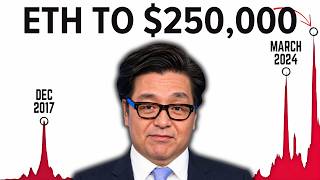
There will be many attempts to catch up with the market due to FOMO. So now this is the fourth catalyst— huge institutional demand. I think Ethereum can easily, very easily surpass its year-to-date highs on an ETH to BTC ratio. But, you know, will it reach 0.04? Well, if so, and if Bitcoin is worth 150,000, you know, that would put Ethereum at about 6,000.
And I think that's a very conservative estimate , because again, 0.08 is the old maximum ratio. Ethereum's ratio to Bitcoin has just broken out of a 10-year downtrend. Lee believes it will go much higher. The old high was 0.08, set in 2021, when meme coins and NFTs were the main topic. This time the story is about tokenization and agent-based AI.
This is a much larger narrative , backed by much larger institutions. His conservative scenario: if the ratio returns to 0.08 and Bitcoin reaches $150,000, Ethereum will be near the $6,000 mark. But he believes that this is an underestimate. Tokenization alone can justify a much higher ratio, and that's before taking into account AI calculations.
Catalysts accumulate. The Clarity Act could be passed in September, giving institutions the regulatory green light to officially operate. If it is not passed, crypto will still continue to innovate. In any case, Ethereum wins. In addition, there is money that is currently set aside. Investors who left crypto for AI are coming back.
Asia is sitting on cash after the mania for Korean stocks subsided. And institutions that measure results quarterly are about to see Ethereum rise by 50%, while stocks have only risen by a few percent. When September is over, they will catch up. The technical breakthrough, the fundamental history, the regulatory path, the institutional demand —all point in the same direction.
Tokenization is happening now. AI-based agents are on the way. Wall Street is building, and Ethereum remains at the center of it all, still priced as if the bear market never ended. The cycle is changing, narratives are shifting, infrastructure is being built, and those who understand that crypto and AI complement, not compete with , each other are the people who are ready for what comes next. See you in the next video.



댓글 0