원문 보기
Let's begin by introducing Romio Agral, a legendary Indian investor whose simple yet powerful approach has inspired countless market participants. Known for his discipline, strategies and long-term vision, Romio's frameworks have helped investors navigate the complexities of the stock market. Today, we'll explore his core investment philosophy, the famous 252525 rule, and the QGLP framework.
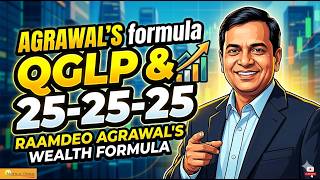
We'll also uncover the behavioral traits and mindset that set him apart. Whether you're a beginner or a seasoned investor, Romio's principles offer timeless wisdom for building lasting wealth. Let's dive into his world and see what makes his approach so effective. At the heart of Romio Agal stockpicking lies the 252525 formula.
This screening tool is both simple and powerful. Designed to quickly filter out the best investment opportunities. The rule focuses on three key metrics. A 25% return on capital employed ROC, 25% profit growth, and a price to earnings PE ratio under 25. By sticking to these numbers, investors can zero in on companies that are not only efficient and growing, but also reasonably valued.
This formula acts as a first checkpoint, helping you avoid overhyped or underperforming stocks and focus on true wealth creators. Turn on capital employed or ROC is a crucial metric in Romio's 252525 rule. It measures how efficiently a company uses its capital to generate profits. A high ROC like 25% or more signals that the business is making smart use of its resources and has a competitive edge.
This efficiency often translates into higher returns for shareholders. By prioritizing companies with strong ROC, investors can filter out businesses that might be growing but are not truly profitable or sustainable in the long run. Next pillar of the 252525 formula is profit growth. Romo emphasizes looking for companies that consistently deliver at least 25% profit growth year after year.
This consistency is a sign of a robust business model and strong demand for its products or services. Steady profit growth not only boosts shareholder value but also indicates that the company can weather market cycles and emerge stronger. By focusing on this metric, investors can avoid companies with erratic earnings and instead back those with a proven track record.
Final filter in the 252525 rule is the price to earnings ratio or PE. Romio suggests looking for companies with a PE of 25 or less. This ensures you're not overpaying for growth and helps avoid the hype that often surrounds popular stocks. A reasonable PE means the stock is fairly valued relative to its earnings, reducing the risk of buying into a bubble.
By combining this with strong ROC and profit growth, you get a short list of companies that are efficient, growing, and sensibly priced. Beyond the 252525 formula, Romo Agall's core investment philosophy is captured in the QGLP framework. QGLP stands for quality, growth, longevity, and price. This approach goes deeper than just numbers, focusing on the overall strength, and sustainability of a business.
It's about finding companies with solid fundamentals, capable management, and a clear path for long-term growth. QGLP helps investors look past short-term trends and identify businesses that can thrive for decades. First element of QGLP is quality. Rondo believes that strong fundamentals, clean governance, and capable management are non-negotiable.
Quality companies have a history of ethical practices, transparent reporting, and a leadership team that can steer the business through challenges. By focusing on quality, investors reduce the risk of unpleasant surprises and set the stage for sustainable returns. This foundation is what allows the other elements of QGLP to work effectively.
Growth is the driving force behind wealth creation. In the QGLP framework, Rondo looks for companies with sustainable long-term growth prospects. This means businesses that can expand their revenues and profits year after year, not just in short bursts. Sustainable growth often comes from innovation, market leadership, or tapping into big trends.
By identifying such companies, investors can ride the wave of compounding and see their investments multiply over time. Longevity is about finding businesses that can stand the test of time. Romo's QGLP framework emphasizes companies with durable competitive advantages, strong brand value, and the ability to adapt to changing environments.
These are businesses that can survive economic cycles and continue to grow for decades. Longevity ensures that the power of compounding has enough time to work its magic, turning good investments into great one. Final piece of QGLP is price. Even the best company can be a poor investment if bought at the wrong price.
Rondo warns against falling into the growth trap, paying too much for fast growing companies with weak economics or the quality trap buying great businesses that aren't growing. The goal is to pay a fair price, ensuring there's enough upside for compounding to work. This discipline protects investors from overpaying and helps maximize long-term return.
One of Rondo Agall's most important lessons is the power of compounding. When a company grows profits at 25% annually, your investment can multiply 10fold in just 10 years. Compounding works best when you stay invested in high-quality businesses for the long haul. This exponential growth is the secret behind true wealth creation.
By combining patience with the right companies, investors can harness compounding to achieve extraordinary results. Patience is a virtue that Romo Agal holds in high regard. He believes that holding investments for the long term is essential to realize the full benefits of compounding. Short-term market fluctuations can be distracting, but those who stay the course are often rewarded.
By resisting the urge to sell during downturns and trusting in the underlying quality of your investments, you give compounding the time it needs to work its magic. Another key principle is identifying early stage tailwinds. Romo advises investors to look for sectors and companies benefiting from major long-term trends such as quick commerce, energy transition, or manufacturing booms.
These tailwinds can provide a significant boost to growth and profitability. By getting in early, investors can ride these trends for years, maximizing their returns as the sector matures. Behavioral discipline is crucial for successful investing. Rondo emphasizes the importance of developing the right mindset to sit through market downturns and avoid selling good businesses out of fear.
This discipline helps investors stay focused on their long-term goals and prevents costly mistakes. By cultivating patience and emotional resilience, you can navigate volatility and stick with your investment strategy even when the market gets rough. Wrap up. Rondo Agrell's investment philosophy combines simplicity with depth.
The 252525 rule offers a quick way to screen for high-quality stocks, while the QGLP framework ensures your investing in businesses built to last. By understanding the power of compounding, practicing patience, spotting early tailwinds, and maintaining behavioral discipline, you can set yourself up for long-term wealth creation.
These timeless principles are as relevant today as ever, guiding investors through both bull and bare markets.


Comments 0