저자: JeremySiegel · 외국인
요약 보기
파월 연준의장 발언은 전반적으로 낙관적이며 실물 데이터는 여전히 견조하다는 평가. 관세발 물가상승은 일시적일 것으로 보고 연준이 즉각 대응하지 않을 것이라는 점이 시장에 안도감을 줬다. 점도표상 올해 말 근원 PCE는 2.5%에서 2.8%로 올라가지만 금리인하 중간값 2회는 유지되어 고물가 용인 여지가 있다. 성장률 전망은 2.1%에서 1.7%로 하향됐는데 이민 축소와 관세 불확실성 중 무엇이 주원인인지는 불명확. 장기 성장률 전망은 변화 없음. 시장은 10년물 금리 하락에 힘입어 S&P500이 전고점 부근까지 반등.
다듬은 글
Market found some reassurance in what Powell had to say. For one thing, essentially saying that we really can only consider the net effects of any future policies, but also suggesting a willingness to look through an uptick in inflation and still have that outlook for potentially two rate cuts for the remainder of this year.
What's your read on how the market took it? Yeah, well, you're exactly right, Mike. I think he threaded the needle pretty well. And we also had a pretty oversold market. It's not a surprise that they cut the GDP forecast. It's not a surprise that we saw the dot plots, the inflation move up as well. I think the maybe somewhat of a surprise is this this slowing down of quantitative easing.
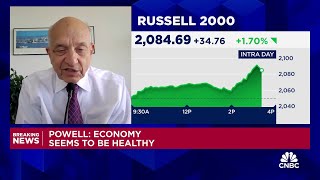
And we look at the 10-year tightening. I'm sorry. Tightening. And you're seeing the 10-year Treasury come down and that's given a boost to the market. That is true. That that certainly helped, it would seem. And the S&P 500, just for context, is right up near yesterday's high, just under 1 and 1/2% at this point.
Keith, you're going to stay with me. Let's bring in the Wharton School Professor of Finance Jeremy Siegel. Professor Siegel, what's your what's your first read here? There was not a great expectation that there would be bold policy pronouncements here, but there maybe was a little bit of tension in there that maybe Powell could have been more hawkish than he was.
Yeah, most certainly. I mean, I would characterize him as basically optimistic. He said that the real data is still strong. He wasn't alarmed. He said he saw the sentiment drop in the in the consumer sentiment and some business sentiment, but didn't say that always translates into slower economic activity.
But as as you said, remains very flexible to move on either side. And I mean, that's sort of an optimal combination. I also think that he was pretty clear that the he that the Fed would not react to the tariffs if they brought about price rises, which he thought would be temporary. And that was something I was definitely looking for.
wondering would he go against those tariffs or not? He seemed to imply that he would not go against those tariffs unless it sort of caught on to inflationary expectations or or or you know, went into some other areas. And I I think that the market really probably took some comfort in in in that statement.
And just to be clear, the the dot plot, the summary of economic projections did imply core PCE inflation going up by the end of this year to 2.8%. It had been 2.5, and yet collectively the median was still for two rate cuts. So, there's some tolerance of higher inflation implied there. And in fact, he did say he thought that tariffs perhaps were built in to that projection to some degree.
Although he as I mentioned earlier, he said, "Look, the Trump administration's got a lot going on with policy changes in play for immigration, trade, regulation, and of course fiscal spending and taxation. And they're going to have to sum up the net effect of all that before deciding what it means for policy, Professor.
Yeah, and and absolutely I mean, that be it's a big drop from 2.1 to 1.7. You know, it's the biggest drop that we've had in a 3-month period in Fed forecast for growth since the pandemic. I would have liked to have known how much of that drop was due to the big slowdown, as we know, in the immigration situation.
And how much was a drop that he, you know, thought could be due to the uncertainty and dislocations caused by the tariff. He didn't He didn't tease that out. Although you also note that the next 2 years also showed a slight drop in real GDP growth. So, I was wondering if that if that is immigration or is that more tariffs?
Although the very long-term growth, of course that I think is 2028, Trump's end of office, that that number wasn't changed. But I would have like to have sort of teased out some of those sources of that real GDP change because certainly it was substantial.




Comments 0