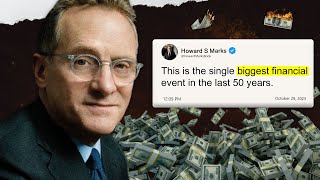
저자: HowardMarks—영상내발언기반,출연자명시없음 · 외국인
요약 보기
결론: 저금리 시대가 끝나는 '씨체인지(sea change)'가 왔고, 고금리 환경에서 부채 부담이 커져 기업·정부·가계에 부실 위험이 높아진다. [핵심 주장] 1980년 연방기금금리 20%에서 2020년대 초 0%까지 내려가며 자산가격(주식·부동산)이 크게 올랐고, 장기간 부채가 누적되었다. [금리 환경] 2009~2013년 제로금리 이후 정상 수준 회복에 실패했고, 현재는 금리 상승으로 저금리 시대가 끝나는 전환점이다. [기업 사례] 1000만 달러 상업용 부동산 대출(이자 2%)이 재융자 시 7%로 올라 연 이자가 70만 달러로 늘고, 임대수입은 40만 달러로 감소했다. 건물 가치 하락으로 LTV 요건 충족을 위해 추가 상환이 필요해져 일부 투자자는 대출 반환(디폴트)을 택한다. [정부 부채] 미국 국가부채 32조 달러, 연간 적자 약 2조 달러. 금리 상승으로 이자 지출이 늘어 인프라·사회보장·의료 재원이 줄어든다. 마크스는 미국 파산 가능성을 우려스러운 상황으로 보며, 달러 기축통화 지위로 단기 여력은 있으나 장기 경로는 불확실하다고 본다. [투자 조언] 거시 예측은 하지 말고 능력 범위(circle of competence) 내 기업을 저평가 여부로 고르는 상향식 접근을 권한다. 대가도 60~80%만 맞힌다는 점을 언급하며 60-40 정도면 훌륭하다고 본다. [시장 관점] 단기 주가는 투표기계(감정 반영), 장기 주가는 체중계(기업 실적 반영)다. 현재 포트폴리오 변동에 과도하게 스트레스받지 말고 장기 관점을 유지하라고 조언한다. [출연자 전망] 특정 자산에 대한 구체적 방향 예측은 없고, 금리 환경 전환과 부채 리스크에 대한 경고 중심이다.
다듬은 글
Howard Marks, the sage of Wall Street, unveils a sea change in the U.S. economy. In this video, we will dive deeper into Marks' remarkable insights on interest rates, US inflation, the Federal Reserve, and the game-changing 'Howard Marks Memo' that's about to reshape our economic horizon. In the world of finance, one name stands out, and that name is Howard Marks.
He's not a fortune teller, but a wise investor with a net worth of over $2 billion. You might have heard of him through his insightful investing memos where he discusses the market's twists and turns. Today, we'll dive into his views and discover the major changes he sees on the horizon. Marks has been sharing his insights since 1990, and he's seeing something significant brewing in the stock market.
Marks refers to this shift as a sea change. What is this sea change, you might wonder? Well, it's the realization that the easy money era we've become accustomed to is fading away, and it might not return anytime soon. To grasp the significance of this shift, let's travel back to 1980. The Federal Reserve funds rate was a staggering 20 percent.
Marks had a loan with an interest rate of 22.25 percent from a bank. Now, fast forward 40 years, and the FED funds rate hit rock bottom at zero, and Marks had a loan with a mere 2.25 percent interest rate. The massive drop in interest rates was a game-changer. When interest rates fall, it becomes much easier to borrow money.
The cost of borrowing shrinks, and suddenly, you can handle larger loans. The result? A surge in asset prices like stocks and real estate. There’s the twist. While declining interest rates made borrowing a breeze, they also inflated asset prices. Think of it this way – as interest rates went down, the price of assets like stocks and real estate went up.
This surge in asset prices created an environment where people started to accumulate more and more debt. So, what did the easy money era bring? A world of high debt. People borrowed a lot, and businesses found it easy to thrive. The economy prospered, setting records for the longest bull market and the lengthiest economic recovery.
It was the "Easy Money Environment." During this time, there were fewer defaults and bankruptcies. Life was good, right? But, as Marks points out, every good thing must come to an end. The turning point came during the 2009-2013 period. The FED pushed the funds rate to zero in response to the global financial crisis.
Despite their best efforts, they struggled to get it back up to what's considered normal levels. So, here's the big shift Howard Marks is talking about. We're no longer in that Easy Money Environment. The era where borrowing was a piece of cake and asset owners were in paradise is slipping away. This sea change is a big, impactful transformation, and it's hitting us right now.
The core issue? Rising interest rates. So, whats happening when interest rates rise? Well, it's like a storm brewing on the horizon. Loan repayments become more expensive, making it harder for folks to borrow money. When this happens, the economy starts to slow down, people lose their jobs, and it becomes a tougher time for everyone.
But here's the real twist in the tale. Over the years, we've grown so used to low-interest rates that we started thinking it's the new normal. That's where the problem lies. We've become accustomed to low-interest rates when, in reality, this isn't how things have been for most of history. To make matters more complex, society has piled on more debt than ever.
The debt-to-GDP ratio for households has been on the rise since the 1980s. If you've entered the financial world since 1980, you've mostly seen interest rates decline or stay ultra-low. And that's where it gets tricky. Marks calls this a sea change because we need to recognize it as a significant pivot.
We can't just assume that what we've experienced for the past 40 years is the new normal. It's not just households feeling the pinch. This sea change also affects businesses and even governments. They're sitting on mountains of debt that need to be refinanced on much less favorable terms. When interest rates rise, refinancing becomes a thorny issue.
Businesses and governments need to replace old loans with new ones. However, because interest rates are higher, the terms of the new loans become much less forgiving. This is where things get tough. When businesses can't meet these new loan terms, that's when bankruptcies start happening. It's not usually because a business is unprofitable; it's because the debt becomes too difficult to manage.
In the world of finance, most bankruptcies or defaults occur when a business can't meet the maturity requirements of its loans. In simple terms, it means they can't pay back their debt, and they struggle to refinance it. Now, let's look at a practical example. Consider a property business that took a $10 million loan a few years back to buy commercial real estate.
Back then, the interest rate was a mere 2 percent, making it a sweet deal. But then came the pandemic, and companies had to adapt by allowing employees to work from home. As businesses scaled down their office spaces, the real estate business's rental income dropped to $400,000 per year. Unfortunately, they also had to refinance their original loan, and now interest rates had surged to 7 percent.
With the new interest rate, they had to cover a whopping $700,000 per year in interest expenses. Ouch! And here's another twist. The value of the building itself had fallen over the years. This meant that many companies had to pay more money to the bank to meet the loan-to-value ratio requirements. With all these challenges, some real estate investors are choosing to default on their loans and return the keys to the bank.
It's not just businesses and households facing the consequences of rising interest rates. Even the government is in a tight spot. The government often sells bonds to investors to cover the gap between its spending and its income. However, as interest rates rise, the government must allocate more of its resources to cover interest payments.
This means that less money is available for vital programs like infrastructure, social security, healthcare, and more. Take the United States as an example. The U.S. government is staggering under a colossal debt of $32 trillion. Each year, it faces an annual deficit of roughly $2 trillion. Naturally, you might wonder if there's a risk of not being able to pay off this debt, which could potentially devalue the U.S.
dollar. Marks acknowledges that it's a worrisome situation, and we've never seen a country as big as the U.S. face bankruptcy. For now, the U.S. dollar is considered the world's reserve currency, and the U.S. can print more money, at least in the short term. But what happens over the long run? The challenge is that we don't know where this journey leads.
The U.S. nearly faced a default earlier this year, which rattled the world. The uncertainty about what lies ahead is a key concern. Despite the uncertainties and challenges, Howard Marks offers some valuable investment advice. He's careful not to predict the future, and he doesn't let macroeconomic events dictate his investment decisions.
Marks points out that a common mistake many people make is believing they can predict the future. He aligns with the thinking of John Kenneth Galbraith, who said there are two types of forecasters: those who don't know and those who don't know they don't know. Marks emphasizes the importance of accepting that we can't predict the future.
It's actually quite liberating because it relieves the stress of trying to foresee what's coming next. Instead, you can focus on rational investment strategies. Marks advises looking at businesses within your circle of competence and checking if they are undervalued. Instead of trying to predict the macroeconomic landscape, he suggests a bottom-up approach.
You don't need to be right all the time. Marks highlights that even the great investors are right only 60 to 80 percent of the time. If you aim for 60-40, you're doing great, especially in times of rising interest rates. It's essential to remember the difference between short-term and long-term stock prices.
In the short term, stock prices can swing wildly due to investor reactions to current events. This is the voting machine. However, in the long run, stock prices reflect how a business has performed. If a company's stock price rises significantly over a decade, it's because the business has done well.
If it falls, it's because the business's performance has been lacking. So, if your portfolio is bouncing around right now, don't stress. This is just people's current perceptions at play. Stay focused on the long term and stay the course. Keep in mind that in the long run, the stock market is like a weighing machine, and it will reflect the true performance of the businesses in your portfolio.
If you want to learn more about the current economic conditions and get ahead of the curve, be sure to check out this video on what the revered investor Ray Dalio says about the current economic conditions of the world.
Comments 0