원문 보기
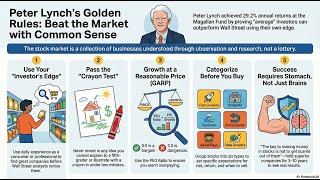
Welcome to the explainer. Today we are diving deep into the mind of a true Wall Street legend, Peter Lynch, and we're going to break down his entire toolkit. So, take a look at that number, 29.2%. No, that's not a typo. That was his average annual return for 13 straight years while running the Fidelity Mellan Fund.
Think about that. From 1977 to 1990, he basically doubled the S&P 500's return. And he took the fund from a kind of small $18 million all the way up to a mind-blowing $14 billion. Just incredible. And you know the craziest part? He did all of this while telling everyone that you, the amateur investor, the person just walking down the street, actually have an edge over the pros.
So, how on earth did he pull that off? And maybe more importantly, how can we use his exact methods today? All right, so here's the game plan. We're going to unpack his whole framework, his philosophy, the edge he thinks you have, how he categorizes stocks, his secret formula, and even an actionable checklist you can use.
So, you ready? Let's get into it. Now, first things first, we got to be clear. His success was not a fluke. I mean, statistitians have looked at this and the odds of it being just random luck are something like 1 in 150 million. No, his method was solid. It was repeatable, and that's what we're here to talk about.
Okay, let's jump right into his core idea. your untapped investor edge. You've probably heard his famous line, "Invest in what you know." But here's the thing, it's also his most misunderstood piece of advice. And getting this right is where he believed you, the regular person, can actually beat Wall Street.
So, let's clear this up right now. He was not saying, "Hey, you like their burgers, so go buy the stock." Absolutely not. That's the misconception. The reality is liking the product is just the starting point. It's the clue that tells you, "Hey, maybe I should research this company." It's your ticket to start doing the real homework, digging into their earnings, their debt, and figuring out if they have a real competitive advantage.
And that leads to this gem of a quote. The whole point is that your knowledge gives you an edge because you actually understand the business. If you can't explain how a company makes money so simply that you could draw it with a crayon, well, you probably have no business owning it. Simple as that. All right, next up, the six types of stocks.
So, once you find a company you can explain with a crayon, what's next? Well, Lynch came up with this brilliant system to categorize any company. And trust me, this isn't just about putting things in boxes. It's the key to building a real strategy. So, he said, "Every stock fits into one of these six stories.
You've got your slow growers, stalwarts, fast growers, cyclicals, turnarounds, and asset plays." And here's the genius of it. Knowing the category is the strategy. It tells you everything. For example, if you own a cyclical, like a car company, you need to know that their sales go up and down with the economy.
You buy them low, sell them high. But a stalwart, like a big consumer brand, that's a totally different game. You might just hold that for its steady, reliable growth. See the difference? And this is how you can start to think about building a portfolio. You use the slow growers and stalwarts as your defensive anchors, the bedrock.
The cyclicals and turnarounds are your special situations. Higher risk, but potentially high reward. But the ones Lynch really loved the engine of his fund. Oh, that was the fast growers. These are the small, aggressive companies with the potential to become what he famously called tenbaggers. Stocks that could go up 10 times what you paid for them.
That's where the real magic happens. But here's the twist, and this really shows his contrarian genius. He didn't hunt for these vast growers in the hot industries of the day. You know why? Cuz a hot industry is crowded. Everyone wants a piece of the action, and that kills profits. Instead, he found his biggest winners in totally boring, out of the way industries.
Think about it. A great company in a boring industry has way less competition. It can just quietly grow and dominate. Okay, so we know we want to find these great fast growing companies, but there's a huge catch, right? How do you make sure you don't overpay for that growth? I mean, that's the classic investor trap.
Well, this leads us to the GARP formula, which was Lynch's simple but incredibly powerful solution. GARP. It stands for growth at a reasonable price. And it's exactly what it sounds like. It's a hybrid strategy. You're not just a value investor looking for cheap stuff. And you're not just a growth investor chasing anything that moves.
You want both. You want awesome growth, but you're only willing to pay a fair price for it. And his secret weapon for finding that balance was the PEG ratio. The PEG ratio sounds complicated, but it's actually super intuitive. It just takes the company's PE ratio, how expensive it is, and divides it by its earnings growth rate.
It's a way to put a price tag on growth. It answers the one question that matters. Am I paying too much for this company's future success? It's that simple. And here's the quick and dirty rule of thumb. A PEG ratio of around one means the stock is probably fairly priced. Its price matches its growth.
But if you can find a PEG ratio under one, bingo. That's where things get interesting. That means the growth is potentially outpacing the price. You might be looking at a bargain. That is the Garp sweet spot Peter Lynch was always hunting for. Okay, let's make this real. We've talked about the theory.
Now, let's build an actionable checklist. This is how you can take all these ideas and actually start screening for companies that might fit the Lynch model. So, let's walk through this. First, PEG ratio under one so we're not overpaying for growth. Second, return on equity over 15%. That tells you the company is actually good at turning money into more money.
Third, debt to equity under 0.5. We want a strong, healthy balance sheet, not a company drowning in debt. And finally, consistent growth in sales and profits. You put all these together, and you start to find companies that look like a classic Lynch investment. Strong, efficient, growing, and reasonably priced.
This is your launchpad for doing that deep dive research. All right, we've covered the research, the numbers, the strategy, but Lynch was adamant that all of that is useless without one final crucial piece of the puzzle. And honestly, it might be the most important one of all. He called it the investor's stomach.
Look, here's his point. In the stock market, your stomach is way more important than your brain. He believed that what separates winning investors from losing ones isn't intelligence. It's temperament. It's your ability to stay calm when everyone else is panicking, to ignore the noise and the scary headlines.
You can do all the research in the world, but if you sell everything the first time the market drops 10%, you're going to lose. It's about having the conviction to stick with your great companies. You have to change how you see a market crash. He compared it to a blizzard in Colorado in January. You know it's coming.
It's totally normal, so you prepare for it. A stock market decline isn't a crisis. It's an opportunity. It's the market holding a sale. If you've done your homework and you love a company at $100 a share, you should be thrilled to buy more of it at $70. So, let's wrap this all up. What's the takeaway here?
It's pretty simple, really. First, use your own unique edge to find ideas in the world around you. Second, do the homework. Don't just buy what you like. Third, categorize the stock so you know what kind of story you're buying into. Fourth, use a tool like the PEG ratio to make sure you're not overpaying.
And finally, and this is the big one, have the patience and the stomach to see it through. It's all about combining your knowledge with disciplined research and emotional strength. So, Peter Lynch believed that you absolutely have the brain power to succeed at this. The real question he leaves us with is a personal one. Do you have the stomach?

Comments 0