저자: CharlieMunger · 외국인
요약 보기
찰리 멍거가 자산 분산투자와 장기 투자 철학을 설명하는 2019년 인터뷰 성격의 영상이다. 핵심 결론은 소수의 확실한 기회에 집중하는 것이 지수 추종보다 낫고, 대부분의 투자 자문은 불필요한 분산을 권한다는 것이다. 분산투자 비판: 멍거는 잘 모르는 사람이 표준 결과를 원하면 분산하겠지만, 돈을 아는 것만 골라 투자하면 종목 3개로도 충분하다고 주장한다. 도시의 상위 3개 기업 주식만 가져도 분산이 충분하다고 말한다. 장기 복리 관점: 인덱스 수익률 10%는 인플레이션 이전 수치이며 실질로는 약 7% 수준이라고 한다. 현재 시점에서 시작하면 실질 2~3%도 가능하다고 보며, 낮은 기대치를 가지라고 조언한다. 중국 투자 언급: 중국 대형 기업이 미국 대형 기업보다 싸다고 보며, 똑똑한 사람들이 중국 시장에 들어오고 있다고 평가한다. 자사주 매입 비판: 주가가 너무 올라 매입이 나쁜 아이디어가 된 시점에 기업들이 자사주를 많이 사들인다고 지적하며, 제록스 사례처럼 잘못된 매입 사례가 많다고 말한다. 정치권의 자사주 매입 규제에 대해서는 전반적으로 열의가 높지 않다고 밝힌다. 출연자 전망: 명시적인 개별 종목 가격 예측은 없고, 시장 전반의 장기 수익률 전망이 중심이다.
다듬은 글
I had a grandfather who was very helpful to me. My mother's grandfather, who was a pioneer, arrived in Iowa without money, but with youth and health. And he took it from the Indians. He fought in the Black Hawk War. He was a captain in the Black Hawk Wars, he stayed there, bought cheap land, was aggressive and intelligent, etc.
And finally, he was the richest man in the town and the bank, and very respected, with a large family and a very happy life. And he had that attitude, having arrived in Iowa when the land was worth little more than a dollar an acre, and having remained there until that black soil created a modern and wealthy civilization on some of the best land in the world.
His attitude was that in a privileged life like his, when you're in the right place, you have few opportunities if you live to be 90. And the trick to getting ahead was to take advantage of the few opportunities that came your way, whenever they came. And he told that story over and over again to the grandchildren who surrounded him throughout the summer.
And my mother, who didn't understand anything about money, remembered the story and told it to me. But I am not a natural imitator of my mother. And I knew Grandpa Eyler was right. So I always knew from the very beginning, when I was little, that the important opportunities that would come my way were few and far between.
And that the trick was to prepare myself to take advantage of the few opportunities that came along . This is not the attitude they have at a great investment advisory firm. On the other hand, they study a million things, they can know a million things . And, of course, the result is that almost no one can beat an index.
Instead, I'm sitting here with my Daily Journal shares, my Berkshire Hathaway shares, my stakes in Li Lu's Asian fund, my Costco shares. And, of course, I'm beating everyone. And I am 95 years old. And apparently, I never make a transaction. And the answer is that I'm right and they're wrong. And that's why it worked for me and not for them.
And now the question is, do you want to be more like me or more like them? The idea of diversification makes sense to a certain extent. If you don't know what you're doing and you want the standard result and to avoid embarrassment, well, of course, you'll probably diversify. And nobody is entitled to a lot of money for admitting it because it's a truism.
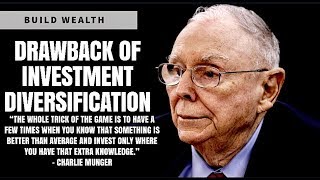
It's like knowing that two plus two equals four. But investment professionals believe they are helping you by arranging a dirty diversification. An idiot could diversify a portfolio. Or a computer, for that matter. But the whole trick to the game is having a few occasions where you know something is better than average and investing only where you have that extra knowledge.
And then, if you only have a few opportunities, that's enough. And what the hell do you do with three stocks when JP Morgan Chase has 100? You know, what's wrong with having a few values? Warren always says that if you lived in a growing city and owned stock in three of the city's top companies, wouldn't that be diversified enough?
The answer is, of course, yes. They are all wonderful places. And that's also because you like stories. Here is an apocryphal story that is very instructive. A young man comes to perform a Mozart. And he says, "Mozart," he says, "I want to write symphonies." And Mozart says: " How old are you?" And the man says, "I'm 23." And Mozart says, "You are too young to write symphonies." And he says, "But Mozart," he says, "you were writing symphonies when you were 10 years old." And Mozart says: "Yes, but I didn't ask other people how to do it." Now, there is another story about Mozart.
This is probably the greatest musical talent that has ever existed. And what was his life like? Well, he was bitterly unhappy and died young. This is the life of Mozart. What on earth did Mozart do to upset her? Well, he did two things that guarantee a lot of misery. He spent too much of his income scrupulously.
That's the first thing. That's really stupid. Then, the other thing is that he was full of jealousy and resentment. If you spend too much of your income and are full of jealousy and resentment, you may have a miserable and unhappy life and die young. All you have to do is learn from Mozart. You can also learn from that young man who asked Mozart how to write a symphony.
The truth is that not everyone can learn everything. Some people are much better. And, of course, no matter how hard you try, there's always someone who's more deceptive. A guy or a girl. And the result is, so what? Do it. Does any of us need to be the best in the world? It's ridiculous. And another thing that people do, like cemeteries, is incredible: they build enormous mausoleums.
I think they believe they want people to walk past them and say, "God, I wish I was there." Anyway, as you can see, we had a bit of fun along the way. And it has worked very well, but if we look at how many decisions were made in the history of the Daily Journal Corporation or Berkshire Hathaway, there weren't many per year that made sense.
It's a game of being there all the time and recognizing rare opportunities when they arise, and acknowledging that it's normal for humans not to have many. Now, there is a group of very self-confident people who sell values, who act as if they have an endless supply of wonderful opportunities. Well, those people are the equivalent of a scalper in horse racing.
They're not even respectable. It is not a good way to live life to pretend that you know many things that you do not know and to pretend that you are being offered many opportunities that you are not offering yourself. My advice is to avoid those people, but not if you run a stock brokerage firm. You need them.
But it's not the right way to make money. And this business of controlling costs and living simply was the secret. Warren and I had small amounts of money. We always spent less than we should have and invested, and well, if you live long enough, you end up being rich. It's not very complicated. And now there's a part of life that consists of how to overcome mistakes without them costing you too much.
And we 've done some of that too. And if we look at Berkshire Hathaway, let's think about its founding companies: a doomed department store , a textile company doomed to disappear in England, a doomed trademark company . That's how Berkshire Hathaway came about . However, we handle those losing hands quite well when we buy them at very low prices.
But of course, success came from changing our habits and getting into better businesses. And it's not like we were that good at doing difficult things. We were good at avoiding things that were difficult. Hello, Mr. Munger, I'm to your right. He talks about the importance of fishing in waters with abundant fish .
If I were starting today, what sea would I be fishing in? Apart from China, of course. Well, apart from China, but if there's a good place in the world, that's more than my part. There are others, I'm sure. But I find it hard to believe that anything could be better for the Mungers than China. So I ca n't help you.
I've solved my problem, you'll have to solve yours. By the way, the water is good in China. And some very intelligent people are getting into this . And, in due course, I believe more will join. Large Chinese companies are cheaper than large American companies. Hello, Mr. Munger. Mhm. My friend Miguel and I were from Barcelona.
And I have a question for you about long-term investing and compound interest. I tried to remember if it was Einstein who said that compound interest was the most powerful force on Earth. And in recent years, with interest rates so low, it has been difficult to find opportunities to have a long-term compound interest strategy.
So, beyond investing in Berkshire Hathaway, value investing, or index-linked finance, where would you suggest we look for long-term investment opportunities where compound interest is actually worse? Well, my advice to someone looking for compound interest that works ideally is to lower their expectations.
Because I think it's going to be more difficult for a while. And it helps to have realistic expectations. It makes you less crazy. But I think, you know, they say that common stock was probably a consequence of the Great Depression, which was the worst thing to happen to the English world in hundreds of years.
To this day, an index may have produced 10%. But that was before inflation. After inflation, it might be 7% or something like that . And the difference between a 7 and a 10 in terms of its consequences is tremendously dramatic over that long period of time. And if that's 7% in real terms, that can be achieved by starting in a perfect period during the greatest boom in history.
Starting now, it could well be 3% or 2% in real terms. And it's not unthinkable that you could have a 5% return and 3% inflation or some other terrible consequences like that. And so, the ideal way to deal with that is to say, if that happens, I can have a happy life. Because why wouldn't you be happy even though civilization is as easy as it was for my generation?
And now, beyond that, when it gets more difficult, how should you do it? Well, the answer is that, since it's going to be very difficult, you should put in the effort. And if all you get is 6% of a lifetime's work instead of 5%, you should be happy. If you want to succeed easily, you should talk to Jim Cramer.
Hi Charlie, my name is Julia La Roche. Last year we saw a record number of share buybacks and now we're hearing rhetoric from Washington D.C. Specifically, legislation to curb share buybacks. What do you think about share buybacks? Do you think politicians should tell companies what to do? Thank you so much.
Well, in general, my enthusiasm for politicians who tell corporations what to do is moderate. But I will say this: when it was a very good idea for companies to buy back their shares, they didn't do much of it. And when stocks have risen so high in price that it's often a bad idea, they're doing a lot.
Welcome to adulthood. That's how things are, but it's questionable at current levels whether much of it is smart. Was Eddie Lambert smart to buy back so many Xerox shares or not? No. And many mistakes of that kind have been made .
Comments 0