원문 보기
Hello everyone and welcome to a new explainer video . I'm really excited to tackle this topic today because, frankly, it's all about math. We will take a detailed look at a very specific, controversial, and hypothetical worst-case scenario financial model for Fannie Mae and Freddie Mac. And we build this model directly on the numbers presented in our source materials.
You know, in the financial world, we often hear huge numbers thrown around just like that, and we somehow accept them without checking with calculations what it means for the bottom line. Well, today we will do these calculations. We will calculate the theoretical minimum value of these common shares if literally every possible capital dilution measure is taken.
Let's begin. To understand everything, we need to determine a starting point. Our sources base all their mathematical calculations on this specific quote from Donald Trump. " Phenomenal work at Fannie Mae, Freddie Mac, you probably have a trillion dollars of value there ." Now I want to make an important clarification right away.
We rigorously analyze the source mathematics based on this statement. We are simply reporting the numbers impartially. We do not discuss politics or support any views. We're simply taking this $1 trillion estimate as the basic mathematical premise for all of today's calculation to see where the math takes us.
Okay, let's dive into this. Here is our plan for today. We embark on a logical, step-by-step mathematical journey. We'll start with the $1 trillion premise, see what happens if the government exercises its warrants, add in preferred stock, add up the final tally, and then finish by comparing this math to other great market outlooks, like Bill Ackman's.
So, let's start with the first section: the $1 trillion premise, our starting point. Here is our anchor for today—$1 trillion . To make it a little easier to visualize, our source translates this amount into $1,000 billion. This huge, staggering figure represents the initial overall assessment of companies in this particular scenario.
This is a giant pie, but as you'll see in a minute, the big question is how many tiny pieces this pie will be cut into. And here's the other side of our original equation: two billion. According to the source, this is the current number of common shares of companies outstanding right now, completely untouched by any theoretical blurring.
So you have a valuation of a trillion dollars and currently two billion shares outstanding. If we just stopped there, the math would be pretty simple . But remember, this is a worst-case scenario model, which means things are about to get a lot more complicated. Which brings us to the second chapter: the execution of the warrants, the first plot twist.
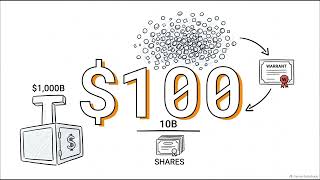
Let's see how it all works. In our worst-case scenario, the government decides to execute its warrants. Exercising these warrants creates an additional 8 billion shares out of nothing. This is a huge influx. We take our current 2 billion shares, add 8 billion new shares through warrants, and suddenly our share pool is completely diluted.
We now have a brand new total number of shares outstanding—10 billion. And now the most interesting part: how this massive blurring affects our price. We take our original valuation, that $1,000 billion, and divide it by our new, greatly expanded pool of 10 billion shares. This math gives us the first intermediate price: exactly $100 per share.
So, if only the warrants are exercised, the theoretical value is $100 per share. Moving on to the third section: adding preferred stock , the absolute worst-case scenario. Our source clearly states that there are rumors that senior and junior preferred shares are not convertible into common shares, but to truly test this financial model, the source calculates what would happen if they were converted.
Let's deal with these huge debt obligations. If they do convert to common stock, it will be a staggering financial burden. We have an incredible $210 billion in senior preferred stock ( SPS) . And on top of that, we have junior preferred stock ( JPS) valued at another $25-30 billion. Combine them and you get a total estimated debt of $235 billion, which theoretically should be convertible and paid off with common stock.
So, the key point here is how to translate this staggering dollar amount into a specific number of shares. Our source uses the exact price we just calculated— $100 per share, which assumed the warrants were exercised. If you take $235 billion in preferred stock debt and convert it at 100 bucks apiece, the math requires creating 2.35 billion new shares of common stock and throwing them into a pool.
And that brings us straight to the fourth section: the final stock calculation. Let's find this final price. Let's go through this final cumulative addition. It's like putting together a huge puzzle. We take the 10 billion shares that we calculated after the warrants were exercised. Next, we add those 2.35 billion shares that we just calculated by converting all the preferred debt.
10 billion plus 2.35 billion gives us a total of 12.35 billion shares outstanding. This is our final fully diluted pool of shares in this theoretical model. And here it is, the true culmination of our mathematical journey. We return to our original estimate: a pie worth 1,000 billion, or $1 trillion.
We divide this 1,000 billion by our absolute number of shares in the worst-case scenario—12.35 billion—and the calculator gives exactly $80.97 per share. According to the source model, if every warrant is exercised and every last preferred share is converted into common, the share price will be $80.97.
As the source points out, mathematically it simply cannot be worse than these specific parameters. Okay, let's wrap up in chapter five: Ackman vs. Math. Let's consider different points of view. How does this particular theoretical result of $80.97 relate to other market views? And, you know, it's a great illustration of why two highly intelligent financial analysts can look at the same company and come up with completely different stock prices.
It all really depends on the starting line. The source admits that legendary investor Bill Ackman calculated a much lower value for these shares. Why? Because Ackman's model uses an initial market capitalization of $245 billion. Our source's math today is based entirely on that $1 trillion estimate.
If you start with a pie that is literally four times bigger, your final piece will definitely be significantly larger, even after a large-scale blur . Which brings us to the real state of the market now. The current market price of the shares mentioned in our source hovers around six dollars. Think about that for a moment.
If you believe the source model with the $80.97 figure, the potential profit is simply staggering. The math suggests that for every dollar invested today at $6, there is theoretically a $13 profit if the stock reaches $80.97 in a worst-case scenario. So, we went through these numbers together step by step.
The mathematics itself— addition, division—is rigorous and reliable , based on the variables given to us. But she leaves us with this very important question to ponder. Is this $1 trillion an undeniable reality, demonstrating a deeply undervalued asset, or is it a perfectly executed calculation built on a false initial premise?
Ultimately, your belief in the $80.97 stock price is entirely dependent on your belief in that initial valuation of one trillion dollars. Thank you very much for joining me for this explanation. Keep questioning these numbers, and I'll see you next time.



댓글 0