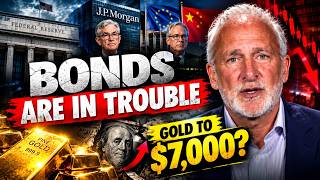
저자: PeterSchiff · 외국인
요약 보기
CPI 3.4%와 금리인상 확률 80%대 상승 속에서 Schiff는 연준 긴축이 재정확대와 상충해 인플레이션을 잡지 못한다고 주장. 금은 5,600달러 고점에서 4,300달러대로 조정, 4,000달러 지지선 매수 권고, 은 64달러 및 광산주 매수 권고. 장기 채권 베어마켓 진입을 경고하며 금리 상승이 주식시장 조정(1987식 폭락)으로 이어질 수 있다고 봄. AI 투자의 GDP 기여(0.4%p)도 언급.
다듬은 글
It's worth buying more gold now. We had a fairly significant pullback from the highs. You know , we reached 5,600, and now we're down to just over 4,300. So, I think this is a good downturn for shopping. I think 4000 is the support level right now. You are still closer to the bottom if you look at the old highs as resistance, but ultimately I think we will go much higher.
Silver is worth about $64. This is about half the maximum it reached in February-March. So I think this is a great pullback to buy. The Fed should tighten monetary policy enough to force the government to cut spending. But all the while the Fed was raising rates, government spending continued to rise.
So, we had an expansionary fiscal policy; Even if you say the Fed tightened monetary policy, we loosened fiscal policy. We were providing stimulus to demand in the economy at the same time that the Fed was supposedly trying to curb demand by raising rates. So no, these small, sluggish quarter-point rate increases won't change anything.
And as long as the Fed also expands its balance sheet, which it does, creating more money and stimulating credit, inflation will continue to worsen. It will not decrease. You know , bonds are currently in a long-term " bear" market. We had a bullish bond market. The market faces persistent inflation, rising energy prices, and increasing pressure on interest rates.
The consumer price index was 3.4%, while higher-than- expected core inflation pushed expectations for a Fed rate hike to 80–88%. Peter Schiff argues that higher oil prices cannot be entirely explained by events in the Middle East, pointing instead to years of loose monetary and fiscal policies. Schiff remains bullish on gold, arguing that it has significantly outperformed TIPS in the long term.
As gold fell from around $5,600 to just over $4,300, he sees this pullback as a buying opportunity with the $4,000 support level. He also finds silver near $64 and mining stocks attractive . Schiff warns that rising rates, which weaken bonds, and other economic pressures could eventually trigger a major stock market correction similar to 1987.
Meanwhile, investment in AI is supporting growth, adding about 0.4 percentage points to U.S. GDP over the past year. Before we delve any further, let's hear directly from Willem Middelkoop and dissect the key warnings and opportunities he points to. If you enjoyed this analysis, be sure to like the video, subscribe to Endgame Medal, and turn on notifications so you don't miss our latest updates on Gold and Silver .
Or, you know, I don't think that's an accurate measure of inflation. Listen, I'd rather own gold. Gold has significantly outperformed TIPS over the last 5, 10, 15, 20, 25 years. I mean, if you were worried about inflation and bought TIPS, you wouldn't make much money. Although, I think it was better than regular Treasury bonds.
But not much. But look where you are now with gold. Gold went from less than 300 to over 4,000. So, let's talk about the CPI, since you mentioned it. Wonderful transition. 3.4% is the figure from the beginning of the year. Sorry, the year-over-year figure that came out this morning, September 11th. You know, what's interesting, Peter, is that 3.4% is more or less the market consensus.
And yet, when these numbers came out , maybe there was something else in the report worth talking about, but the probability of a Fed rate hike jumped from 60% to 80-something percent. And the markets are taking this painfully. Stocks are rising. So, how do you interpret this? Why did this happen? Well, first of all, I think the probability increased because we didn't get a weak indicator.
If we got a number below expectations, people would say, "Okay, there won't be a hike because that gives the Fed an excuse not to raise rates." So there was always a chance that we would get a soft score, which we didn't get. We got a figure that was in line with expectations, but expectations still indicate that there is no progress towards 2%, and, perhaps worse, the baseline was slightly higher than expected.
Yes. They expected a 0.2% increase, and the indicator increased by 0.3% over the month. Which, you know, is only 1/10 of a percent. This may not seem like much, but it's 50% more than they expected. So I think that was part of it too. Listen, you know, yeah, but if he doesn't raise the stakes, if Powell doesn't raise it next week, I mean, not Powell, if Warsh...it's, you know, a make-or-break moment, right ?
Because he constantly talks about the need to fight inflation and that it is too high. In his last speech in Jackson Hole, he mentioned raising rates at least six times. So, he has every reason to raise rates. If he doesn't do it now, when markets are estimating an 88% probability, I don't recall a situation where the Fed would ignore such expectations, because it usually doesn't like to surprise the markets.
She prefers to do what the markets expect. So I think many people will be surprised if the Fed doesn't raise rates. Well, most of the CPI and high figures were driven by gasoline and oil prices. What is your general forecast or, if not a forecast, your opinion on the Federal Reserve raising rates during a supply shock, an energy shock?
This CPI increase was not due to inflation of the money supply through quantitative easing, at least not yet. It was not caused by uncontrolled economic growth . This happened because of the war in the Middle East, which caused an energy supply shock, which pushed the CPI up, as energy is an important component.
So should they even do it? Well, first of all, they made the same excuses at the beginning of COVID. Oh, we don't need to do anything. This is just supply shock due to COVID. And look where that got us. There were people who made the same arguments in the 1970s when oil prices were rising. You know, they twisted everything.
The price of oil responded to our monetary and fiscal policies. And I believe that the rise in oil prices is largely due to our monetary and fiscal policies . This is not entirely related to the war. No, I mean people should buy more gold right now. We had a pretty good pullback from the highs. You know, we used to reach 5600.
And now we're down to 4300 with pennies. So , I think this is a good opportunity to buy on the dip. I think 4000 is the support level right now . So you are still closer to the bottom than if you were looking at the old highs as resistance. But ultimately, I believe we will go much higher. Silver is worth about $64.
This is approximately half of the maximum it reached in February- March. So I think this is a great correction to buy. I think mining stocks are still very cheap. That's why I think people should buy it. And I think over the next few months there will be more pressure for rates to rise and more pressure on the government to try to stop them rising.
And of course, we're getting closer to the midterm elections, and rising interest rates and consumer prices are a bigger problem for Republicans, which means a bigger problem for the country; because I think that if the Democrats gain control of Congress, then no matter how badly the Republicans are doing, it will get even worse.
And at some point, the stock market could easily take notice and collapse. You know, the stock market can ignore bad news for a while before it suddenly stops ignoring it. The best example is 1987. After all, before the stock market crash of 1987, bonds were falling, interest rates were rising, the dollar was falling , and the trade deficit was widening .
So you had all these problems, but the stock market still continued to rise. So investors completely ignored all these problems until suddenly they couldn't ignore them anymore , and the crash happened. So let's see. We are in a much worse state now than we were then. So, the market has many more reasons to crash now than it did then.
The last point I would like to make is that we have not yet talked about building capital spending on AI, which many are talking about as a driver of the economy. The Atlanta Fed forecasts GDP growth of 4.4% in the third quarter. This is a huge number, and a significant portion of it will be for capital spending on AI if this continues.
JP Morgan estimates how much AI has contributed to GDP. We estimate that this appeared about 2 weeks ago. JP Morgan: " The impact on the economy has been relatively modest. A proxy measure of AI-related investment added 0.4 percentage points to the 2.1% growth rate of real US GDP last year." About 1/5 of the growth.
I mean, 1/5—that's still significant, Peter. Yes, and there will probably be more. I think the contribution of AI, all this capital spending, uh , will be an even larger share of GDP than the estimates suggest. Peter Schiff argues that official CPI figures underestimate the true impact of inflation because it not only raises prices, but also prevents them from falling as much as they could.
He believes that raising interest rates alone will not solve the problem, as businesses are passing on the costs of credit to consumers, while government spending and credit expansion continue. Schiff sees that after a 40-year bull market, bonds have entered a long-term bear trend, and warns that rising yields could eventually trigger a bond market crash.
He also warns that higher yields could hurt stocks as companies face rising refinancing costs and investors shift funds into bonds, putting pressure on corporate earnings and the market overall. Well, let's analyze the interview. Yes, it was specifically designed to minimize the level of price increases.
So, you know, it's like driving a car with a broken speedometer: I'm going 60, and it shows 20; I can't rely on it and step on the gas just because I think I'm going too slow. I have to look out the window and see that I'm actually going much faster because the speedometers aren't working. This is how the CPI doesn't work.
This is not an accurate measure of how much prices are rising as a result of created inflation. But there is another factor that was especially relevant in the first years after the financial crisis: prices should have fallen . We should have seen a more substantial decline in prices, but it didn't happen because the inflation created by the Fed prevented it.
So inflation doesn't necessarily have to force prices to rise. It can prevent them from decreasing. Therefore, the real impact is not how much prices have risen , but how much higher they have become than they would have been without inflation. But people forget about this and think: well, you know, lowering prices is bad.
The Fed must save us from this horror. You know, that's not bad at all. I mean, everyone wants the cost of living to go down. You don't want anything to become more expensive. Of course, you want your shares to go up because you want to sell them to someone else at a higher price. But you don't want gasoline to become more expensive.
You don't want food to become more expensive. You don't want clothes to become more expensive. You don't want the cost of medical services to increase. You don't want the cost of college to increase. You don't want your rent to increase. That is, everyone wants these prices to go down. It would be, you know, great if your landlord said, "Hey, you know what?
We're lowering your rent this year." Fantasy, isn't it? This is much better than having your rent raised. So do we want long-term interest rates to rise? Your recent video talked about the bond market being about to crash. What will happen to the economy if long-term rates continue to rise? Wouldn't that solve the inflation problem for us, Peter, if interest costs went up and we spent less money?
No, that won't solve the problem at all. In fact, it will only exacerbate it, as these higher interest rates will become costs that will be passed on to consumers. You know, a business passes on its interest costs just like it passes on the costs of raw materials, labor, and everything else that is part of the production process.
No, the problem is that credit, like inflation, is also an expansion of credit. And while the Fed has been raising rates, they haven't raised them enough to slow credit growth. Lending expanded the entire time the Fed raised rates, which suggests that these steps were insufficient. What we really need to do to reduce inflation is to cause a net reduction in debt.
People need to start saving money again, not spending it. And this also applies to the government. The Fed must tighten monetary policy enough to force the government to cut spending. But all the while the Fed was raising rates, government spending continued to rise. So we had an expansionary fiscal policy; Even if you say the Fed tightened monetary policy, we loosened fiscal policy.
We were providing stimulus to demand in the economy at the same time that the Fed was supposedly trying to curb demand by raising rates. So, no, these hesitant quarter- point rate hikes won't change anything. And as long as the Fed continues to expand its balance sheet, creating more money and stimulating lending, inflation will only get worse.
It's not... It's not going to go down. You know, bonds are currently in a long-term bear market. We had a “bull” bond market that lasted from 1980 to 2020. This was a 40-year bull market, and the yield on the 10- year Treasury bond went from over 16%, or I think a little under 16% for the 10- year. It fell from just under 16% to less than 1 %.
The 10-year Treasury bond was at about 60 basis points, you know, at its lows. All of that changed, and I talked about it then. I said, “That’s it. This is the main climax . This is the end of the " bull" bond market. Welcome to the " bear" bond market. And now we are in it. We are in a " bear" market.
Profitability has been growing for 6 years. But if this bear market is as long as the previous bull market , we are still in the early stages. We're still... It was a 40-year bull market. If this is a 40- year bear market. Although usually bear markets are faster. So if it took 40 years for yields to fall from 16% to 0%, it will probably take 10 years to go from 0% back to 16%, and we are already 6 years into the process.
So, there's not much time left. The bond market could collapse completely. We could see a crash in the bond market. Profitability can simply skyrocket. Now, obviously the Fed in your video... Yeah. Sorry. Yes, I said that the Fed could now panic and try to prevent this by printing money on a massive scale, but that would add fuel to the fire again , because it would only create even more inflation and destroy any trust anyone might still have in the dollar.
You said we could expect a carnage in the bond markets. Here's the 40- year bull market you talked about in the bond market. The S&P is a bar chart , and the blue line is the 10- year bond yield. So, for 40 years, portfolio managers have operated on the assumption that returns and stocks move in opposite directions.
Isn't that right? So that's why the 60/40 portfolio worked . But now they are moving in the same direction. But if they are moving in the same direction, Peter, why do you assume that the stock market will also suffer if yields continue to rise? Well, I think as long as bond yields have been relatively low, maybe moving from, you know, 2% to 4% or 3% to 5% yields, those numbers have still been low, and in real terms, negative.
You know, especially if you take into account the real inflation rate, not the government figures. So it's entirely possible that the stock market could have ignored the rise in yields when they were rising from such a low base. But I think at some point, maybe it will be an increase from 5% to 6%. Maybe from 6% to 7%, or whatever .
But someday this should make a significant difference, since stocks are a function of the present value of their future earnings, discounted at current interest rates. And of course, the short-term rate, in my opinion, is more important in this function. But, in addition , stocks compete with bonds.
And, you know, higher yields make people decide to shift some of their funds from stocks to bonds. But also, if lending actually shrinks due to higher rates, that will also impact corporate earnings, especially if companies have a lot of debt that now needs to be refinanced at these higher rates. And because corporations have taken on a lot of debt at low interest rates and are now forced to refinance it at much higher rates, it drains their cash flow, leaving them with less money to buy goods and services from other companies.
Share your thoughts in the comments. We want to hear your perspective. If you found this analysis valuable, please like, subscribe to Endgame Battle, and click the bell to receive notifications of new content on gold, silver, markets, and the global economy. Don't just follow the headlines. Look deep. This is the Endgame Battle, where the market tells the real story.
Comments 0