원문 보기
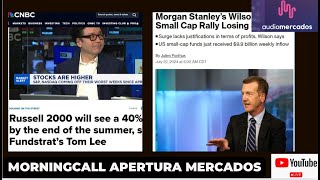
Good morning to all the friends of Audio Markets and to all the traders who follow us daily. Welcome to this new live broadcast, a new morning call, which we're going to start now. In this preview of the European session, we'll look at the main headlines, and as we mentioned, in this preview we have two major figures from the Wall Street markets, both talking about the Russell 2000, the index that makes up small-cap companies, and giving completely opposite views.
On one hand, Tom Lee from fstat is talking about a possible 40% retracement, while we have Morgan Stanley analyst Mike Wilson talking about the fact that we've probably already reached the top of the Russell 2000. Meanwhile, let's see how the markets are closing. In this case, in Asia Pacific, we have a mixed close because we have the two main Chinese markets down 1.4%, Shanghai is down, Hong Kong is down nearly 1%, Japan's Ikei is completely flat at 39,594 points, and South Korea's Cospi is up.
The change is 0.4 and in Australia the SX is advancing by about half a percentage point at this hour. Meanwhile, as we approach the opening of the European markets, which we are about to experience, after yesterday's good close of the Wall Street session, we are seeing the K40 in Paris slightly down 0.09, the DAX in Germany advancing by about half a percentage point, the EUR Stock 50 up 0.3, London is currently down half a percentage point, Milan is up 0.2, and the IBEX in Madrid is advancing by about 0.1 due to several factors concerning the fall in demand, in this case from China, which has led to an unusual discount in Shanghai's cash prices compared to the international benchmark index.
In any case, here you can see the evolution; notice how gold imports are practically falling in the last month and in the two previous months had stagnated at that figure. Meanwhile, in China, after the Third Plenum of the The main government bodies seem to be facing growing skepticism about their commitment to political promises made over a decade ago.
According to Reuters, the Bank of Japan (BOJ) has stated that weak consumer spending, as confirmed by recent macroeconomic data, could complicate interest rate decisions. It's worth noting that the markets, and the Bank of Japan itself, are anticipating another interest rate hike, but the macroeconomic data does n't seem to be supporting it.
Meanwhile, for traders and markets, one crucial factor is that geopolitical issues are once again taking center stage for investors. Until now, they had been relegated to the background, but we are now seeing not only the US elections but also other factors such as Taiwan, the return of Donald Trump to the presidency, the situation in Ukraine between Russia and Ukraine, and the situation between Israel and Japan.
The managers here are saying that this is one of the most important considerations they are incorporating into their process throughout the year. It points, among others, to the asset manager of different funds. It also points out that the way this is manifesting itself at a high level is by evaluating the overall levels of the portfolio.
It says that the high geopolitical risk environment leads to reducing that positioning or that risk, so it is certainly important to take geopolitical factors into account because professional investors are also considering them. Meanwhile, the European Central Bank is back and generating more headlines, pointing out that the bets that the European Central Bank will cut interest rates are not wrong, but are certainly just a reference.
And Vice President Luis de Guindos, who gave an interview to Europa Press, says that they are determined to keep interest rates unchanged because they will have more information between now and September. He says it will be crucial to see if inflation effectively converges sustainably towards the European Central Bank's target of 2% in the medium term.
And regarding the American economy, JP Morgan says that the The gap between the robust US economy and the rest of the world continues to persist. This week, we'll have data, including GDP figures, and the news should bring encouraging news on the growth front. JP Morgan is pointing to the possibility of seeing more positive economic growth data.
Two Wall Street heavyweights, Mike Wilson, chief strategist at Morgan Stanley, are speaking about the Russell 2000, the small-cap index of small-cap companies. He says it faces technical resistance and lacks fundamental drivers or catalysts to keep it at current levels for a longer period. He says that, driven by softer inflation and the increasing likelihood of another Donald Trump presidency, the Russell index has risen 6.7% in July compared to a modest 0.8% for the S&P 500.
He says that this lower-than-expected inflation reading has bolstered expectations that the US Fed could cut interest rates, which typically benefits small companies. But, as we were saying, Morgan Stanley... Morgan Stanley's Mike Wilson is back, this time with a bearish outlook on the Russell 2000, saying that we may have reached the top.
He points out that last week's inflow into the Russell was close to $10 billion, and the Russell's reaction is the biggest rise in the last two years. So we're at two- year highs, near 2,300 points. Mike Wilson is talking about a possible top for the Russell. On the other hand, FSTR analyst Tom says the Russell could rise 40% by the end of summer.
That could be a significant rally for the Russell, as we said. So, two completely opposite views, as you can see, from two analysts regarding the Russell 2000's performance. Meanwhile, while we wait for the Ethereum ETF to be approved, it could skyrocket according to various fund managers. In this case, concerning the Ethereum Group, it was said that it could jump 90% the moment the marketing of these ETFs on Ethereum is authorized, as we also saw earlier with Bitcoin.
Looking ahead to the European session, which will be very similar to yesterday's, we will have statements from several members of the European Central Bank. Philip Lane will speak, among others. We have also had statements from Luis de Guindos, as we mentioned earlier in that interview, who indicated that inflation levels will remain high well into 2024 and also said that the wage sector is beginning to decline.
Philip Lane will speak, as we said, today I'm looking up the German Treasury's corporate results, which are important because we have UPS, General Motors, General Electric, and Coca-Cola, among others. Looking ahead to the American session, we will see housing, existing home sales, and also the Richmond Fed index, the US Treasury auction, 2-year bonds, and especially at the close of the session, we have heavyweights for the technology index.
Alphabet, the parent company in this case of Google Visa, and we also have Tesla. So, especially at the close of the North American session, that's probably when we'll have more news. So, we'll be waiting for all of that, and staying tuned, as we said, to this new session. And as always, we thank everyone for joining us for this market preview.


댓글 0