원문 보기
All right, let's get into it. You know, when you think of the big names on Wall Street, few are as controversial or as captivating as Bill Aman. This is a guy who doesn't just invest in companies. He launches full-on campaigns. He shakes up boardrooms and he makes these massive highstakes bets that either pay off spectacularly or, well, go down in flames.
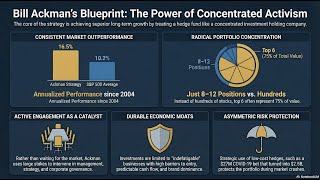
Today, we're going to deconstruct his entire playbook. And why are we talking about him? Well, the numbers speak for themselves. Since he started his firm, Persing Square back in 2004, he's pulled in a 16.5% return every single year on average. To put that in perspective, the S&P 500 did 10.2%. He's not just beating the market, he's crushing it, and you just don't get that kind of performance by accident.
So, the big question is, how in the world does he do it? So, here's how we're going to break it down. First, we're going to dig into what we're calling the AMAN thesis. That's his core philosophy. Then we'll look at the quality over quantity blueprint, which is all about how he picks his shots. After that, it's the activist's playbook, how he actively forces a win.
And finally, we'll look at the report card, the incredible wins, and yes, the painful losses. Okay, let's start with the absolute bedrock of his entire strategy, the AMAN thesis. And really, it all comes down to betting big in a world that tells you to bet small. And this slide right here says it all.
You know, conventional wisdom, what every financial adviser tells you is to diversify. Own hundreds of stocks so if one goes down, it doesn't hurt too much. Aman thinks that's a recipe for being just average. He argues that real massive wealth isn't built that way. It's built by concentrating your capital, by owning a huge piece of just a handful, like 8 to 12 truly incredible businesses.
That's it. His whole fund is built on this idea. So, if you're only going to own a few companies, you better be darn sure you're picking the right ones. And that brings us to his blueprint for finding those winners. The single most important idea in his entire process is something called an economic moat.
And the analogy is perfect. Think of a castle. What protects it from invaders? A big wide moat. For a company, that moat is some kind of durable competitive advantage that keeps rivals at bay and protects its profits. For AMAN, this isn't just a nice to have. It is an absolute non-negotiable requirement.
No moat, no investment. So, what does a moat actually look like? Well, it can be a brand that's so powerful people are just intensely loyal to it. Think Chipotle. Or it could be a crazy network effect like with Uber. The more riders it gets, the more drivers it attracts, which in turn attracts even more riders.
It's a virtuous cycle. It could also be high cost for customers to switch to a competitor or even government regulations that lock other players out. He wants businesses that are just plain hard to kill. And here's what that looks like in practice. This is a snapshot of his top holdings. You can really see that high conviction approach.
He's not just buying a little bit of Uber. No, he's got a massive chunk of his portfolio writing on it. Same with giants like Brookfield and Alphabet. He's not dipping a toe in. He's diving in head first. And if you break it down by industry, you see just how focused he is. almost 40% in tech thanks to those huge bets on Uber and Alphabet and another 30% in financials.
This isn't a portfolio that's trying to be a little bit of everything. It's a sniper rifle aimed at specific sectors where he sees those wide protective moes. But here's where things get really interesting with Aman. You see, for him, just buying a great company isn't enough. That's just the start of the game.
Now, we get into the activist playbook and his strategy for literally forcing the win. This quote says it all, doesn't it? He's not a passive investor. He's not going to buy a stock, sit back, and just hope it goes up. He believes his biggest edge is to use his huge ownership stake to become the catalyst for change himself.
So, how does he do it? Well, first he buys up a massive stake in the company, making him one of the biggest voices in the room. Then, he goes directly to the board and management and starts pushing for big changes. Maybe that's a new CEO. Maybe it's selling off parts of the business or completely overhauling the strategy.
A textbook example was with Canadian Pacific Railway. He got in, won a fight to install a new CEO, and bam, the stock quadrupled in a few years. He doesn't wait for value to appear. He forces the company to unlock it. But as you can imagine, this combination of high concentration and aggressive activism is incredibly risky.
I mean, you're walking a tight rope without a net. One bad bet could be an absolute catastrophe. So, how does he protect himself from a total meltdown? Well, that brings us to a secret weapon, asymmetric hedging. And there is no better example of this than his now legendary COVID hedge. In early 2020, when most of the world was still brushing off the Corona virus, Aman saw a huge risk.
So, he went out and spent $27 million on what are essentially insurance policies that would pay out if the market tanked. And just a few weeks later, when the market did completely crash, that little insurance policy paid off to the tune of $2.6 billion. I'll say that again. He turned 27 million into 2.6 billion, a return of nearly 100 times his money.
It's one of the greatest trades of all time. But here's the absolute genius of it. The hedge wasn't just about making a quick buck. That 2.6 billion was a war chest. It acted like a giant shield for his main portfolio, allowing him to hold on to his best companies while everyone else was panic selling.
And then he used that cash to go on a shopping spree, buying more of his favorite stocks at bargain basement prices. He turned a defensive move into a game-winning offensive strike. Of course, a strategy this intense, this aggressive, it doesn't always go according to plan. So, let's pull up the report card and take an honest look at the results.
And wow, this timeline really tells the story of a roller coaster. I mean, look at these swings. You have these incredible highs, like a 40% gain in 2014, but then you have this brutal three-yearong slump where he was massively underperforming. And just when people started to count him out, he comes roaring back with a 58% gain and then a 70% gain.
This strategy is definitely not for the faint of heart. And this right here really shows you the two sides of that coin. On one hand, you have a massive win like Chipotle. He jumped in when the company was in crisis mode, helped stew the ship, and made a fortune. But then you have the other side, a disaster like Villiant Pharmaceuticals.
He bet huge on a company with a flawed business model, and it resulted in a catastrophic loss for his fund. It was a very public, very painful lesson about the kinds of risks to avoid. So, when you boil it all down, what are the big takeaways here? First, that having deep conviction in just a few great ideas can in fact beat spreading your money all over the place.
Second, those economic moes, they're not just important, they are everything. Third, you don't have to wait for good things to happen. Activism can be a way to create your own catalyst. And finally, being willing to admit when you're massively wrong, like with Valiant, and learning from it, that's absolutely essential to staying in the game.
And that really leaves us with the big lingering question. Is Bill Aman's strategy a masterclass in focused, high conviction investing, or is it just a reckless gamble? It makes you wonder where exactly is that fine line between genius and just taking on way too much risk.
Comments 0