원문 보기
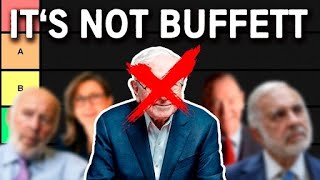
Who is the greatest investor of all time? Surely it’s Warren Buffet, the Oracle of Omaha who was once the world richest man thanks to his now world famous value investing technique. And maybe he is if all you care about as an investor is maximum portfolio value, but actually, then the title would go to Larry fink the co-founder and CEO of BlackRock the world’s largest asset management company, that has over ten trillion dollars in assets, more than ten times the assets under management of buffets Berkshire Hathaway.
Maybe the greatest investor of all time is whoever has had the best consistent annual returns on wall street. Someone like Jim Simons, the grand daddy of quantitative investing. His company Renaissance Technologies ran the medallion fund which returned over 40% annually in the 34 years it has been operating.
Very impressive, but even with an extra 20 years of compounding the medallion fund would still be outperformed by any regular person that happened to buy and hold bitcoin at any point before 2010. There is a solid argument that that greatest investors of all time avoided wall street all together. It makes sense that a properly smart investor would try to operate in markets where there is less competition from other very smart investors who are all fighting to earn as much money as possible.
So it’s time to learn how money works to rank the greatest investors of all time and learn from them to potentially make our own portfolios as lucrative as possible. This weeks video was made possible by The Daily Upside, a completely free high quality business and finance newsletter that is written by real business analysts so that you can be sure you are waking up to an article written by someone in the know.
The daily upside has a great mix of articles that make sense of the big issues as well as stories that you would never have heard about unless you were working in the industry. I particularly liked this weeks report on Apple moving into the VR space and threatening Mark Zuckerberg’s meta which is currently the dominant player in the space.
Virtual Reality has not exactly become the household essential that early investors might have hoped but neither was home computing, mp3 players, smartphones and tablets before apple released the mac, ipod, iPhone and Ipad to push these markets to the masses. Will they be successful this time? Well go read the article on the Daily Upside to go and find out for yourself, it is completely risk free and it will take you less than thirty seconds when you use the link below.
… I know I dismissed Warren Buffet at the beginning of this video but no investor tier list would be complete without the oracle of Omaha. Buffet got his start as a professional investor by buying up companies that were so bad that their market value was lower than their net assets, this allowed buffet to buy up a controlling interest in these companies before liquidating them and paying himself out more money than he put in originally.
This practice was very controversial because it meant any employees the company had would be terminated and in company towns this could often mean the end of entire communities. The folksy story that Buffets PR team will tell is that his long time business partner Charlie Munger showed him that it was better to buy good companies at a fair price than bad companies at a great price.
The more cynical onlooker will see that this is only half true. In reality buffets original corporate raiding style of investing was getting harder and harder more competition and regulations in the marketplace. There was also a cap on how much money could be deployed using this strategy. Corporate raiding opportunities only came up so often and if buffet wanted to continue to grow his portfolio he would need to find something that allowed him to put more money to use at a given time.
He slowly transitioned into making private equity style acquisitions of non-public companies, famously places like the Nebraska furniture mart, before this style of investing also became too small scale for buffets pool of funds. Today Berkshire Hathaway is effectively a glorified index fund with large static holdings in publicly traded companies that anybody could simply buy themselves.
Another thing worth mentioning about Buffets shift in investment styles is that long term investing has become significantly more tax efficient than short term trading. Buffet speaks frequently about the merits of investing in companies for the long term, and this is another advantage of that strategy.
From 1965 to 2021 Berkshire Shares returned a compounded annual return of 20.1% which is insanely good over such a long period of time. If an investor gave buffet $100,000 five and a half decades ago it would be worth SEVEN BILLION DOLLARS today. If that investor had simply invested their $100,000 into the broad market which generated a compounded annualized return of 10.5% they would only have thirty five million dollars, that extra 9.6% really does make a big different when compounded over such a long period of time.
I am still only putting warren buffet into A Tier though and this is why. 20.5% annualized returns are certainly very impressive, but they aren’t as impressive as some of the other investors we are about to see, these high returns also come disproportionately from the first few years of Berkshire when the business was much smaller and buffet was able to take on more aggressive positions.
You might think that too much money isn’t really a problem an investor can have but it really is. Today Berkshire is so big that it basically just tracks the market, it really can’t do anything else. I think Warren deserves respect not because he was necessarily a great investor, but instead because he was brilliant at shifting his investment styles as he outgrew certain strategies over time.
The next investor on our list had a different technique for dealing with too much money. Jim Simons is another strong contender for the crown of the greatest investor ever simply because of the staggering returns his firm was able to deliver. Although Simons wasn’t really an investor at all, he could have run his operation without even knowing what the companies he was trading did, it’s likely for most of his trades that he didn’t, to him they were purely numbers in a database.
Simons had a strong background in mathematics and science before he turned his attention to the stock market. In the early 80’s as he was making the move from academia to finance the efficient market hypothesis had become mainstream. The efficient market hypothesis is a financial theory that prices in liquid markets like securities markets are always perfectly priced because they are the aggregate of all information available at that time.
By this logic it is impossible to outperform the market, without resorting to insider trading, because you can never know more about a stock than every other participant in the market combined. The efficient market hypothesis would suggest that the best way to invest (assuming you don’t have insider knowledge), is just to buy and hold a broad portfolio of stocks and bonds for a long time period.
Not bad advice for the average person, but Jim Simons was not an average person. In 1988 after almost a decade of trying to build out a data driven trading model Simons launched the medallion fund. The medallion fund would use huge amounts of data, managed by teams of actual rocket scientists using state of the art computers to try and outperform the market by marking trades when a stock was deemed to be undervalued or overvalued.
The team at renaissance technologies were mostly PHD’s in a wide variety of fields who all added unique expertise into how to make sense of the data and use it to make informed trades. Even with the collective brain power of the firm the medallion fund ran of a black box system which meant even the scientists putting together the trading program didn’t totally understand how it operated.
This is an advanced strategy even today and in the early 90’s it was completely ground-breaking. Simons initial problem was getting people onboard with an investment strategy that nobody could explain, but after posting consistent annualised returns of 66% Simons had no more problems raising money. Simons’ fund posted such massive returns that he doubled the traditional fee structure of already very expensive hedge funds and he was still outperforming them.
If you invested $100,000 with Simons in 1988 when he started his fun it would be worth three hundred and six trillion dollars today, which you might notice is more money than exists in the entire world. In reality the returns experienced by investors were only 39% not 66% because of the fee’s Simons charged, this would bring that return down to forty-six billion dollars which is still an unreasonable amount of money.
Simons himself is only worth twenty-six billion dollars so what happened to the rest of the money? Well, nothing really, it’s just that the medallion fund could only work up to a certain size. If it got any bigger, it would start moving the market as it entered and exited positions. The medallion fund also worked effectively by taking advantage of unsophisticated investors and as Simons put it there were only so many dentists out there to make money off of.
To medallion fund was only ever open to outside investors for five years, and any investors that were lucky enough to get onboard in that time were forced out of the fund by 2005. Today the fund is run exclusively for the benefit of the three hundred employees at renaissance technologies. Jim goes into A tier, because of his mind-blowing fund performance, but he misses out on s tier because his strategy has major scalability issues.
If you are interested in learning more about Jim Simons Career I highly recommend Partick Boyles video because he is a hedge fund manager himself so he is much more qualified to speak about Simons’ investment strategies. If Jim Simons is the nerd of wall street then Carl Icahn is the big tough bully.
Ichan takes a very different approach to both buffet and Simons. He takes control of companies that he believes can do better if certain changes are implemented. When he first started doing this the strategy didn’t really have a name, but we now call it activist investing. Icahn’s strategies are almost the exact opposite of Simons because he relies almost entirely on his business intuition to find opportunities, whereas Simons would have seen human insights as points of failure in his mathematical models.
Today just the mention that Icahn is taking over a company will drive it’s stock price up because he has had an almost flawless track record or improving the operations of the businesses he takes over. Since 1968 Ichan has returned 30% annualised returns to his investors before fees. This put’s him well behind Simons, but his investment style is much more scalable.
In fact the enormous size of his fund is actually an advantage in the way he does business because it means he has the cash required to do things like hostile buyouts and short squeezes, both things that he is famously not shy about doing. Icahn also goes into B tier with Buffet because while he hasn’t amassed as big a fortune, his returns are better which with compounding can make a very big difference.
John Bogle is probably the most important investor for regular people to know about. He was the founder of the Vanguard Group, the creators of the first ever index fund. Bogles returns are not as spectacular as the other investors on this list, but what he lacked in outright annualized returns he more than made up for in almost limitless scalability.
His investing principle was the opposite of everybody else so far and he admitted that he couldn’t outsmart the market. So if you can’t beat it, join it. Bogles index funds bought up large pools of shares and then made shares in those pools available to investors. The benefit was that even small investors could buy shares in these pools that gave them diversification across the entire stock market, something that would have previously involved buying up all of these shares individually.
While people like Icahn and Simons could get away with charging huge fees for their active management style, bogle tried to do as little active management as possible to make the fees on his funds as cheap as possible. Buffet himself said that Bogles funds are the best way for most people to invest their money and this mass market approach has obviously worked.
Today Vanguard has over 4.5 trillion dollars in asset under management. Blackrock, a similar operation to vanguard has TEN trillion dollars in assets under management. Index funds are now so large that people are fearful of the control they have over asset markets. The funds are held on behalf of their investors but the managers of these funds get almost total control over the voting decisions of the shares that they manage.
Trillions of dollars worth of voting power means that these passive fund managers are much more powerful than even the most aggressive activist investor could ever hope to be. Bogle himself goes into C Tier. The investment products he made literally changed the world of finance, but by design they did not outperform the market.
Bogle himself also passed away with a relatively modest fortune of only eighty million dollars. Bogle probably wouldn’t want to be anywhere other than c tier either, because he admitted that some active investors could outperform his funds over time, but most wouldn’t and that’s why it was better to stick with the safe option rather than risk your money with a hedge fund manager.
For every Simons and Icahn there were dozens of managers who underperformed the market after fees. Speaking of which. Cathie Wood runs Ark Invest, an investment management firm that actually operates in a very similar way to Vanguard. Cathie makes investment pools filled with shares. Regular people can then buy portions of those pools to benefit from the aggregate performance of the companies in those pools.
The difference between Ark Invest and Vanguard is that Vanguard buys as many companies as possible to buld a diversified index, Cathies Woods’ Ark Invest buys shares that she believes will outperform the market. The technical systems that she uses to determine the future performance of the stocks she picks are less based in rigorous technical analysis and more designed to cater towards what the general public thinks is a good investment.
Ark Invest has the following funds, the Innovation ETF, The Next Generation Internet Fund, The Genomic Revolution Fund, The Autonomous Technology And Robotics Fund, The Fintech Innovation fund and the Space Exploration fund. These are all very appealing markets to people who frankly don’t know very much about what makes for a good investment.
This buzzword investing strategy is great for getting her reddit and twitter followers to poor money into her funds but most of the companies in these fields are overhyped and overvalued. Ark Invest performed remarkably well during the tech stock boom but now that the hype surrounding companies like Tesla, Zoom and Coinbase has cooled, the fund is now trailing the broad market in annualised returns.
Woods goes into D Tier. She really is not as bad as a lot of her critics say the problem is simply that her investments are public knowledge and not particularly special. Most investors would be much better off diversifying away from hype stocks, but even if they did want to go all in on technology, they could just buy the shares in Cathy’s funds individually and avoid the management fee that her fund charges.
The truth is that most managed funds are terrible investments, and as we have seen the few that are good are normally only open to the public for a very short period of time. If you want to know why rich people still invest in them then go and watch my video on hedge funds, it comes complete with an overview of Ray Dalio’s investment style, another investor that would go into A tier.
A special thanks again to the daily upside for making it possible to keep on learning How Money Works.

Comments 0