원문 보기
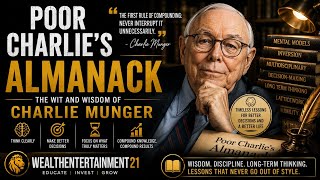
Some investors become successful because they discover a brilliant strategy. Others succeed because they understand businesses exceptionally well. Charlie Munger believed there was another path to better decisions. One that extended far beyond investing. Rather than mastering only finance, he argued that the world's most effective thinkers draw ideas from many different disciplines.
He encouraged drawing ideas from many different disciplines. Psychology, economics, biology, physics, mathematics, engineering, history, law, human behavior. Together, these fields create what Munger famously described as a lattice-work of mental models, a broad framework for understanding reality. A broad framework for understanding reality.
This philosophy transformed not only the investment decisions made alongside Warren Buffett, but also influenced leaders, entrepreneurs, academics, and decision-makers around the world. Today's documentary explores these ideas through original analysis and practical examples. Instead of repeating the book, we'll examine why multi-disciplinary thinking matters, how cognitive biases affect judgment, and what lessons investors can apply in an increasingly complex world.
Chapter 1. Why intelligence alone is not enough. Many believe high intellect guarantees success. Many people believe high intelligence automatically leads to good decisions. However, history suggests otherwise. Knowledge alone is rarely enough. Brilliant scientists have made poor financial decisions.
Successful executives have misjudged markets. Experienced investors have allowed emotions to override careful analysis. Knowledge alone does not protect us from mistakes. Munger argued that judgment depends not only on what we know, but on how we organize knowledge and apply it under uncertainty. The goal is not to become an expert in everything.
The goal is to develop enough understanding across multiple disciplines to recognize patterns that others overlook. Chapter 2 The power of mental models Frameworks define our worldview. A mental model is a simplified framework for understanding how part of the world works. First, economists study incentives, while engineers study complex systems, psychologists study behavior and the complexity of the human mind.
Biologists study adaptation and the diverse forms of life on Earth. Mathematicians study probability. Each discipline offers useful ways of thinking. Complex problems often require multiple perspectives. People often respond to the rewards and consequences surrounding them, but it can provide insight into why individuals and organizations behave the way they do.
When evaluating a company, investors may ask, "What incentives influence management? How are executives compensated? What drives their daily focus? Do those incentives encourage long-term value creation or short-term performance? These questions remain relevant in modern corporate governance. Chapter 4 Psychology and cognitive biases Mind shortcuts often fail us.
Human beings are not perfectly rational. We often rely on mental shortcuts that can introduce bias into decision-making. Examples include confirmation bias, overconfidence, anchoring, social proof, loss aversion, availability bias. Recognizing these tendencies does not eliminate them, but it may encourage greater self-awareness.
One practical habit is to actively search for evidence that challenges your own conclusions, rather than only seeking information that confirms them. Chapter 5 Patience and long-term thinking. True compound growth takes patience. Modern markets operate at remarkable speed. Prices update every second.
News spreads instantly. Yet Munger often emphasized patience. Waiting is not simple inactivity. It is a calculated discipline. Waiting allows time to gather information, compare alternatives, and avoid impulsive decisions. Long-term thinking requires accepting that meaningful results often develop gradually rather than immediately.
Chapter 6 Continuous learning Intellectual compounding is the ultimate edge. Learning is not limited to formal education. Books, history, science, business, technology, philosophy, psychology. Each field contributes ideas. Each field contributes ideas that improve decision-making. Knowledge accumulates.
Munger believed lifelong learning creates a compounding effect similar to investing. Knowledge accumulates over years, allowing individuals to recognize relationships that others may overlook. Chapter 7 Avoiding preventable mistakes. Inversion helps avoid failure. Munger frequently suggested that avoiding major mistakes thought can be just as important as making brilliant decisions.
Examples include ignoring excessive debt, making decisions based solely on emotion, following crowds without independent analysis, overestimating one's knowledge, failing to consider alternative explanations. Thoughtful decision-making often involves asking, "What could I be missing? What evidence contradicts my conclusion?" These questions encourage intellectual humility.
Chapter 8 Rational decision-making Objectivity requires constant discipline. Rational thinking does not require perfect certainty. Instead, it involves making decisions based on the best available information, while recognizing uncertainty. This includes gathering evidence, considering probabilities, evaluating risks, remaining open to changing one's opinion when new information becomes available.
Chapter nine, applying these ideas today. Wisdom endures through changing times. Today's world includes artificial intelligence, biotechnology, cybersecurity, renewable energy, and global financial markets. Although technology has changed dramatically, Munger's message remains relevant. Learn continuously, think independently, understand human behavior, study multiple disciplines, recognize your own limitations, make decisions with humility.
These principles apply not only to investing, but also to leadership, entrepreneurship, education, and everyday life. In our final summary, we reflect on Charlie Munger's ultimate legacy. Poor Charlie's Almanack is far more than a book about investing. It is a guide to improving judgment through broad learning, critical thinking, and intellectual discipline.
Its central lesson is not that one mental model explains everything, rather, better decisions often emerge when we combine insights from many fields.

Comments 0